
Participants
For our participants, we selected students who felt as though they did not get enough satisfying time outdoors. We define satisfying time as time spent around green or blue space, aka varying types of nature. This means that although some of them already spent a decent amount of time outdoors, it was in not-relaxing circumstances (athletic practice) or while being surrounded by concrete (only going out to the house’s porch). All of our participants had a desire to increase the amount of time they spent in nature, not just outdoors. We recruited a mixture of new and old participants, and we reached out through previous participants’ friends or our own circles to find people who would fit the intervention criteria.
Interviews
First and foremost, we were hoping to figure out whether our participants actually wished to spend more time outdoors from our interviews. This is important because otherwise we would not necessarily want them participating in our intervention if they did not want to spend more time outdoors. We specifically sought people who want to spend more time in nature (i.e. surrounded by trees, by a lake, etc.) Other than that, we asked participants about their daily routines, what sort of activities they like to do outdoors, etc.
Intervention Study Protocol
For our intervention study, we asked people to have a meal, snack or drink outside surrounded by some sort of nature. At the end of the day, we send them a google form that asks the following questions:
- What meal/snack/drink did you have outside?
- Where did you have your meal/snack/drink outside?
- What time did you have your meal/snack/drink outside?
- How long were you outside when you had your meal/snack/drink outside?
- Was anyone with you when you had your meal/snack/drink outside? If so, state your relationship.
- How did you feel about having the meal/snack/drink outside?
We feel like it is important to not only know how long they were outside and the time of day, but also whether the person was alone or with friends, as this could also influence mood. Our goal is to figure out if there is any correlation between spending time outside and our participants’ corresponding mood. We also are hoping to see if connecting meal times to outside is an easy and positive change that people can integrate into their lives. Due to the freedom of being able to choose whichever meal, we expect this change should not be hard for students to integrate into their lives. We also expect that bad weather might hinder our study.
Key Insights
One of our key insights is that although people tend to enjoy eating outside, it is somewhat conditional. This means that if the weather is cold, it’s cloudy, or it is too early in the morning, people have a harder time enjoying their time outside. We somewhat expected that bad weather would be a deterrent, but we did not think the timing of it being too early could also be a deterrent. Generally, people enjoyed eating and being outside with other people, mostly friends. Many people spent about 30 minutes outside during the intervention meal, which is certainly enough time over 5 days to have an added benefit (150 minutes outdoors, when the recommended amount is at least 120 minutes per week for well-being). It also seems that if people are already super stressed out, just going outside is not necessarily enough to reduce their stress or increase their mood. Their responses end up being along the lines of “I was super stressed, and being outside was cool but I was just outside and stressed.” This means that just eating a meal outside might not be immersive enough for a pronounced mood change when one is heavily stressed, as going for a hike might be. However, most people reported feeling happy, or very nice after being outside, so if one does not already start with a terrible mood it seems to have a calming effect.
Using these key insights, we will move towards a design that is still nature-based, but allows for more freedom for the users. Thus, we are shifting away from attaching the outdoors to eating habits. This way, if the only meal that users can fit in outside is an early morning breakfast (and it wouldn’t improve their mood because it is so cold during that time), we are not adding an extra inconvenience for the user. Instead, we want to shift more towards photography, and a design based around collecting photos. This approach would still incorporate nature, but also would incorporate the game aspect of tokenization. This approach also would also make it easier for users to endure colder temperatures, as they are not sitting down.
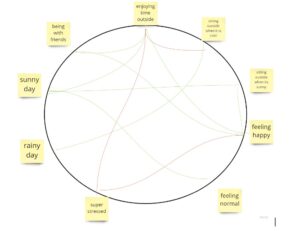
This is one map that helped us synthesize the data and find one of our key insights. We saw negative correlations between being super stressed and enjoying time outside, as well as rainy days and sitting in the cold. We saw positive correlations between sunny days, feeling happy/normal, being with friends, and enjoying time outside.
Intervention Study Synthesis
Throughout the five-day study, from 13 participants we’ve received a total of 40 responses. Most participants ate lunch outside as the choice of meal/drink/snack (30%). Most people were outside with at least one other person/friend (62.5%). A vast majority of participants generally reported not staying outside longer than an hour, but a majority of participants (56.25%) spent 15-30 minutes outside, usually going outside for class. When being asked how going outside was for the participants, a lot of the participants expressed a positive sentiment about being outside that can possibly be associated with uplifting their mood (65.63%). Only two participants logged or managed to complete the whole study, with 5 additional participants logging for 3 or 4 days. The low rate of user retention might be due to lack of reminders from team members, a busy schedule during this past week, or the intervention itself might have been too difficult to follow through on. However, the intervention being difficult is most likely not the reason why, as it factored into what people are already doing (eating or grabbing coffee).



