
Here is the link to the document for better quality photos and formatting.
Baseline Study:
The baseline study was to understand how students use pauses during periods of focused academic work, and how different types of breaks affect students’ restoration levels. Specifically, the study looked to try to distinguish between restorative breaks (defined for this study as walking, resting, stretching, or social interaction) and non-restorative breaks (activities that do not meaningfully improve energy or focus). We wanted to examine when and why students turn to one versus the other.
Rather than prescribing what an ideal break should look like, the study focused on capturing students’ natural pause behaviours and perceptions. The goal was to understand the situational and emotional conditions under which breaks could feel restorative vs non-restorative, and then how these choices can affect students’ reported energy and focus. The aim was to get a baseline understanding that would help us design future interventions that support more effective recovery during work pauses.
Study Methodology:
We conducted a week-long diary study that combined behavioural tracking with short daily reflections. Participants were asked to log pause moments, defined as any time that they stepped away from focused work (instead of being told to log “breaks” on a set schedule). This framing let participants describe what naturally happened during pauses without feeling like they had to evaluate or justify their behaviour.
During the day, they filled out a simple break log that captured the time, how long it lasted, what they did during the pause, and how they felt right before it. At the end of each day, participants wrote a reflection (asked for 3-4 lines, expected time 5 minutes) about how restorative their pauses felt overall and how different types of breaks affected their energy and their focus.
This allowed us to obtain their quantitative data, including the frequency of pauses, their duration, and the times at which they occurred. and qualitative data (how participants actually experienced these pauses and whether they found them restorative). This allowed us to conduct more detailed comparisons between restorative and non-restorative breaks.
Participant Recruitment:
Participants were undergraduate and graduate students aged 21-24, who regularly spent long periods doing focused academic work like studying, attending classes, completing laptop-based assignments, and prioritizing work. To be eligible, participants needed to report taking frequent pauses during work sessions and experiencing ongoing cognitive load, stress, and overall fatigue from their academic demands.
We selected students as our target group because they consistently have to balance productivity with the need for recovery and also maintain time pressure. Their pauses are usually unstructured, which makes them a good fit for examining how people decide (consciously or unconsciously) if a pause will be restorative or not. The participants were recruited through an online screener survey to make sure that they met the study’s demographic and behavioural requirements. We then carried out pre-study interviews as another step in the screening process to ensure that the participants were right for our study.
Key Research Questions:
The baseline study was built on the following research questions:
- What types of pauses do students take during periods of focused work?
- Under what conditions do students engage in restorative versus non-restorative breaks
- How do different pause activities affect perceived energy, focus, and mood afterward?
- Do students feel that their pauses adequately support recovery over the course of a workday?
We wanted these to focus on pause quality and not just pause frequency and how breaks shape students’ experiences of fatigue, attention, and recovery.
Raw Data and Grounded Theory Report:
To understand the mechanics of student breaks, we mapped our data across three dimensions: a Timeline (the chronological user journey), a Restoration Matrix (energy cost vs. benefit), and a Feedback Cycle (emotional drivers).
Here is the board for better quality: https://miro.com/app/board/uXjVGDexF6A=/?share_link_id=678416631305
Timeline:

Grid:

Affinity Map (check out GDrive link for better quality):
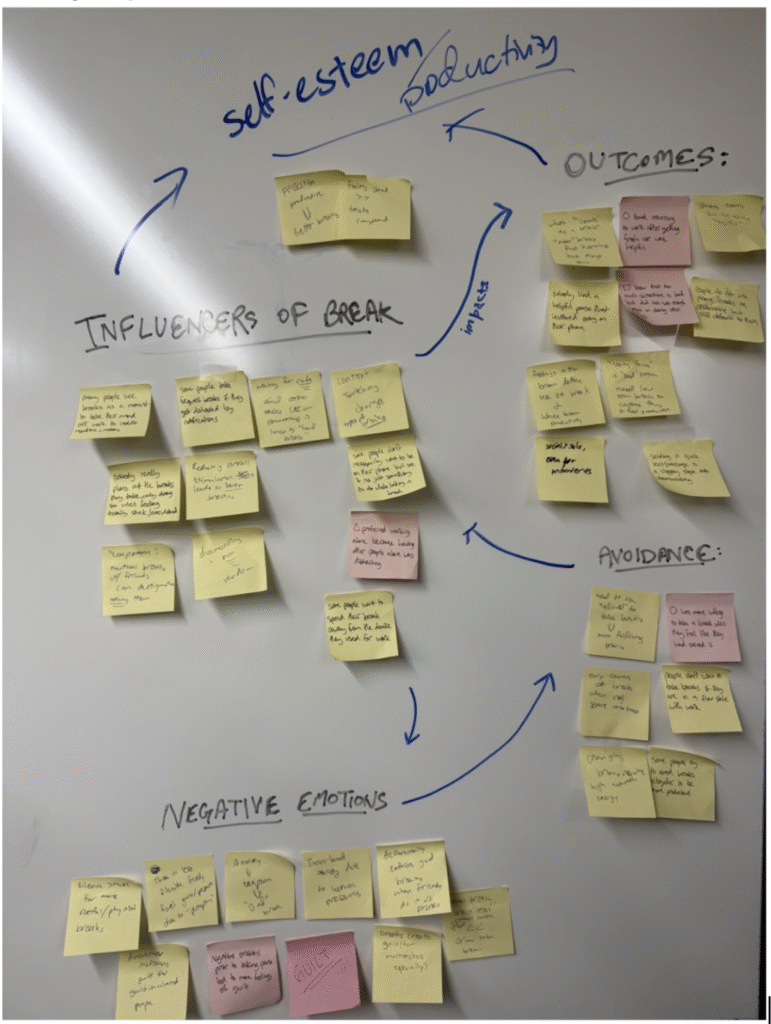
Insight 1: Productivity acts as a permission slip for rest.
The most critical driver of break quality turns out to be self-esteem rather than fatigue. Our cycle diagram reveals a direct link where feeling productive leads to better breaks, whereas feelings of low productivity lead to guilt. Students often feel they need to be allowed to take breaks, believing they must earn it through suffering or finishing a task. When students do not feel productive, they deny themselves these earned breaks, such as walking or socializing. Instead, they default to low-visibility shadow breaks like using their phone. They do not count these as real breaks, which helps them bypass the guilt, but it also causes them to bypass the restoration.
Insight 2: The activation energy trap.
Our restoration matrix highlights a fundamental design flaw in how students choose breaks. We found an inverse relationship between how easy a break is to access and how much it actually restores you. The most restorative activities, such as socializing and getting fresh air, require high activation energy. They demand planning, movement, or coordination. In contrast, default behaviors like doomscrolling or sending a quick text require low activation energy but result in negative restoration. Exhausted students naturally seek the path of least resistance, which inevitably leads them into a trap of non-restorative phone use.
Insight 3: The limbo state versus the bad break.
Our timeline and cycle maps identified a specific type of pause that is universally detrimental, which we call the limbo state. Moments like waiting for code to compile or switching contexts are often treated as pauses, but they remain high-friction and high-stress. Students labeled these as bad breaks because they occupy the time of a break but maintain the mental load of work. This creates a scenario where the student is neither working nor resting, leading to increased burnout without any recovery.
Insight 4: Socializing acts as a guilt vaccine.
Social interaction emerged across all three maps as a unique modifier that neutralizes break anxiety. While students often feel guilt when taking breaks alone, especially when they are motivated by avoidance, taking mutual breaks with friends helps destigmatize the act of stopping work. Social breaks function as a cooperative pact that enforces a clear beginning and end to the break. This prevents the slippery slope into doomscrolling that characterizes solo phone breaks.
Please find our Grounded Theory Report linked. For convenience, here is our theory/subtheory list:
- Grounded Theory 1: Good pauses need a socially acceptable cover story
- Subtheory 1A: We take better breaks when they look like work.
- Subtheory 1B: Feeling watched pushes us into low-quality and sedentary pauses.
- Grounded Theory 2: Small friction changes pause quality more than willpower
- Subtheory 2A: Logging adds friction that interrupts automatic doomscrolling.
- Subtheory 2B: Tiny rules beat ‘uuuge plans when you are tired.
- Grounded Theory 3: Some pauses extend work instead of interrupting it
- Subtheory 3A: A yap a day keeps feeling stuck away!
- Subtheory 3B: Movement breaks protect focus by reducing physical friction.
- Grounded Theory 4: Phone breaks are split into two types, and people confuse them
- Subtheory 4A: Escape scrolling starts when your task hits identity stress.
- Subtheory 4B: Recovery breaks feel calm and have clear endpoints.
- Grounded Theory 5: Your environment sets your default pause options
- Subtheory 5A: Built-in destinations create movement breaks without planning.
- Subtheory 5B: Sparse or isolating spaces collapse breaks into the phone.
- Grounded Theory 6: The best resets lower stimulation and increases body cues
- Subtheory 6A: Low stimulation pauses restore attention faster.
- Subtheory 6B: High stimulation pauses increase guilt and make return harder.
System Models:
Model 1: Connection Circle
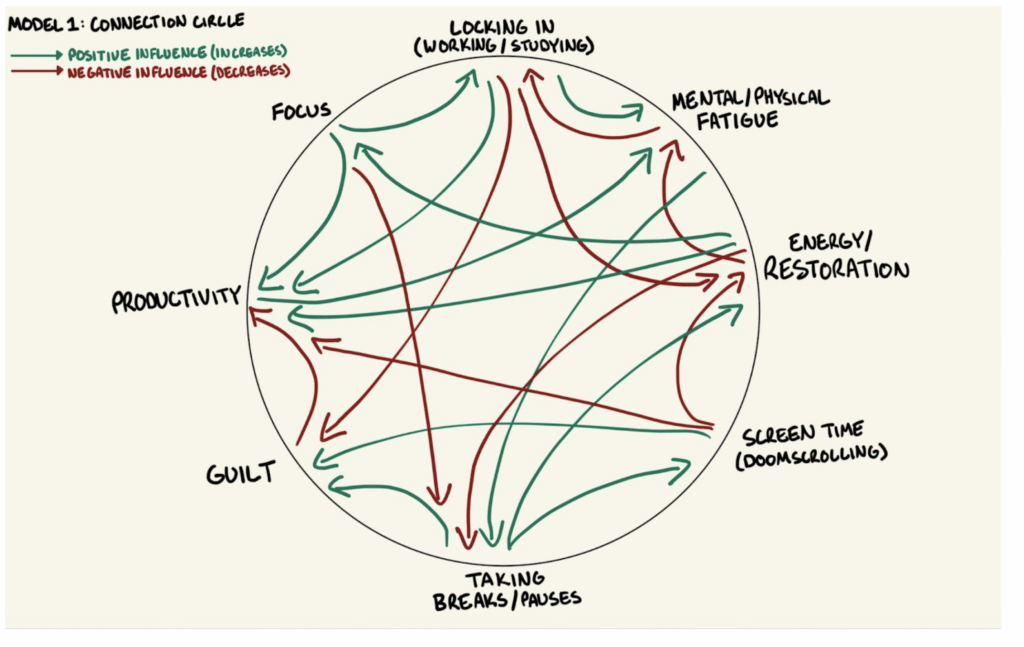
Key insights:
When people are locked in with work/studying, their fatigue, whether physical or mental, increases over time. This increase in fatigue increases the likelihood that a person will decide to take a break/pause. Under certain circumstances, this break/pause successfully increases the individual’s level of energy/restoration, which in turn decreases their mental and physical fatigue. At this point, they will feel an increase in productivity, which increases their ability to lock in and get work done.
Additionally, taking breaks/pauses can result in two main outcomes: in the first, the individual ends up doomscrolling during their break, which results in a decreased feeling of restoration after the break and coincides with decreased productivity and increased feelings of guilt; in the second, the individual successfully takes a restorative break/pause, leaving them feeling restored and ready to get back into work.
This means that a key point for future intervention will be to determine how to promote more restorative break/pause behaviors to increase feelings of productivity and energy to allow the individual to better lock in.
Model 2: Fishtail Diagram
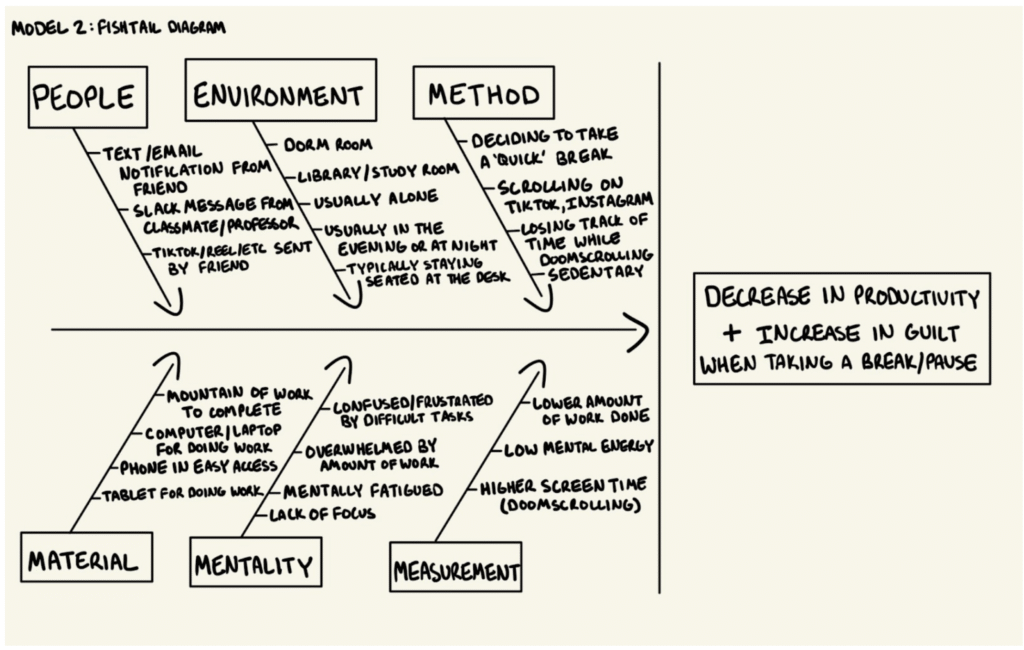
Key insights:
Among the most notable contributors to this decrease in productivity and increase in guilt when people take breaks/pauses during work sessions is the phone. As the individual’s phone remains in easy access during work, they are more susceptible to distractions from phone notifications. This, coupled with negative feelings of frustration, confusion, and mental fatigue that accumulate over the course of the work session, results in an increased tendency for the individual to check their phone during their break/pause, which often devolves into doomscrolling.
An additional contributor is the individual’s sedentary nature during the work session. Individuals often reported staying at their desk while working and while pausing. Due to the limited availability of things to do while sitting at the desk, individuals often defaulted to their phones again.
This means that a key point for future intervention will be to determine an assortment of pause activities for the individual that present as lower friction than defaulting to using their phone. This has potential for incorporating more restorative activities that can help the individual feel more prepared to transition back to their work at the end of the break/pause.
Secondary Research (Key Findings from Literature Review and Comparative Analysis):
Findings Summaries:
Research papers we studied consistently showed that micro-breaks work best when they are short and frequent, helping people maintain their energy and attention over time rather than just giving a quick temporary boost. Also, the research points out that the quality of a break matters more than how often you take them. The breaks that help you relax and mentally disconnect are more restorative than breaks that require mental effort.
The studies showed that people often take breaks because they’re feeling depleted, which means pauses almost function as a way to manage resources rather than just avoid work. However, not all the breaks that people chose actually helped with recovery. Breaks that keep people mentally/emotionally engaged might be distracting without actually restoring their energy, while activities that reduce mental load and let one physically or emotionally reset are more likely to improve how they feel. Based on these findings, we wanted to focus on subjective restoration (energy/mood/focus) as our key outcomes rather than assuming any single break automatically improves performance.
The comparative analysis showed that there is a divided market. A lot of products focus on preventing distraction (such as blocking apps, using penalties, and social accountability) or encouraging intentional breaks. These apps have breaks such as reminders to rest, reminders to check posture, manage energy, and work management. However, not a lot of apps do both, so many tools successfully prevent distraction without actually supporting meaningful recovery. Other apps promote restorative breaks, but could be easy to avoid/not listen to if someone is tired.
Another gap we saw was an overall lack of support or an idea for what someone could do instead. Products that block/discourage distraction don’t give users a clear alternative, which means people could substitute other non-restorative activities. Examples include screen blocking apps, which have been a lot of interest in. There are both physical apps (like the “Brick”), as well as digital apps (the most basic being Apple Screen Time blocker). Also, several gamified tools encourage screen-based break activities that feel rewarding but keep one in the same mental state, which limits real restoration. These patterns suggest there could be an opportunity to better guide what users actually do during breaks and not just what the user should avoid.
Full literature review available here.
2×2 Competitor Analysis:
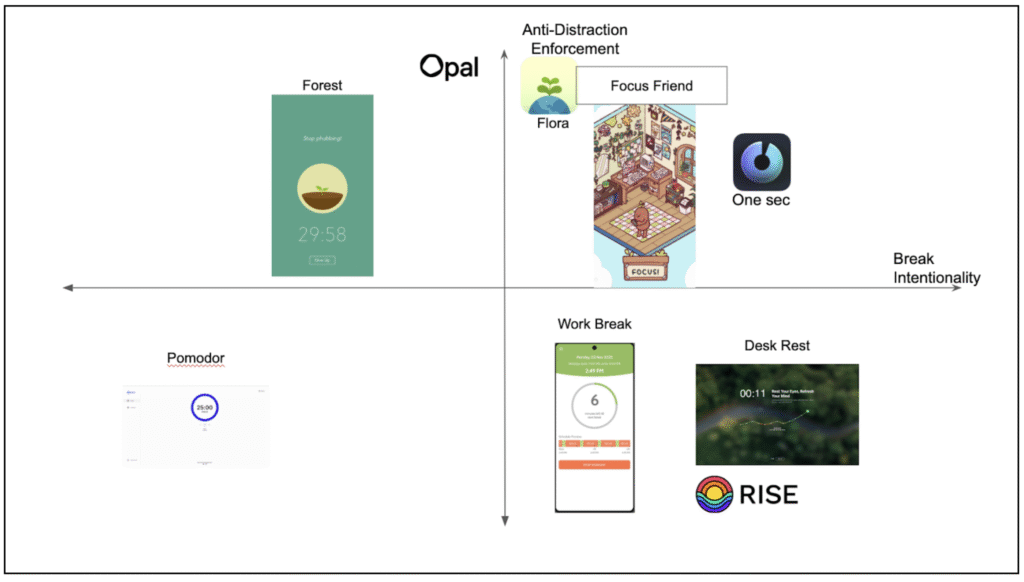
Full competitor analysis available here.
How does this influence our ideation:
These findings point us towards designing breaks as international recovery moments, especially at that vulnerable moment when someone is transitioning between work and taking a pause. They suggest that we should focus on looking to combine gentle enforcement with low effort restorative guidance, to be that midpoint between strict blockers and passive reminders. We should focus on off-screen restorations that are easy to start but feel satisfying to complete, hoping to help people maintain their overall energy and focus.
Behavioural Personas and their respective journey maps:
The High-Performing Undergraduate



