

Link: https://www.figma.com/board/VTHt14TjGIi880VHpbPnoJ/Assumption-Map?node-id=0-1&t=GCIgvabLZSSdg6lB-1
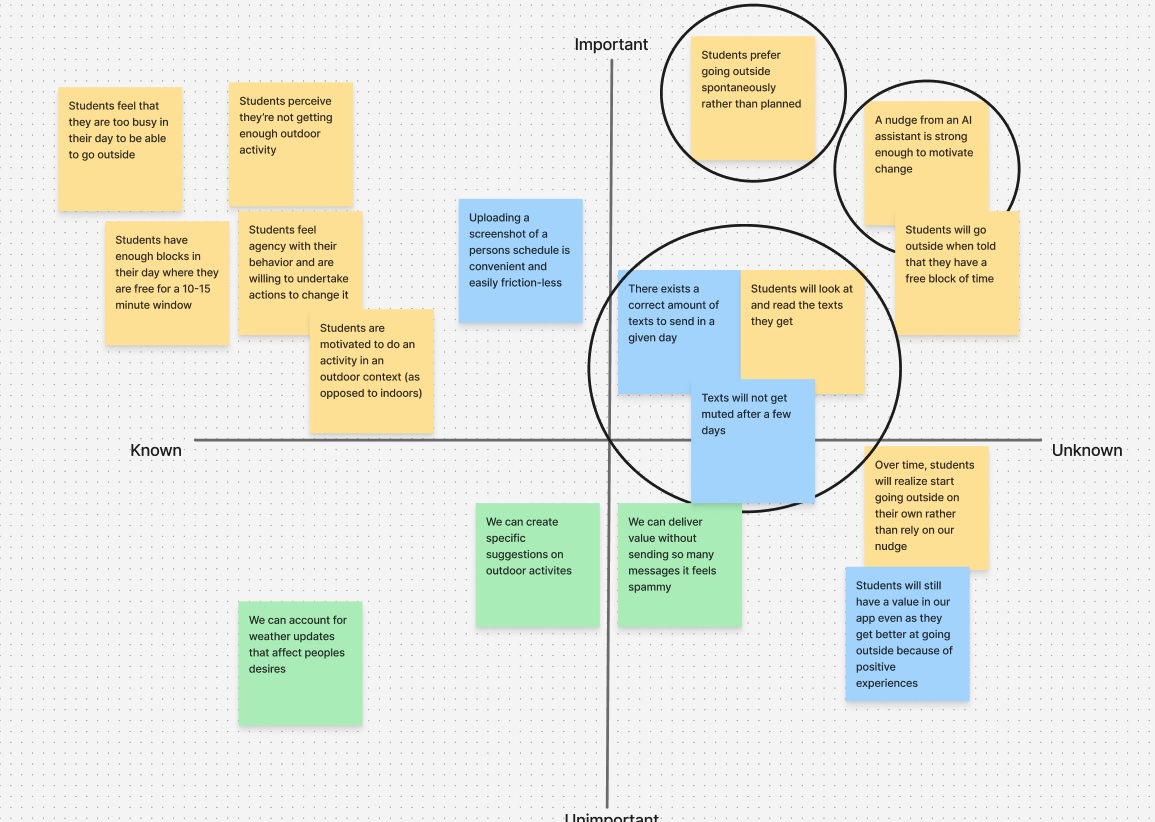
Above is our assumption maps. Through this exercise, we were able to gain more insight into the assumptions of our product and importantly what we need to still test.
What became clear is that most of our assumptions are concentrated around user behavior. That’s partly because the product itself isn’t deeply technical or feature-heavy, the core risk is whether the experience actually changes what students do.
One core insight was that we feel fairly confident in a set of our behavior assumptions: students generally believe going outside is good for them, they do have small pockets of free time during the day, and they often feel “too busy” despite having those openings. They also tend to feel some agency over their schedule and behavior, but still report they aren’t getting enough outdoor activity. This set of assumptions is what led us down this path and is why it sits closer to the “known” side of the map.
From the map, we see three main areas we want to focus on that sit in the unknown and important area:
- Do students want to spontaneously go outside? One of our most important assumptions is whether students truly prefer spontaneity over planning. This is a core part of our concept: rather than asking students to plan outdoor time in advance, we want to test whether “right now” prompts and nudges are more effective.
- Will nudges actually cause action?
We need to prove that students will not only notice the prompt, but actually change behavior (go outside when nudged). This sits at the intersection of desirability and feasibility (“can we deliver nudges at the right moment and in the right way without creating friction or annoyance?”). - Is texting the right medium for nudging?
Based on feedback that calls can feel intrusive or annoying, we’ve shifted toward text messages. Now we need to validate that SMS is the best delivery channel (versus email or other formats) for something lightweight, timely, and repeatable. This also builds on the topic above that if nudges are sufficient, a text message is the correct nudge.
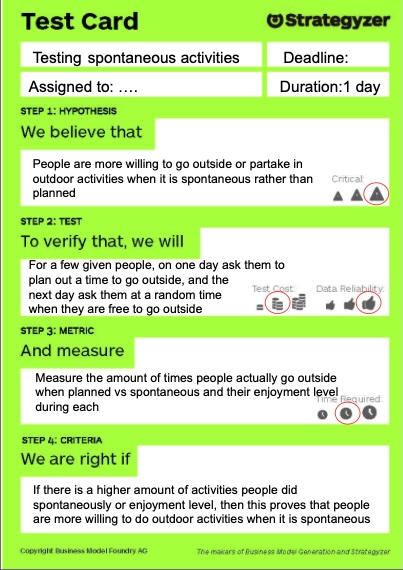
These are the three assumptions that we decided to test, and therefore the test cards are built accordingly to test these quickly and provide the necessary feedback.
Test card 1, Spontaneous activities
link: https://docs.google.com/drawings/d/1azST8wrzzMC2t_xkaItVJvhonHJwT0Iy3C193EiCGSo/edit?usp=sharing
Test card 2, how people respond to nudges,
link: https://docs.google.com/drawings/d/1gS7hj1QkLasVIioNn8eLhvKLZf5nSVVd5pcPRzmq7ws/edit?usp=sharing

Test card 3, text messages are the ideal medium,
link: https://docs.google.com/drawings/d/1ckgL1fwNyKIegbfhPxG5BanOyMABJdrRL8SOIAH3InA/edit?usp=sharing




