
Research Question:
How can we get college students who already have numerous things on their plate to spend more time outdoors and experience the associated benefits?
Key Insights:
- Low motivation- Participants from our baseline study simply didn’t find going outside attractive enough to regularly do so. They are generally aware of the health benefits, yet this is not a sufficient incentive to enact change.
- (Perceived) Low ability- The participants in their interviews expressed outdoor recreational activity as too burdensome. They often mentioned being too busy to introduce new habits. Moreover, it would take more effort to change their behavior, so they often opt to continue indoor lifestyles.
Our intervention ideas below aim to target these factors by increasing motivation to go outside and reducing the initial hurdle of getting started with an outdoor activity through a variety of ways.
Intervention Ideas:
Idea #1: Coupon Incentive
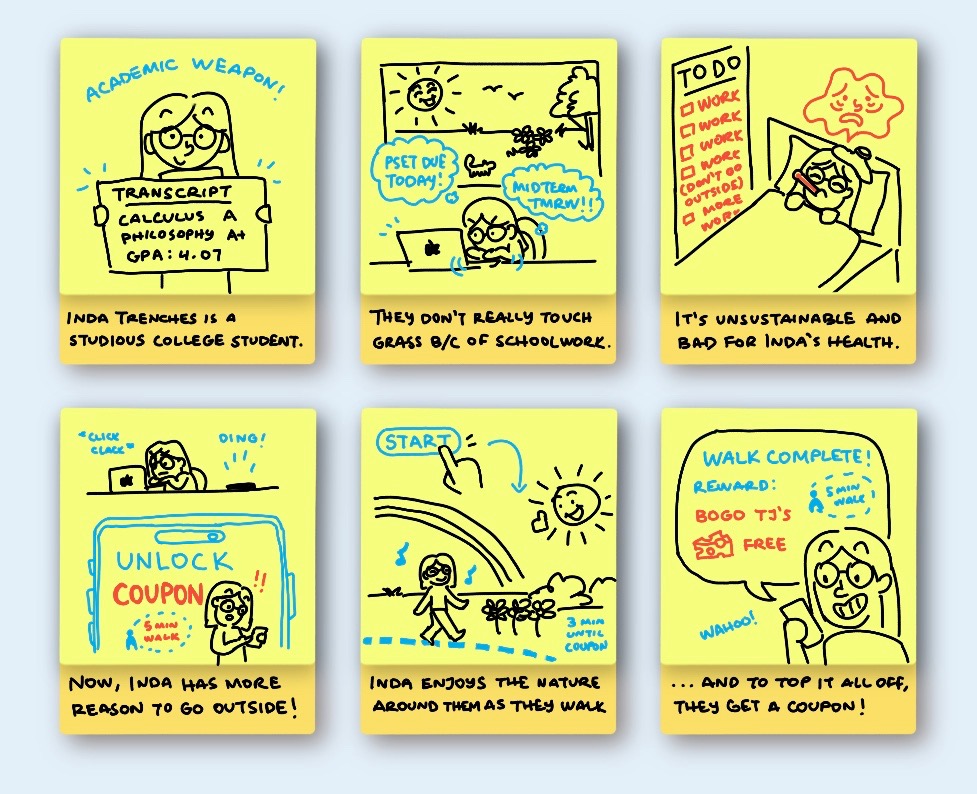
Description: Reward time spent outdoors with coupons/deals to local restaurants, stores that appeal to the user. Make it happen at unspecified intervals so there’s an element of spontaneity. Also hide the actual deals until they are won to add to the element of interest.
Pros:
- Spontaneity improves adoption and fun during the experience, better effectiveness and adoption
- Can partner with local experiences including outdoor activities, so by spending time outdoors, get coupons for things like biking lessons, creates flywheel effect
- Directly rewards time spent outside
Cons:
- May be harder to feasibly do— how do we procure the coupons?
- Students may not like the coupons
- Operational complexity to deal with various business and deal management
Idea #2: Novel Nudge
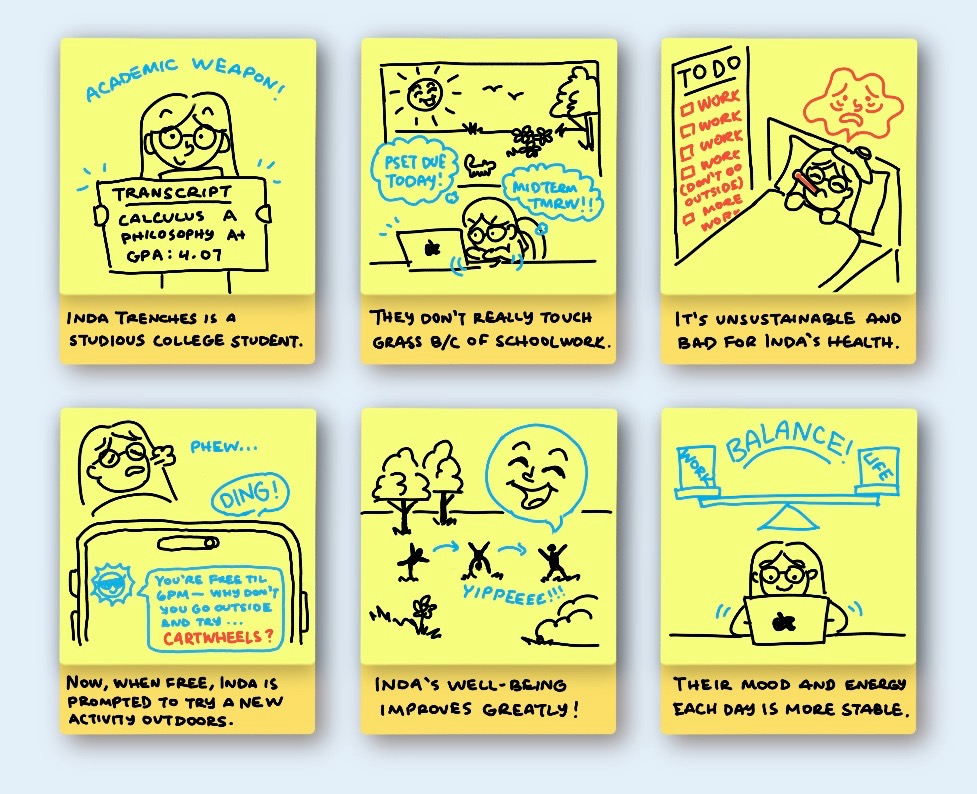
Description: At intervals, an app reminds you to go outside and suggest new activities to try. You can input your schedule so it knows when you are free.
Pros:
- Very direct and pretty easy to set up
- Habit forming nudges as timely prompts can normalize short low-effort outdoor breaks
- Context aware and able to adapt to weather, time of day and even user preferences
Cons:
- Can get spammy with a lot of notifications
- Hard to input your schedule in manually
- Mechanical buy-in as users may comply without any genuine interest which would limit behavior changes
Idea #3: Social Nudge
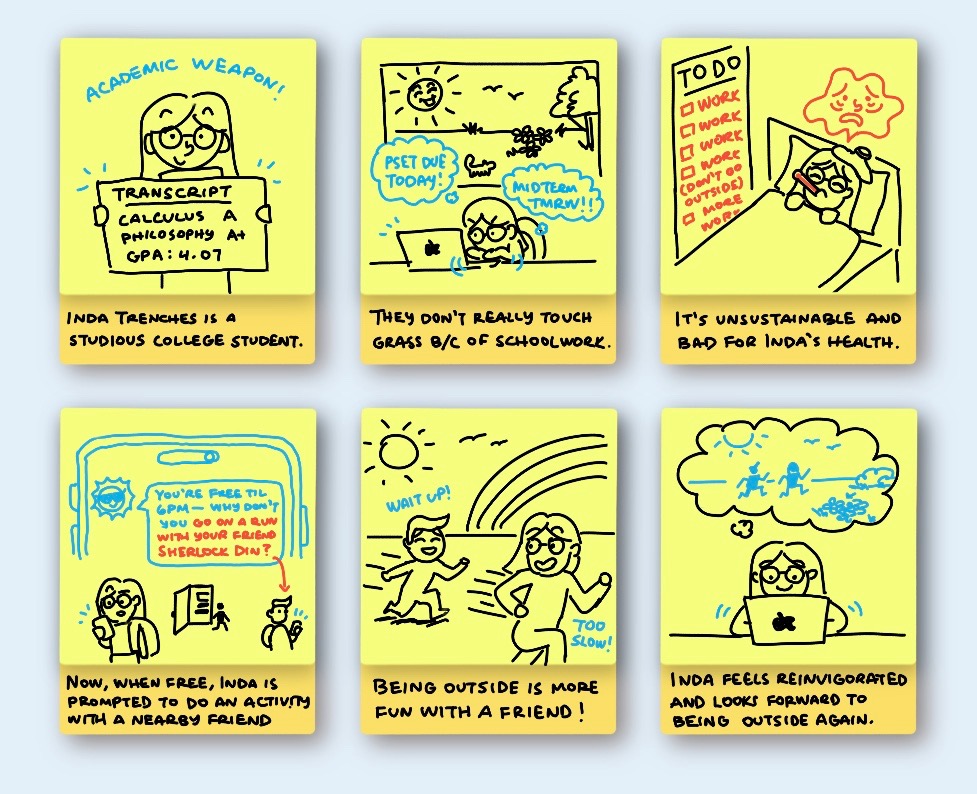
Description: App that pairs you with friends to do activities together. Uses your locations and schedules to detect when you are both free and close by. Suggests activities available in the area like strolling, hiking, and sports.
Pros:
- Builds on social experiences, brings people together, higher effectiveness
- Suggests activities so broadens horizons
- Supports a feeling of belonging through reconnection with friends, addressing social isolation
Cons:
- Relies on people being available
- Harder to coordinate as needs multiple people to align schedules
- Input scheduled manually is a lot of friction
7-Day Intervention Study Plan
| Day | Morning | Throughout the Day | End of Day |
| 1 | Participant uploads their daily schedule to identify free blocks, and write their outdoor activity goal for the day. | Send 1-3 nudges to participant to remind them to go outdoors when they are free. | Ask participants:
1. What percent of nudges they responded to by going outdoors. 2. Whether they completed their outdoor activity goal 3. How satisfied and happy they feel overall, on a scale of 1 (poor) to 5 (great). |
| 2 | Repeat | Repeat | Repeat |
| 3 | Repeat | Repeat | Repeat |
| 4 | Repeat | Repeat | Repeat |
| 5 | Repeat | Repeat | Repeat |
| 6 | Repeat | Repeat | Repeat |
| 7 | Repeat | Repeat | Repeat |
Data Collection Plan
We plan to ask participants to export and upload their calendar schedule every day via a Google form, which will allow for the identification of free blocks of time. This will help test our assumption of whether users are willing to upload their schedules on a regular basis, which is crucial for sending nudges during free blocks of time they may have.
At the end of the day, based on the nudges they receive, they will also complete a brief questionnaire regarding the percentage of nudges they completed, whether they accomplished their goal, and how satisfied they feel overall with their activity that day. This will help us test the assumption that nudges indicating free time to users encourage them to go outdoors when they would otherwise think they are too busy to do so. Furthermore, we will test whether setting an explicit goal and meeting or not meeting it affects their overall happiness and motivation levels, and how that influences their relationship with outdoor activity. We specifically aim to gauge this through the self-report rating.
Introduction Document
Hello,
Thank you for volunteering to continue the study! Over the course of one week, you will get nudges from our application to spend time outside. These nudges will be timed based on free blocks in your daily schedule, which you’ll upload each morning.
Purpose
We’re studying whether nudges that arrive during moments when you’re likely free make it easier to spend time outdoors, especially when people otherwise feel “too busy.” We’re also interested in how this affects your daily satisfaction and motivation.
Daily Steps
- Morning: Upload your schedule and write a simple outdoor goal for the day (e.g., “10-minute walk”).
- Throughout the day: You may receive 1–3 nudges during times you appear free. Respond naturally: go outside if it fits, ignore it if you’re busy or not interested.
- End of day: Complete a short check-in about whether you went outside, what % of nudges you responded to, whether you met your goal, and your overall satisfaction/mood (1–5).
Expectations
There are no right or wrong responses: we’re not grading outdoor time! What matters most is that you behave normally and answer honestly. You do NOT need to go outside every day or at every nudge to be a “good participant.” You’ll also continue tracking your outdoor activity during the week, similar to the first phase of the study.
Time Commitment
This will run for 7 days where each day this will be about 5-10 minutes of total commitment for the study itself to record everything.
Thank you again! Please reach out if you have any other questions



