
Overview
For Team Bull, it didn’t take long to identify the habit we wanted to explore: sleep. It’s universal, yet surprisingly difficult to control. After reviewing research on sleep behavior and habit formation, we chose to focus not on increasing total sleep, but on improving consistency—recognizing that small, incremental changes are often the most effective drivers of lasting behavior change. While sleeping more is ideal, we believe consistency is the necessary first step.
For our baseline study, we aimed to better understand the environmental, contextual, and emotional factors that influence people’s ability to maintain a consistent sleep schedule—going to bed and waking up at roughly the same time each day. Rather than immediately solving the problem, the goal of this study was to uncover opportunities for small, sustainable behavioral shifts that could gradually move participants toward greater consistency.
Methodology
We recruited 8 participants for our study. Our target group was college students who wanted to improve their sleep habits, especially when it came to consistency. To screen participants, we confirmed that they:
- Expressed a desire to improve their sleep
- Were willing to complete a five-day sleep diary
- Could participate in both a pre- and post-interview
- Had an inconsistent sleep schedule
The study consisted of a five-day diary study paired with pre- and post-interviews. During the diary period, participants recorded their bedtime, estimated sleep time, wake-up time, any daytime naps, and rated their sleep quality on a scale from 1–5. We also included optional notes to capture contextual details—such as workload, social activities, stress levels, or environment—so we could identify any patterns within participants or between participants.
In addition to the diary, participants completed a pre-interview to surface their perceived sleep challenges, habits, and goals. After the five days, we conducted post-interviews to reflect on emerging patterns, uncover underlying reasons behind their behaviors, and examine whether their initial perceptions aligned with the data they recorded.
This structure allowed us to gather both quantitative data (sleep timing and quality metrics) and qualitative insights (motivations, environmental triggers, and emotional context), giving us a more holistic understanding of consistency in sleep habits.
Participant Recruitment
From the screener responses, we narrowed our sample to our target demographic: college students ages 21–24 who expressed a desire to improve their sleep schedule. Among those selected, 70% reported difficulty waking up in the morning, and all participants struggled with maintaining a consistent sleep routine. Notably, every participant reported averaging fewer than eight hours of sleep per night.
We also observed variation in how participants were attempting to manage their sleep challenges. Thirty percent regularly traveled across time zones, introducing additional disruptions to consistency, while another 30% reported using sleep medication—highlighting active, but varied, strategies to improve their sleep. Together, these factors reinforced both the relevance of our focus on consistency and the complexity of the behaviors surrounding it.
Key Research Question
With this study, we hoped to answer the following:
- What kind of environmental factors influence sleep timing?
- What emotional or psychological factors contribute to inconsistent sleep?
- What are potential moments to place an intervention?
- What kind of potential ‘rewards’ or ‘motivations’ can propel people to sleep more consistently?
Grounded Theory
Through interviews with eight college students who logged their sleep for one week, we identified four key patterns governing student sleep behavior.
- Screen time as a “psychological airlock”: Phone usage is commonly the necessary decompression ritual between high-stress academic work and sleep, which often delays bedtime significantly. Nearly all of our participants admitted to this habit, so this insight sparked questions like: ‘Does the cognitive relief granted by phone usage outweigh the physiological cost of blue light exposure at night?’ and ‘Is it really the phone that helps them fall asleep or is it stories that are being accessible through a phone?’
- Physical exhaustion as a powerful tool: Not only did our participants report that they thought physical exhaustion led to earlier and better sleep, the data proved it far more effective than mental fatigue at enabling quick sleep onset, as it bypasses the need for digital decompression entirely.
- Awareness does not equal long-term change: While logging sleep created immediate awareness and temporary accountability, students struggle to translate these insights into lasting behavioral change without addressing underlying stressors and habits.
- Social factors and environmental factors are hard to control: Factors like roommate schedules and environmental elements like room temperature create constraints on sleep that students often don’t recognize or control. These findings suggest that improving student sleep requires not just awareness interventions, but systemic changes that reduce academic stress, promote physical activity, and provide alternative decompression methods that don’t involve screens.
The entirety of our grounded theory includes many sub theories, examples, and questions that can he found here. And to follow our synthesizing process, check out our miro board to view insights from each participant, our say/do, feel/think, see, hear diagram, affinity groups, and contradicting insights.
System Models
Connection Circle
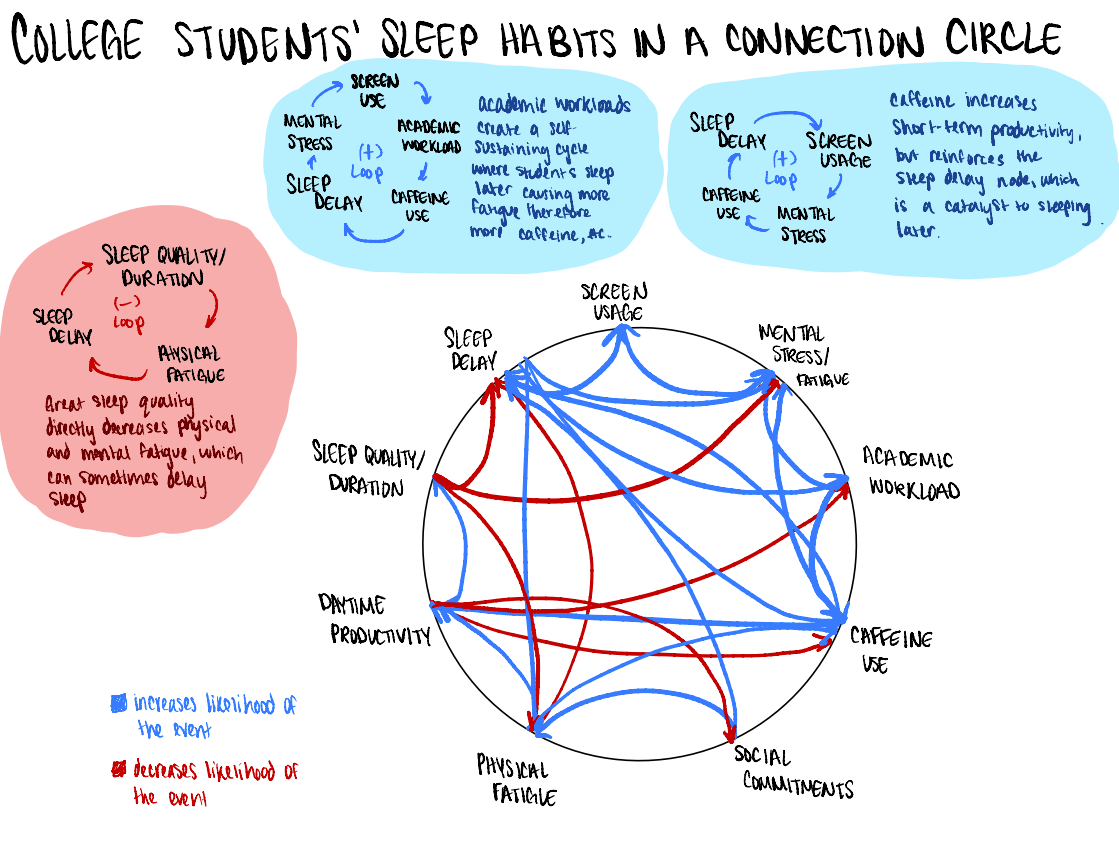
Our connection circle shows that students get caught in a trap between academic pressure and their need to feel in control of their own time. After grinding through stressful work, they turn to screens as a way to mentally decompress before bed. This creates what we are calling a “psychological airlock” where students are stuck in a decompression chamber between work mode and sleep mode. And without fail, this buffer zone eats into their sleep time, and kicks off a vicious cycle. Less sleep means students are groggier and less focused during the day, so homework takes longer, which creates more stress, which makes them need even more screen time to unwind at night. Round and round it goes.
On the other hand, physical exhaustion seems to form a combative negative loop where physical exhaustion leads to less screen use and less sleep delay and so on. Physical fatigue essentially overrides the mental need to decompress. But, this system becomes unreliable when you add in caffeine and social factors like staying up with roommates. Both prioritize feeling good right now over sleeping well later.
Iceberg Model
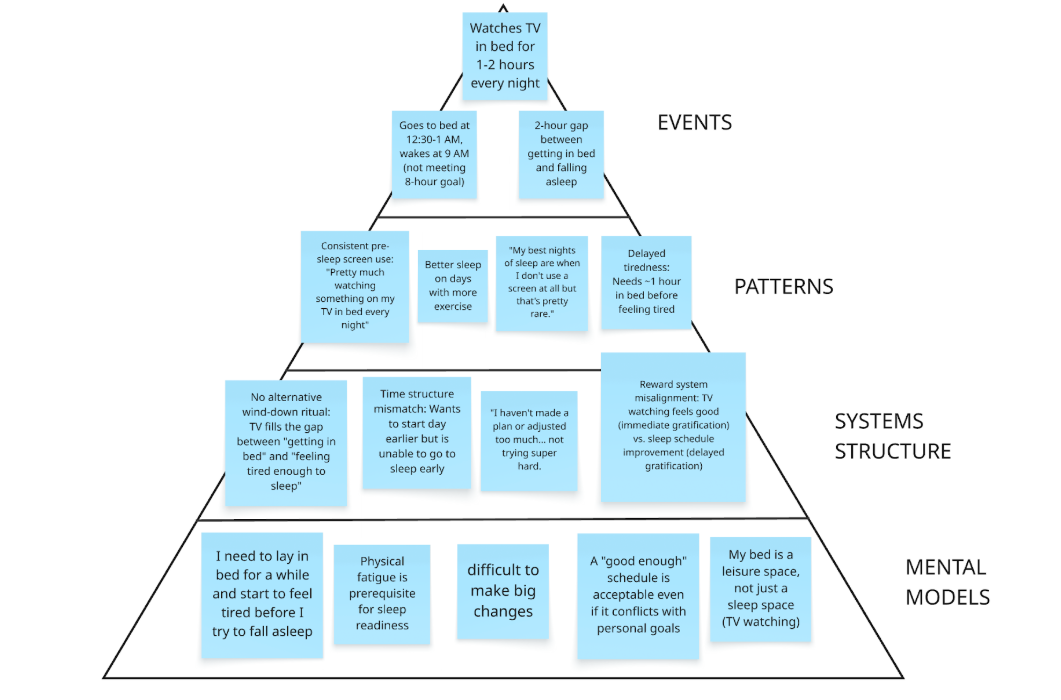
Our iceberg reveals that participants are caught between knowing what good sleep looks like and being unable to build toward it. What looks like a sleep problem is more likely a winding-down problem. Participants get into bed early to make space for sleep. But the buffer between getting in bed and actually sleeping is contaminated by screens. Screens are the only thing filling the functional gap between alert and tired. The bed has become a leisure space first and a sleep space second, and no alternative exists to challenge that.
Deeper down, the system has no real pressure valve. Awareness doesn’t do much: some participants said the sleep diary changed nothing about their behavior. Physical exhaustion is the only reliable override, forcing the body to decide when the mind won’t. What holds it all together at the deepest level is a belief that sleep is something that happens to you. You wait for it, screens fill the time, and eventually it arrives. The design has to slip into that gap and replace what screens are doing, not demand that people think or behave differently first.
Secondary Research
Previously, we compiled a comparative analysis and research analysis on our topic and discovered the following insights:
- The Impact of Pre-Bedtime Screen Use
- Melatonin and Arousal: Screen use in the hour before bed delays melatonin release due to blue light exposure and increases cognitive arousal, leading to delayed bedtimes (avg. 19 minutes) and poorer sleep quality.
- Simple Restrictions Work: Restricting phone use just 30 minutes before bed can significantly improve sleep duration (by ~18 minutes), decrease sleep latency, and improve mood and working memory within four weeks.
- Susceptibility: “Night-owl” types are particularly vulnerable to screen-related disruptions, and the issue spans all age groups, not just students.
- The “Planning Gap” and Procrastination
-
- Lack of Structure: University students rarely plan their bedtimes (averaging less than one night per week). However, nights with a plan result in roughly 12 minutes more sleep.
- The Procrastination Cycle: When bedtime plans are made, they are frequently overrun by an average of 46 minutes, primarily due to academic work (26%) and electronic leisure (26%).
-
- Holistic Ramifications of Poor Sleep
-
- Nutritional Impact: Sleep-deprived adolescents consume significantly more “junk” (high-carb, high-sugar calories) and fewer fruits and vegetables, increasing the risk for metabolic issues and weight gain.
- Mental Health: Chronic insomnia is a documented risk factor for suicide ideation and impaired cognition. Conversely, even brief sleep interventions can improve general mental health.
-
- Barriers to Change
-
- Multilevel Factors: Sleep is not just a personal choice; it is hindered by academic workloads, family responsibilities, social commitments, and unpredictable schedules.
- Cognitive Blocks: “If-then” goal setting can improve sleep hygiene (like reduced caffeine), but environmental stressors (like a heavy workload) often prevent these intentions from translating into earlier bedtimes or longer duration.
-
- Intervention Efficacy
- Low-Intensity Success: Brief, scalable interventions—such as online education (Sleep 101) or simple bedtime planning—can produce measurable improvements in hygiene and duration.
- Habit vs. Customization: General habit-building interventions are often as effective as highly customized, clinical programs (like internet-based CBT-I), suggesting that consistency is more important than complexity.
- Market Gaps and Differentiation
- The Screen Paradox: Most existing solutions (Calm, Headspace, Sleep Reset) are app-based, which paradoxically requires users to engage with a screen at bedtime, potentially undermining the goal of sleep hygiene.
- Functional vs. Emotional: Current hardware solutions (Hatch) are functional and impersonal. Research suggests an opportunity for a tactile, screen-free companion (like the proposed “Teddy Bear” prototype) that provides emotional grounding and physical accountability without digital distraction.
Our full analysis can be found here.
Behavioral Personas
Based on cross-analysis of our sleep diaries, participant interviews, and affinity mapping exercises, we developed three proto-personas that capture the most significant and recurring sleep behavior patterns within our participant pool. These personas were chosen because they emerged consistently across multiple participants and data sources, represented distinct emotional and physiological factors affecting sleep, and pointed toward clear opportunities for intervention.
Rather than categorizing students by major or year in school, these proto-personas reflect shared behavioral patterns that govern when and how sleep happens. Together, they encompass a wide range of our target audience and illuminate different failure points in stress regulation, wind-down routines, and the ability to prioritize rest over competing demands.
- The Screenager
-
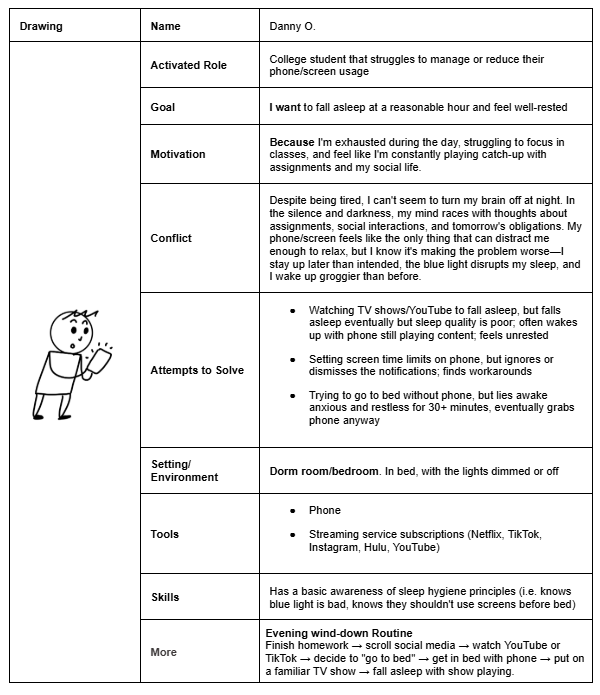
- Overview: Danny is a college student who uses his phone as a “psychological airlock.” He relies on the stimulation of YouTube or TikTok to drown out racing thoughts about assignments and social obligations. Although he knows blue light is detrimental, he views the screen as his only tool for relaxation, often falling asleep mid-stream and waking up unrested.
- Why this persona matters: This persona represents the most common behavioral barrier to sleep hygiene. It illustrates the paradox of the modern student: using the very device that disrupts sleep (blue light) as a coping mechanism for the anxiety caused by a high-pressure environment.
- Key Insight: Digital consumption is not about entertainment, but a distraction technique used to mitigate “silence-induced anxiety.”
- The Picky Sleeper

-
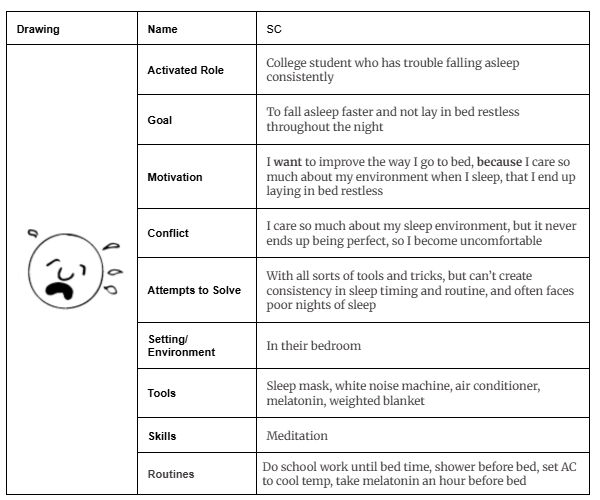
- Overview: SC is a “sleep perfectionist” who has invested heavily in environmental tools—sleep masks, white noise, and cooling systems. Despite this, they struggle with consistency. Their focus on creating the “perfect” environment has turned bedtime into a high-stakes performance, leading to restlessness when even one variable (like room temperature) is slightly off.
- Why this persona matters: This persona highlights “orthosomnia”, which is the phenomenon where the obsession with perfect sleep metrics or environments actually causes more sleep-onset anxiety. It proves that environmental control alone cannot fix a lack of behavioral routine.
- Key Insight: Environmental perfection creates fragility; because SC relies on external “tricks” rather than internal cues, their sleep system collapses the moment their environment is not strictly controlled.
- The “Always in Huang” Grinder
-
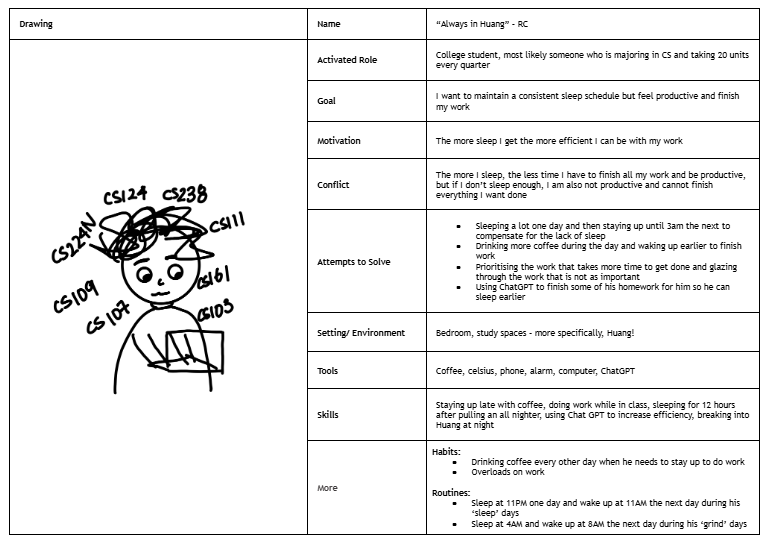
- Overview: RC is the quintessential high-achiever who views sleep as a tradable currency for productivity. He lives in a state of “Social Jetlag,” oscillating between extreme 4-hour “grind days” fueled by caffeine and 12-hour “recovery days.” He uses tools like ChatGPT and high-caffeine drinks to maximize efficiency, essentially treating his body like a machine.
- Why this persona matters: RC represents the systemic “burnout culture” in elite academic environments. Research shows that 41% of adults report daily screen use before bed, but for students like RC, this is combined with chronic sleep deprivation that increases late-night calorie intake and metabolic risk.
- Key Insight: RC operates on a “productivity deficit” model; he doesn’t realize that his “grind” hours are actually lower-quality work due to impaired cognition, which necessitates the very all-nighters he is trying to use to “get ahead.”
Rationale for Persona Selection
We selected these three primary personas because they:
-
Appeared consistently across participants and data sources: From Michelle’s reliance on the “psychological airlock” to Ray’s social late nights, these archetypes represent the lived experiences of our 12 study participants.
-
Represented distinct psychological and situational drivers of sleep delay: They categorize the three main forces at play: the need for emotional decompression (Danny O.), the pursuit of academic productivity (RC), and the nitty gritty of perfect sleep (Picky Sleeper).
-
Revealed different breakdown points in behavioral self-regulation: They expose how sleep is sacrificed differently including the “caffeine trap” used to power through deadlines, or the “orthosomnia” caused by a high-stakes, fragile sleep environment.
-
Offered complementary perspectives for intervention design: The Screenager highlights the need for a non-digital “bridge” to sleep. The “Always in Huang” reveals the friction between biological recovery and academic achievement. The Picky Sleeper reveals how fragile a person’s sleep can be.
Journey Map Synthesis
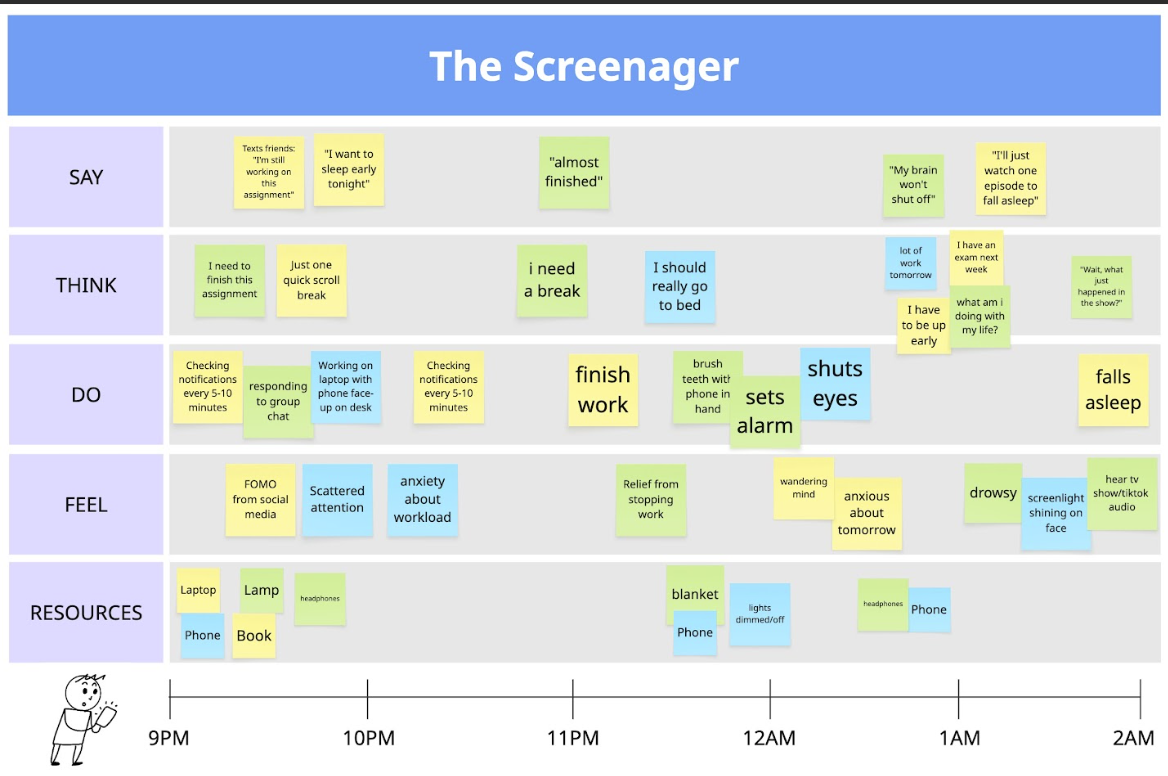
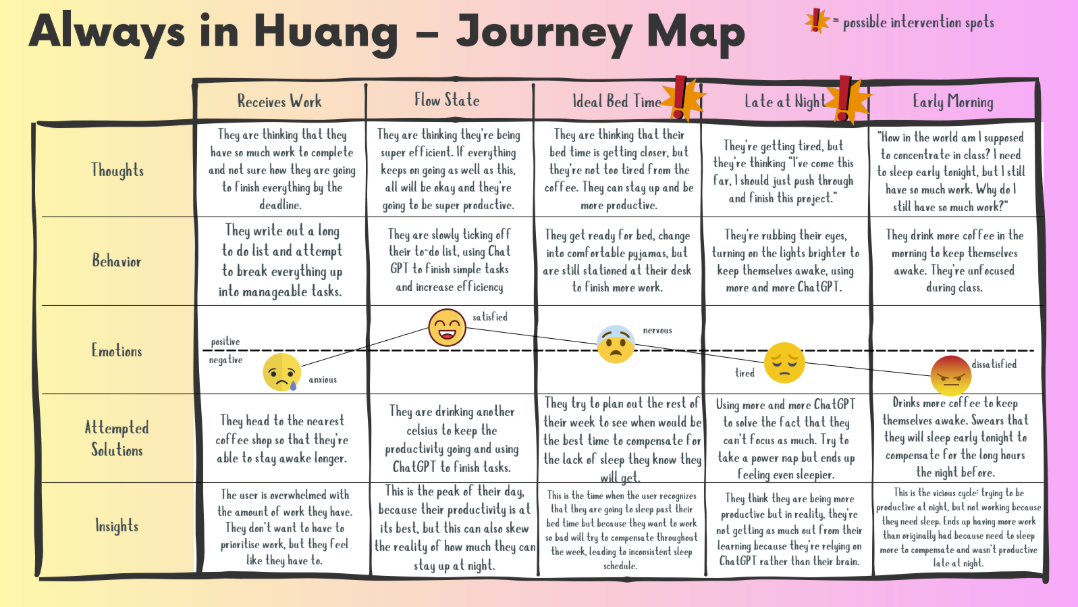
Each persona is supported by a corresponding journey map that visualizes how sleep delay unfolds from the moment a student finishes their final task of the day until they eventually fall asleep. While individual schedules vary, strong structural similarities emerged across participants regarding the creep of bedtime.
Key Cross-Persona Insights from Journey Maps
- Context matters more than intention: A student’s stated goal (e.g., “I will sleep at midnight”) was frequently overridden by environmental triggers—whether that was a smartphone on the nightstand (Danny), a remaining deadline (RC), or a room temperature that felt “off” (SC).
- Justification happens in real time: Participants actively constructed narratives to enable sleep delay:
- “I need this screen time to turn my brain off” (Screenager).
- “I’ll be more relaxed if I just finish this now” (Always in Huang).
- “I can’t sleep because the white noise isn’t right” (Picky Sleeper).
- Emotional outcomes diverge by persona:
- Screenagers experienced “morning-after” grogginess and digital regret.
- Always in Huang felt temporary achievement followed by severe cognitive burnout.
- Picky Sleepers experienced “bedtime performance anxiety,” where the effort to sleep perfectly made them more restless.
Strategic Value for Design
Synthesizing these personas and journeys allows us to design interventions that are:
- Context-aware: Targeting the “Psychological Airlock” period where students are most vulnerable to screen use or over-thinking.
- Emotionally responsive: Addressing the “silence-induced anxiety” that Danny faces and the “perfectionism stress” that SC experiences.
- Tactile and Sensory: Moving away from digital apps (which Danny would abuse) toward a physical, calming object that provides the sensory consistency SC craves.
- Proactive rather than reactive: Shifting from tracking “bad sleep” after it happens to providing a physical companion that guides the user during the transition to bed, effectively acting as a “circuit breaker” for the stress-work-screen cycle.
By grounding our design in these three personas, we ensure the final solution addresses internal behavioral mechanisms (anxiety, perfectionism, and productivity guilt) rather than just external symptoms.



