
Storyboard Idea #1: Teddy Bear Intervention
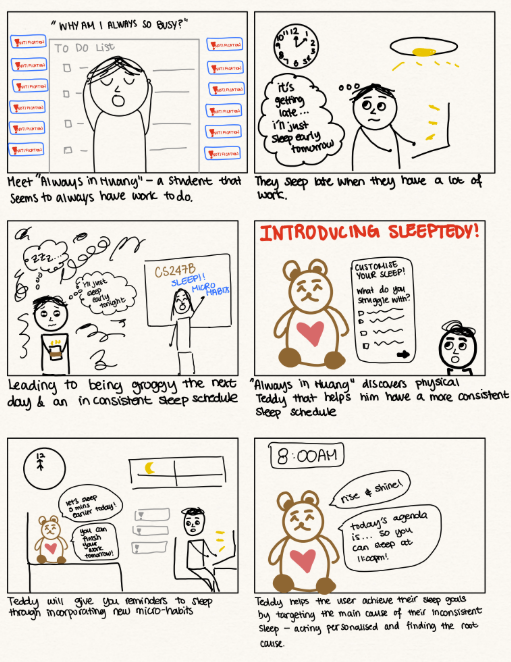
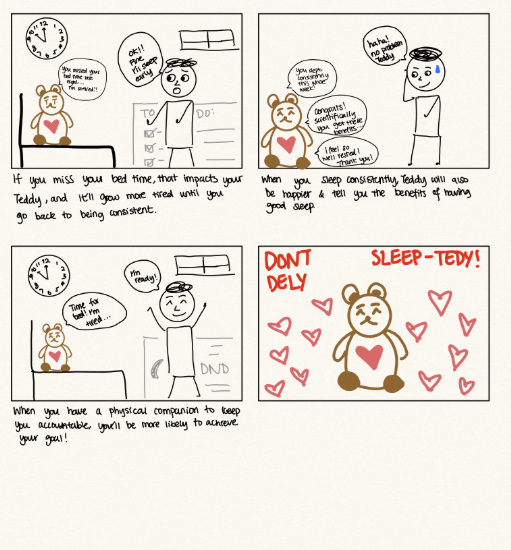
Main Question: Is a personalized and humanized sleep companion more effective at improving sleep consistency and earlier bedtimes compared to traditional phone-based sleep apps?
Description: Our design builds on competitive analysis findings that highlight two major gaps in current sleep apps: lack of meaningful personalization and lack of emotional, human-like engagement. While many apps provide tracking and reminders, they often feel transactional and screen-based, which can paradoxically reinforce late-night phone use.
We propose a personalized physical “sleep companion” in the form of a teddy bear that acts as a behavioral support system. The teddy bear identifies the primary factor contributing to a user’s inconsistent sleep (e.g., phone scrolling, stress, procrastination, irregular routines) and provides consistent, emotionally supportive nudges tailored to that factor.
Unlike traditional sleep apps, the companion minimizes reliance on phone interaction. By existing as a physical object in the sleep environment, it reduces screen exposure before bed while fostering a sense of accountability, companionship, and gentle emotional encouragement. The goal is to combine personalization, physical presence, and humanized interaction to promote earlier and more consistent bedtimes.
Pros:
- Reduces late-night phone use by removing screen-based reminders
- Creates emotional attachment and social accountability
- Provides personalized nudges targeting the user’s main sleep barrier
- Acts as a physical bedtime cue in the environment
- Feels more supportive and less clinical than traditional apps
- Differentiates from existing sleep-tracking competitors
Cons:
- May feel childish or less credible for some user
- Effectiveness may decline as novelty wears off
- Limited data tracking compared to digital apps
- Requires hardware production and higher cost
- Personalization may be inaccurate without strong onboarding
- Risk of users becoming dependent on the companion
Collection Method
Addressed in the intervention study details
Storyboard Idea #2: Phone Lock Box Alarm
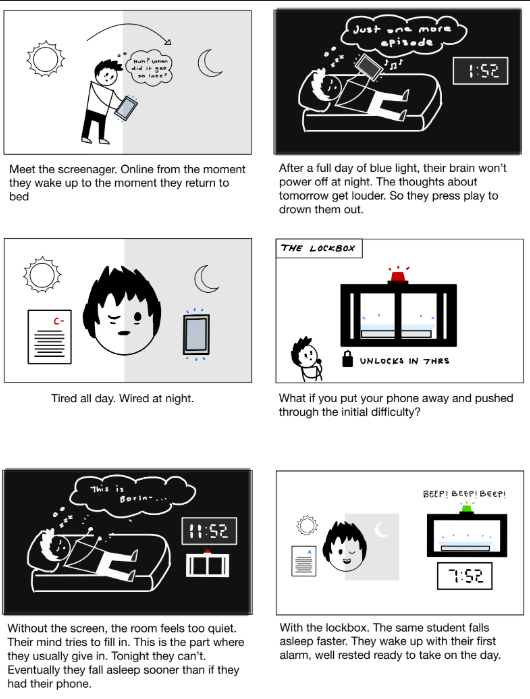
Main Question: Does physically removing the phone from the sleep environment lead to faster\better sleep and better mornings for high screen-use students?
Description: Our design addresses a common obstacle to sleep among college students: routine nighttime phone use in bed. Many students rely on their phones to scroll, stream, or manage anxiety about the next day. However, nighttime screen use exposes users to blue light that delays melatonin release, while constant content keeps the brain alert. Over time, this conditions the bed as a place for stimulation rather than sleep.
We propose a timed lockbox intervention in which participants place their phone into a physical lockbox 30–60 minutes before their intended bedtime. The lockbox is set to remain closed for a set time, preventing late-night access. A standalone alarm clock replaces the phone alarm.
Unlike screen-based sleep apps that require continued phone interaction, this intervention removes the device entirely from the sleep environment. The lockbox acts as a commitment device, reducing impulsive scrolling and eliminating the option to use screens as a coping mechanism for boredom or anxiety in bed.
The goal isn’t to eliminate phone use entirely, but to create a clear environmental boundary:
By altering the physical environment rather than relying on willpower, the intervention aims to improve sleep onset time, increase total sleep duration, and improve next-day alertness.
Pros:
- Directly reduces late-night screen exposure
- Removes temptation instead of relying on self-control
- Creates a clear environmental cue separating day from night
- Simple, low-tech, and easy to understand
- Breaks the “scroll to fall asleep” association
- Increases intentionality around bedtime
Cons:
- May create anxiety about being unreachable at night (need some emergency bypass)
- Users may resist loss of control or autonomy
- Could feel restrictive or extreme
- Students may bypass the system using their laptop, tablet, etc.
- Requires purchasing and remembering to use hardware
- Does not directly address underlying anxiety or stress
Collection Method
Morning Survey (daily)
- Bedtime (time)
- Time fell asleep (estimate)
- Wake time (time)
- Sleep quality (1–5)
- Morning alertness (1–5)
Evening Check-In (daily)
- Phone locked? (Yes/No)
- Time locked (time)
- Urge to check phone (1–5)
Post-Study Survey
- Did it reduce time to fall asleep? (Yes/No + why)
- Did mornings feel different? (Yes/No)
- Would you continue using it? (Yes/No)
- Biggest challenge? (open response)
Storyboard Idea #3: Lock In List
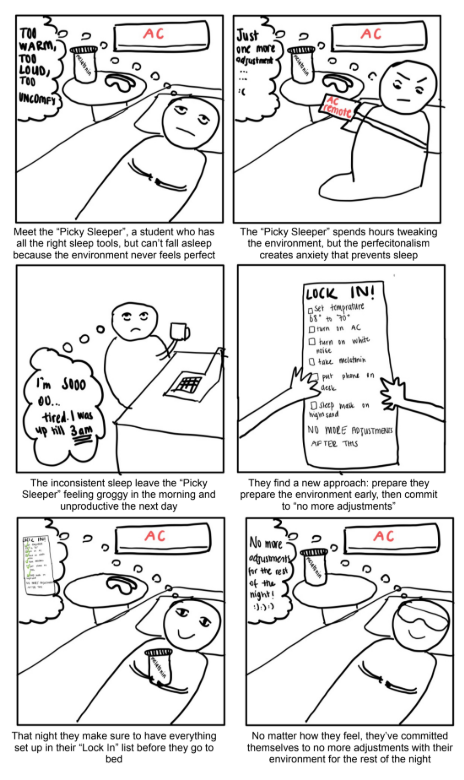
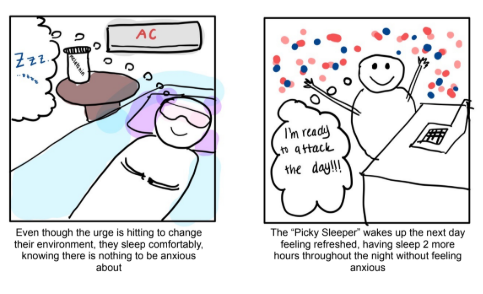
Main Question: Can a structured pre-bedtime ritual that enforces environmental setup and eliminates adjustment behaviors reduce the time it takes to fall asleep and improve consistency for perfectionistic sleepers?
Description:
Our design for this study addresses a key insight from our baseline study: some students with many sleep helping tools (ex: white noise machines, sleep masks, temperature controls, melatonin) struggle to fall asleep because they continuously adjust their environment until they feel comfortable. This perfectionism creates anxiety that prevents them from falling asleep.
We propose a simple checklist-based ritual that participants complete 30 minutes before their target bedtime which they set beforehand. The ritual requires setting up all environmental factors once (temperature, white noise, sleep mask placement, melatonin), then having them commit to a “lock-in”, which says they absolutely cannot make any further adjustments. The 30-minute buffer transitions users away from work or screens into wind-down activities like meditation or reading before bed.
Unlike some digital sleep apps that add more variables to manage and things to do, this intervention simplifies pre-sleep routines by creating clear boundaries. The physical checklist acts as both a guide and a commitment device. By accepting good enough conditions and removing the option to continue to mess with the environment, users eliminate the anxious feeling of changing the environment that keeps them awake. The ritual creates the consistency that perfectionistic sleepers lack while requiring little effort,
Pros:
- Directly addresses perfectionism of picky sleepers
- Creates structured consistency through repeatable ritual
- Uses existing sleep tools
- Simple tracking (checklist completion)
- Reduces decision fatigue
- Low-tech, only check list required
Cons:
- Requires discipline to resist adjustment urges
- May feel restrictive to users who like to be in control
- Doesn’t solve genuinely uncomfortable environments (broken AC, noisy neighbors)
- 30-minute timing may conflict with unpredictable bed time schedules
- Could increase anxiety if environment is actually wrong
- Checklist usage or compliance may decline over time
Collection Method:
- Daily sleep diary: Bedtime, time to fall asleep, wake time, sleep quality (1-5), total sleep hours
- Compliance log: Checklist completion (Y/N)
- Adjustment violations: Did they adjust anything post-lock-in? Why?
- Post-study interviews: Perceived difficulty, relationship with lock-in technique, barriers to compliance, attitude shifts
Intervention Study Outline
Our Relevant Question: Can a personalized, emotionally supportive virtual companion motivate people to improve their sleep consistency and achieve earlier bedtimes over 7 days? Poor sleep habits and inconsistent bedtimes often happen due to unconscious behaviors like phone scrolling, stress, or simply not feeling tired. By creating a warm, humanized “teddy bear” that sends personalized text messages, we test if emotional support + accountability can help address sleep inconsistency issues.
To recruit our participants, we will be using this onboarding survey to record a baseline for their habits: Sleep Study Intervention Onboarding Survey
After finalizing participants, the following materials (introduction document, introduction email, closing email) will be shared with them: Sleep Study Introduction Materials
7-day Study Outline:
We will recruit individual participants who struggle with irregular sleep schedules (bedtime variance >45 minutes, typical bedtime after 11:00 PM). We assume:
- All participants own smartphones with text messaging capability
- They can respond to brief text surveys twice daily (morning and evening)
- They are willing to engage with the concept of a virtual “teddy bear companion” sending them supportive messages
- They can dedicate 7 consecutive days to the study without major travel or schedule disruptions
- Participants will naturally encounter their phones in bed, making this a realistic test environment
Design:
Personalized Messaging System
- Each participant receives a “virtual teddy bear” that sends personalized text messages based on their identified sleep barrier (phone scrolling, stress, not feeling tired, etc.)
- Messages are timed strategically around their typical bedtime routine:
- 90 minutes before target bedtime: First gentle nudge to begin wind-down
- 30 minutes before target bedtime: Stronger reminder with specific behavioral guidance
- At target bedtime: Encouraging message to sleep now
- Morning (1 hour after wake): Supportive reflection message
Message Tone
- Warm, friendly, companion-like language (e.g., “Hey friend! 🐻 It’s getting close to wind-down time…”)
- Uses first-person “I” and “we” to create relationship
- Non-judgmental and emotionally supportive
- Personalized to participant’s specific sleep barrier
Target Bedtime Calculation
- Based on pre-study survey about typical sleep patterns
- Target bedtime = participant’s reported average sleep time – 20 minutes
- Goal: Gradual advancement toward earlier, more consistent sleep
Data Collection
Morning Text Surveys (sent ~1 hour after typical wake time)
- “What time did you get into bed last night?” (time entry)
- “What time did you actually fall asleep?” (estimated time)
- “What time did you wake up today?” (time entry)
- “Rate your sleep quality last night” (1-5 scale)
- “Did you use your phone in bed before sleeping?” (Yes/No)
- If yes: “For how long?” (Under 15 min / 15-30 min / 30-60 min / 1+ hour)
Evening Check-In (sent at 9:00 PM)
- “What time do you plan to be asleep tonight?” (time entry)
- “How tired are you right now?” (1-5 scale: Wide awake → Very sleepy)
- “How confident are you that you’ll stick to your planned bedtime?” (1-5 scale)
Mid-Week Bonus Question (Day 4, evening only)
- “Do you feel connected to your teddy bear companion?” (Yes / Sort of / Not really)
- “Has receiving messages ‘from the bear’ felt different than regular app reminders?” (Yes/No + optional why)
Data Storage:
- All responses collected via automated SMS platform (e.g., Twilio)
- Stored in secure database with participant IDs (no names)
- Response timestamps automatically recorded
Our Assumptions
- People can respond to 2 brief text surveys per day (~2-3 minutes each)
- Participants will engage authentically with the virtual companion concept despite no physical bear
- Self-reported sleep times are reasonably accurate (±15 minutes)
- Receiving warm, personalized messages won’t feel annoying or intrusive if well-timed
- A 20-30 minute shift toward earlier bedtime is meaningful and achievable in 7 days
- Consistency matters as much as absolute bedtime—we want to acknowledge both earlier sleep AND reduced variance
- The emotional tone of messages (warm vs. clinical) will influence participant experience and potentially behavior
Success Metrics
- Bedtime Consistency: Standard deviation of sleep onset times across 7 days (lower = better)
- Bedtime Advancement: Average sleep onset time (Days 1-7) compared to reported pre-study typical bedtime (earlier = better)
Secondary Outcomes
- Sleep Quality: Average self-rated quality (1-5 scale) across 7 days
- Phone Use Reduction: Change in pre-sleep phone usage duration
- Adherence: Percentage of daily surveys completed
- Emotional Connection: Self-reported connection to the bear (end survey)
- Perceived Helpfulness: Ratings of message usefulness and tone
Qualitative Insights
- End-of-study reflections: What worked, what didn’t, how the bear felt different (or not) from typical apps
- Interview themes: Patterns in what participants found supportive vs. annoying, childish vs. comforting
Analysis Plan
- Thematic analysis: Qualitative responses about the companion experience
- Success threshold: We consider the intervention promising if:
- Average bedtime consistency improves by ≥15 minutes (reduced SD)
- Average bedtime shifts ≥20 minutes earlier
- ≥70% of participants complete all 7 days
- ≥60% report they would want to continue using the companion



