Intervention Study
For our intervention study, we tested whether social accountability through a shared group chat could improve daily task completion among college students. Participants joined an iMessage group with approximately seven other students, posted three priority tasks each morning, marked completions publicly throughout the day, and received name shout-outs when they finished all three. Overall, participants reported that the intervention was effective and that they could feel it directly causing them to complete more tasks. However, what was driving this effectiveness varied significantly between individuals, and several design elements that we expected to be helpful turned out to be neutral or even counterproductive.
Some participants described being driven primarily by avoiding the embarrassment of visible failure, caring less about praise and more about not having incomplete tasks on display. Others were motivated by aspiration, wanting to “join the club” of people who completed all three tasks and feeling genuine excitement about the name shout-out recognition. The binary “Winner Club” model worked well because it allowed multiple winners each day without ranking or streaks, so participants who missed a day didn’t feel permanently behind. When asked about hypothetical leaderboards or streak systems, participants expressed strong resistance, describing them as punishing for inevitable bad days and likely to cause disengagement after early failures.
The intervention helped far more with non-academic tasks than with schoolwork. Participants consistently reported that academic tasks already have external accountability structures like deadlines and grades, so the group chat added relatively little. But tasks like going to the gym, folding laundry, or calling a family member lack any external pressure, and participants described completing these specifically because they wanted to check them off in the group chat. One participant explicitly said they would prefer a self-care-only accountability group over a general one. Relatedly, several participants identified the morning planning ritual as the most valuable aspect of the intervention, independent of the social layer. Being forced to communicate three specific priorities at the start of the day changed how they carried those tasks mentally throughout the day. This suggests that the commitment device of morning planning may be as important as the accountability mechanism itself.
The notification overload from reactions was the primary UX complaint across all participants, with some considering muting the chat entirely. Optional reflections were skipped by everyone, partly due to friction but largely because no one else was doing them publicly, creating a norm of non-participation. These findings suggest that encouragement features need to feel voluntary and authentic rather than mandated, and that social proof is required to seed participation in optional behaviors.
Overall, rather than building a heavy productivity tool, we are doubling down on low cognitive load, daily intentional focus, light-touch social accountability, and stability through repetition. The intervention confirmed that behavior change here is less about motivation and more about structured simplicity and consistent cues. This targets deadline-less personal tasks, defaulting to stranger matching for vulnerable goals, implementing binary daily achievements without streaks, and making encouragement features optional rather than expected.
System Path

In creating this system map for Overload Octavia, I shifted from describing her traits to mapping her behavioral loop over time. I started with the trigger (a new task or deadline), followed her instinct to capture it in her calendar, and then traced how she overcorrects by overloading future days to “catch up.” The key turning point became emotional overwhelm, which transforms helpful tools like reminders into stressors, leading her to abandon the system entirely and revert to mental tracking. The circular format made it clear that the real issue isn’t motivation but fragility, her system collapses under disruption because it lacks flexibility and recovery mechanisms. This step helped me see that the design problem isn’t better planning, but building a resilient system that can absorb interruptions without triggering shame or abandonment.
Story Map

In creating the story map, I shifted from analyzing internal breakdown loops (like with the system maps) to laying out the user journey in chronological, experience-based steps. I started with core onboarding actions, create account, join or create a group, invite friends, then layered in the main engagement behaviors: writing commitments, receiving nudges, updating completion, and viewing progress. From there, I mapped the social reinforcement layer (kudos, feed, streaks, leaderboard) and separated future-facing or intelligence features (AI narrowing, group recommendations) below the line to distinguish MVP functionality from stretch ideas. This process helped clarify what the essential user flow must include to create value early (accountability + visible progress), while also revealing that motivation in this system is social and feedback-driven, not just task-driven. The key insight was that the product isn’t just a to-do tracker, it’s a social commitment loop where nudges, visibility, and recognition reinforce follow-through.
MVP Features

- Account and Onboarding: Sign in screen with email and password fields, create account screen with username, email, and password with minimum character requirements, toggle between sign in and sign up flows, basic profile setup with display name and customizable avatar
- Groups: Home screen with empty state prompting user to create or join a group, create group flow with group name and optional description that auto-generates a unique invite code, join group flow where user enters invite code shared by group admin, bottom navigation between Groups and Profile tabs
- Group View: Group header displaying group name, invite code, and member avatars, group progress bar showing priorities completed and in progress across all members, members section with participant avatars, today’s goals feed showing all members’ declared priorities with their current status, post button for sharing updates
- Goal Declaration: Today’s Goals modal asking for top 3 priorities, three labeled input fields for each priority, declare goals button to submit priorities to the group, empty state on group screen prompting user to declare their priorities
- Goal Tracking: Status toggles for each priority with three states: complete, started, and not started, color-coded visual indicators for each status, my goals today section expandable within the group view, real-time visibility of status changes to other group members
- Social and Engagement: Comments thread on individual goals, text-based encouragement messages between members, member profile view displaying avatar, username, day streak count, total goals completed, completion percentage, overall completion progress bar, and today’s goals with status
Bubble Map

For our app we found that there were three main areas of focus: Accountability, Intentionality, and Reflection. All three areas are deeply connected. Intentionality shapes what commitments users make, accountability supports them in following through, and reflection closes the loop by helping users recognize patterns and set better intentions over time.
Accountability: This pillar is split into internal and external mechanisms. Internal accountability includes reminders to keep users on track with their own commitments. External accountability brings in social elements (joining a group, giving and receiving kudos, group rewards, and leaderboards). These features create gentle social pressure and positive reinforcement without relying solely on self-discipline.
Intentionality: The 3 tasks per day limit is central here, forcing users to be deliberate about what they commit to rather than overloading their schedule. This directly addresses the overcommitment patterns we found in our research. Group rewards and leaderboards also play a role in intentionality by giving users a reason to think carefully about which tasks they take on. When your follow-through is visible to others, you’re more motivated to set realistic intentions.
Reflection: The end of day check-in prompts users to look back on what they accomplished, what they missed, and why. This is the layer that existing productivity tools almost entirely lack. Rather than just capturing intentions, it helps users build self-awareness around their patterns of follow-through and avoidance.
Key Insights:
- Of the 3 areas that we identified (Accountability, Intentionality, and Reflection) it seems that accountability weighs the most
- Our research showed that self-discipline alone often leads to guilt and avoidance, so social reinforcement is key
- Intentionality is driven by the 3 tasks per day limit to prevent overcommitment
- Group rewards and leaderboards encourage realistic goal-setting when follow-through is visible to others
- Reflection uses an end of day check-in to help users recognize patterns in what they accomplish, miss, and why
Assumption Map

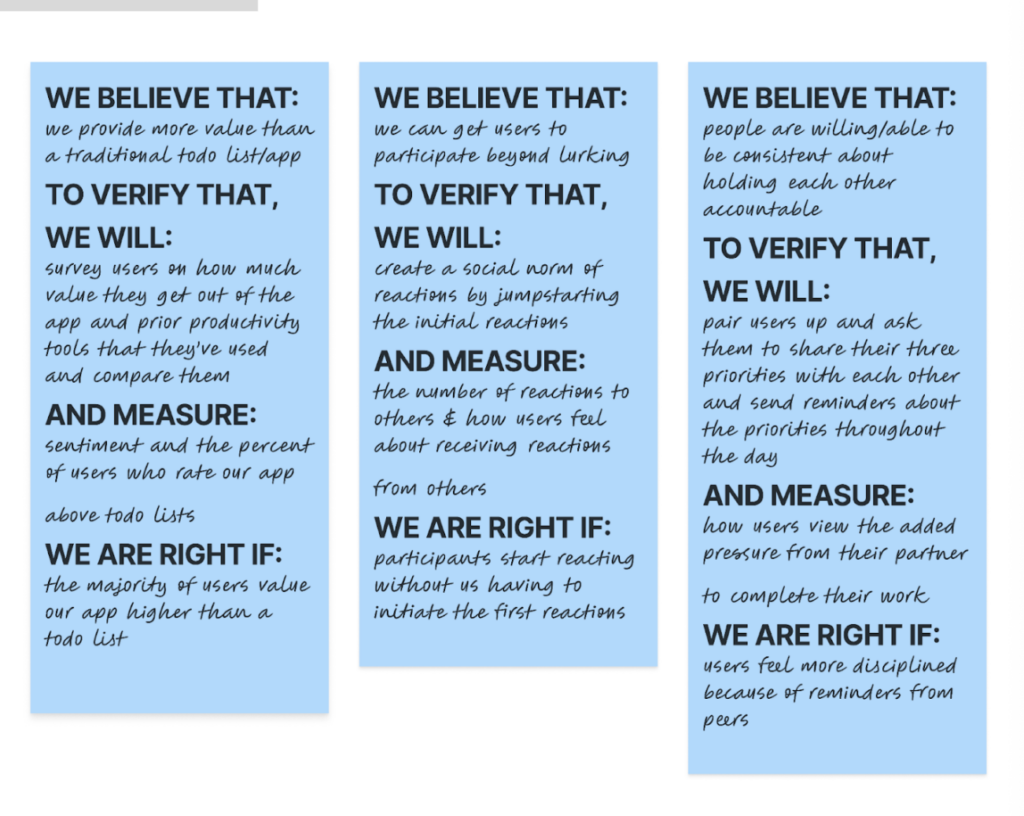
In creating our assumption map, we realized that while we were able to validate the novelty and effectiveness of our solution through the intervention study, we were not able to determine whether a simpler intervention (i.e. a three item todo list) would’ve garnered the same positive feedback from our participants. Thus, it’s our utmost priority to test the assumption that participants benefit more from our social-based solution than a stand-alone rudimentary todo list. Additionally, since our participants consisted of friends and strangers, to keep the study lightweight, we did not explicitly set the expectation that participants should hold each other accountable. Given the integral role of social pressure in our intervention, it’s critical for us to test this assumption. Lastly, with all social-based interventions, it’s difficult to get users to interact beyond simple lurking. While we did see some users react to each other’s updates, we do not have enough information to conclude the reason behind users’ lack of reactions. As the study ran over the weekend, some users were less active and productive than usual. It’s also possible that some users are just not on their phones enough to check in throughout the day and react. If this assumption fails, the social aspect of our app will suffer greatly and we’ll lose our competitive edge.
Assumption Tests