Team Rakali } Kalman, Konig, Navale, Wang, Xu | Screener and Baseline Study Outline
We went back and forth on several behaviors before deciding to study late-night eating behavior among undergraduates at Stanford. Eating late at night can have many side effects, such as sleeping troubles caused by bloating and indigestion, heartburn, and hormone imbalances. As Stanford students cramming for PSets, midterms, and interviews, eating late at night is unfortunately commonplace. While some people might adopt a “no pain, no gain” attitude toward the behavior — momentary discomfort for the sake of above-the curve performance on a MATH 51 test — the scientific consensus is that this habit is bad. For us students, it’s difficult to break.
Our screener is linked here. The screener should exclude potential participants who do not engage in the behavior or are ineligible, such as Stanford graduate students. We also seek participants who plan to break this habit to obtain high-quality data from which we can synthesize our findings. Participants must be willing to complete the 5-day study and to participate in a 30-minute screening interview. We also have a screener question about the participant having a diagnosed eating disorder (in Yes/No/Prefer not to answer format). At present, we include this question to identify edge cases and extreme users, but we are beginning to think this idea through and might reframe our use of people with eating disorders in our study.
Our diary entry form is linked here. The diary is being developed as a series of Google Forms, sent to each participant at the start of the n+1 day. So, the diary entry logged on Monday will be for late-night eating on Sunday. Questions will include “Did you eat any after-dinnertime food between 9 pm and 5 am the day before?” and “How did you feel before eating?” We are most interested in collecting data on participants’ feelings before and after eating to understand why they choose to engage in this habit. We want to know whether eating late at night because you’re stressed makes you feel worse in the morning, or whether eating after skipping dinner gives you the energy to stay awake and finish your assignments. Thus, we are less concerned with logistical data (when a participant eats) and more concerned with content data (why a participant eats). Most of the questions on our Google Form will be Yes/No answers, with a few content questions requiring a short text entry. We hypothesize that this low barrier to participation will make participants feel unencumbered by the questionnaire and thus more likely to stay in our five-day study.
We have a detailed data collection plan linked here. Our first phase is to design the project and iterate on it. Once completed, we’ll proceed to recruitment and pre-study interviews with potential participants before conducting our one-week behavioral tracking study. Following that, we’ll conduct exit interviews with participants to gain personal reflections on changes, experiences, and perceived impacts of the diary study. With those phases completed, we’ll have sufficient data for analysis and will be able to report our findings.
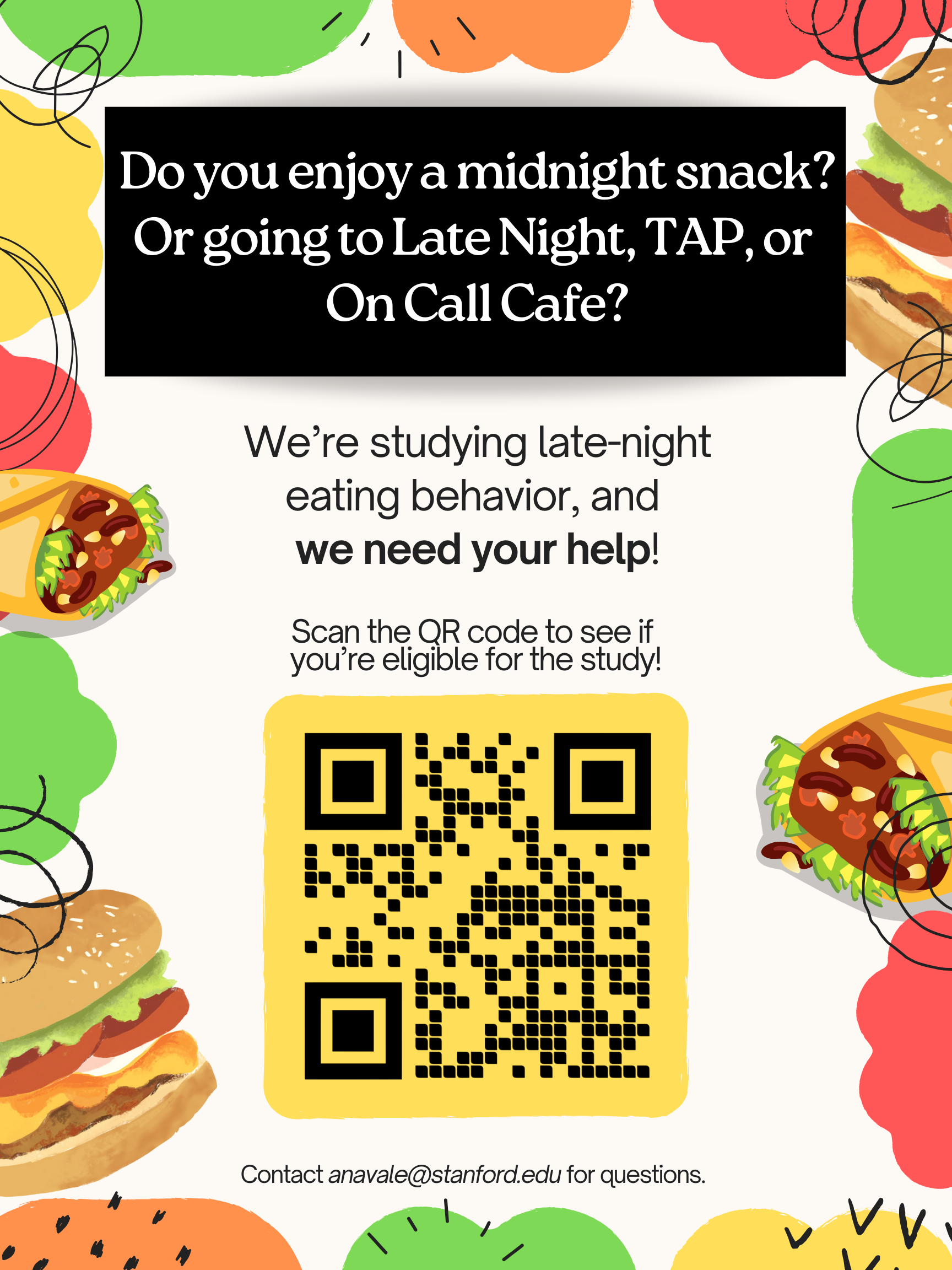
Additional supplemental materials for our study can be found here. Also, scan the QR code in the attached flyer to participate in our study!