Intervention Study:
For our intervention, we focused on the concept of a primary nudge and a backup nudge to increase language learning consistency. We specifically targeted new grads with full-time jobs who are learning a language as a hobby.
During the study, participants were reminded to practice right after work or after dinner (their fatigue window). The daily message contained a task to help them start practicing and if they didn’t respond to that, a shorter micro version of the task was sent as a back-up nudge. If users missed a day, there was also a re-entry message to get back into their routine guilt free: “If you missed yesterday, welcome back! Today’s goal is just to start”.
We used daily google form responses and post-study interviews to track the results. Here’s what we learned:
- Lowering Activation Energy: The 2-5 minute micro step provided a highly effective fallback for low-energy days by lowering the energy barrier for the users to get started. The clearly defined next step, reduced the decision fatigue that usually prevents them from starting.
- Breaking the Guilt Spiral: We also learned that guilt for falling out of routine was a significant barrier to restarting daily practice. By framing the return with “Welcome back! Today’s goal is just to start”, we tried to minimize avoidance behaviors and the guilt that typically leads users to abandon learning apps.
- Emotional Shifts: By asking about emotions before and after practice, we saw how practice helped users go from feeling tired or stressed to feeling accomplishment. The micro-tasks allowed practice to feel achievable even when energy was low.
This study demonstrated that our solution must prioritize targeted, low-friction initiation. Now that we know a clear, 2-5 minute step helps users start on tired days, our app’s core design will heavily feature these micro-entries. Furthermore, we won’t punish missed days and instead implement the non-punitive re-entry messaging we tested. Thus, when users inevitably miss a day, the app can help support their recovery rather than inducing a guilt spiral.
System Path:
We mapped out the different paths between our personas which included a wide range of professionals to hobbyists. To do this, we traced the mental and physical steps a user takes from receiving a trigger/nudge to completing a lesson. Mapping this out helped us realize that users have intermediate steps and decisions they go through before even practicing. Therefore, shortening this path to try to route the user directly from the external trigger to the learning interface in a single action would have a higher success rate.
Story map:
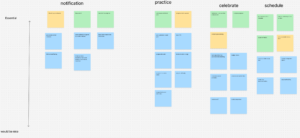
We charted the user’s journey from notification to practice to celebration to scheduling, and noticed a few things. For users who have busy and demanding schedules:
- Guilt is a Demotivator: The notification column revealed that we need to avoid using guilt as a motivator. Punishing a user for missing a day due to an unpredictable schedule causes them to abandon the app/routine.
- Friction Must Be Zero: In the practice column, we realized that users don’t want to browse for what to do next or think about it. We should just tell them what to do in small tasks so that they can squeeze in practice during a commute or between meetings.
- Flexibility Over Rigidity: Under schedule, we realized that advanced calendar integrations weren’t crucial to the functioning of the app. The core insight was that users prefer flexibility for when they practice rather than being bound to a daily timeslot that would get overwritten.
By analyzing the story map, we realized that rigid schedules create guilt and friction for users with unpredictable schedules. To solve this, we used a volume bar metaphor, so that users fluidly adjust their practice schedule. We also prioritized focusing on a streamlined home page, a flexible goal setting interface, and a forgiving progress tracker.
MVP Features:
Sketchy Screen Widgets:
- Log in button
- Log out button
- Progress tracker
- Progress tracker button
- Profile button
- Settings button
- Menu bar
- Messaging box
- Confirm purchase?
- Logo to go home
Key Screens:
- Log in
- Home page
- Progress tracker
- Lessons
- Goal setting
- Settings
- Language selection
Metaphors:
- Volume bar (representing manageable, adjustable effort levels rather than an all-or-nothing approach)
Bubble Map:

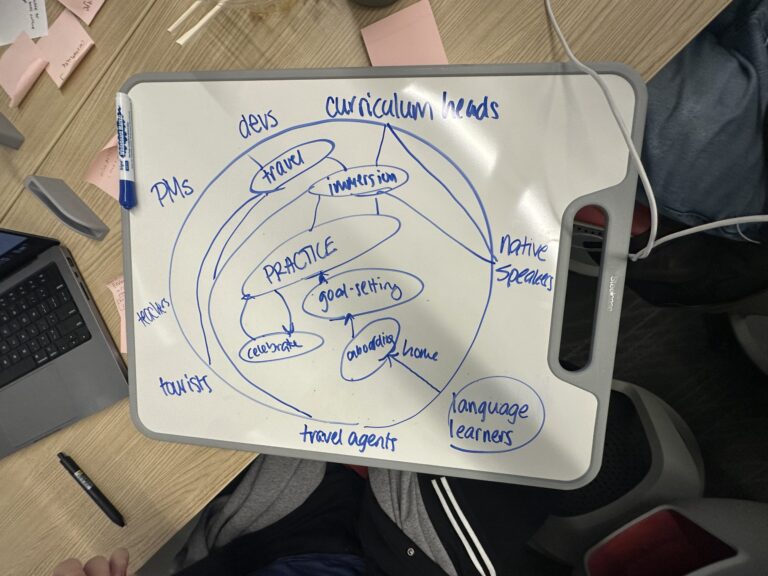
Mapping the system into two layers really helped us see where the real points are in our solution. We realized that content is not the bottleneck. There is already strong evidence that people want to learn languages and may have access to high-quality tools. The core issue is not supply but their behavior.
Our biggest risks are around activation and re-entry. The most crucial assumptions are that reducing activation energy will hopefully increase consistency, that a two-minute start can get around avoidance, and that non-judgmental re-entry is more effective than the pressure streaks can cause. These are high-importance design assumptions that our intervention study began to support.
The bubble map also clarified that reinforcement mechanisms such as streaks are not the center of our system as activation mechanisms are closer to the core. Meaning and identity should sit above practice. Notifications and personalization support behavior, but they cannot compensate for the friction at the moment of starting practice. Visually separating the User Behavior Layer from the System and Adaptive Layer made this distinction explicit.
This exercise helped us shift our focus. Instead of asking, “What features should a language app include?” we now need to test, “Can we consistently lower the barrier to starting, especially on low-energy days, and does that compound over time?” Overall, the bubble map clarified what truly drives our solution and what is secondary. It helped us prioritize activation and re-entry as the core of our behavioral architecture, rather than treating them as minor features within a larger learning tool.
Assumption Map & Tests:
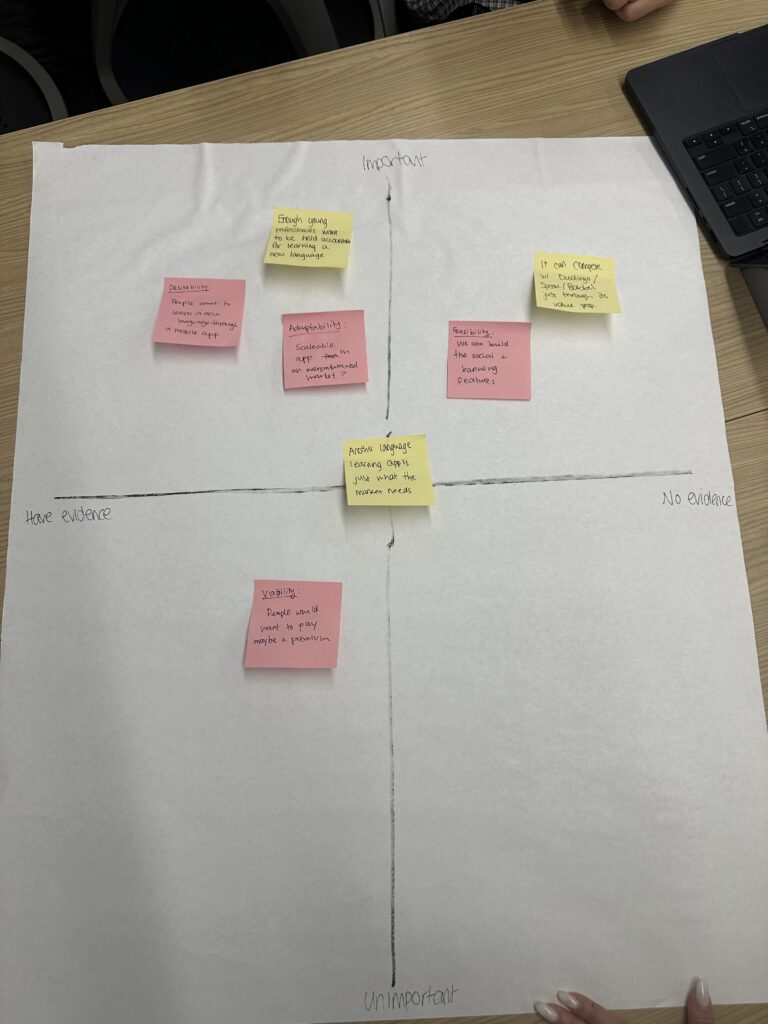
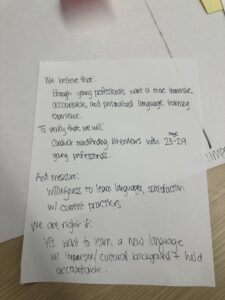
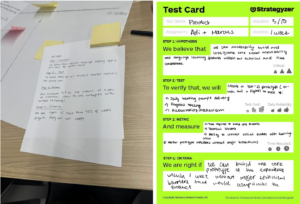
Mapping our assumptions helped us see the most crucial risks. We realized that language learning is in high demand and that there’s plenty of evidence people want to use mobile apps to learn languages. However, these risks we thought of haven’t been researched yet.
Most crucial assumptions:
- Young professionals actually want social accountability when learning.
- Our value proposition can compete with established apps like Duolingo.
- The market needs another language app at all.
These are the high-importance assumptions that we don’t yet have strong evidence for. Overall, the assumption map clarified what we need to validate next and where to focus our research efforts.