
In 2008, BuzzFeed was five people raising a Series A. Peretti later said nearly every investor rejected this deck, and going through it slide by slide, I can see why.
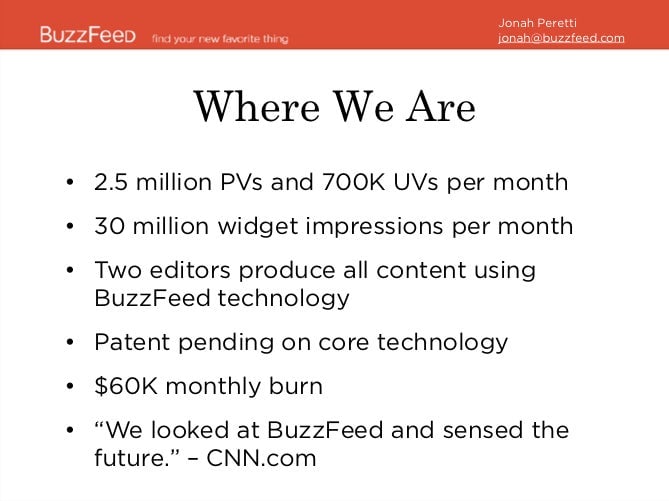
The deck never states a problem. It opens with traction bullets, so the problem is only implied: publishers can’t tell what’s spreading online, and advertisers can’t get people to share their content. That traction is the strongest evidence in the deck, and it comes right after the cover. The next several slides are screenshots of the viral-detection tech and “spotters,” which are hard to decode without Peretti there to explain them.
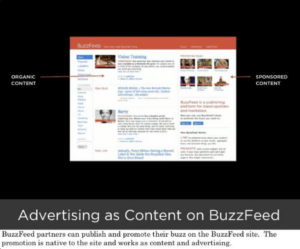
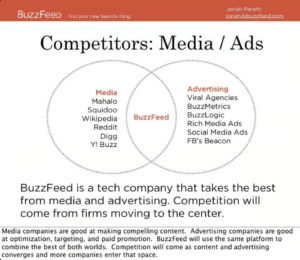
Instead of sizing the market, the deck offers a thesis: ads and editorial are converging into “advertising as content,” with Google sponsored links and YouTube promoted videos as proof. A Venn diagram then places BuzzFeed between media companies and ad companies.
An investor would still have big questions. How large is the ad market BuzzFeed is going after, in dollars? What does the patent-pending algorithm actually do, and why couldn’t a bigger publisher copy it? And what would the $3.5M actually pay for?
For our Sanity Check pitch on how PMs spend too much time assembling trustworthy context, I’m stealing two things: putting our interview evidence early, and using a Venn diagram to show where we sit between existing tools. What I’m not stealing is skipping the problem slide. BuzzFeed could get away with it because Peretti was in the room to explain; our deck needs to make sense on its own.



