Value Prop:
What we promise: An AI assistant for virtual meetings that creates agendas, facilitates meetings, and allows for live chat.
To whom: PMs running cross-functional meetings.
Why it beats today: Existing tools (Otter, Granola, Zoom AI) only transcribe and summarize. We offer a shared roadmap that maps the meeting live and keeps everyone aligned in the moment. No competitor offers in-meeting facilitation and agenda-mapping.
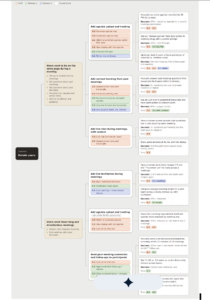
Opportunity Solution Tree
Smoke Test Design and Results
Our smoke test design priced Flipper at $25/user/month for medium-sized teams. This price positions Flipper above Otter.ai’s $19.99/user/month package and Granola.ai’s $14/user/month package for similar sized teams, reflecting its additional live guidance and roadmap features. Assuming subreddit traffic remains constant each day, we shared Flipper with approximately 1429 PMs (calculated from 10K weekly visitors) by posting our smoke test on product and alpha/beta testing subreddits for a day. We also set a threshold of 30% of page viewers clicking the sign up button and 20% of page viewers entering their email to join the waitlist as sufficient evidence of demand.
Extra Credit (Smoke Test Results): Dawson wrote a crawler guard so bot traffic returns 403, so we can differentiate between bot versus human traffic on our page by removing the 4XX requests.
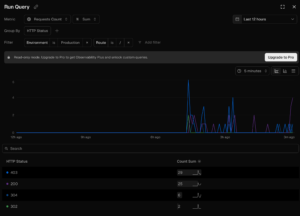
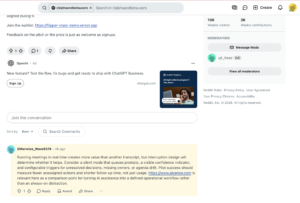
In the detailed view, we see that ~31 requests were served, each representing a unique site visit. We also received stakeholder feedback from a subreddit about including a silent mode, confidence indicators, and triggers for unresolved decisions during meetings in our design.

Story Map with MVP Line:
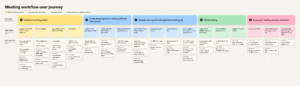

Top user stories:
- “As a PM running a cross-functional meeting, I want to see a live roadmap of the agenda, so that I can tell at a glance whether we’re on track.”
- “As a meeting attendee, I want a visual signal when the conversation drifts, so that the group can refocus without someone having to awkwardly interrupt.”
- “As a PM, I want to upload project docs before the meeting, so that the assistant has real context and doesn’t give confidently wrong suggestions.”
What we plan on changing: Building our opportunity-solution tree and story map made us realize how many features we were trying to tackle at once. We’re narrowing our initial MVP to shared agendas, action-item tracking, and post-meeting summaries, while saving more complex features like live AI facilitation and contextual chat for later. We want to test whether these core features actually make meetings more productive before expanding.
Our connection to the reading: We applied Patton’s idea of mapping the entire user journey rather than just listing features (Chapter 1) by organizing our story map around what users do before, during, and after meetings. His emphasis on building less and identifying an MVP (Chapter 2) also guided how we’re narrowing our initial feature set.