Team 12 Participatory Roadmap Test
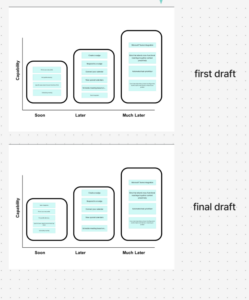
The five of us ran a P-roadmap session together in section. As for the main notes, we first received hesitancy about Slack integration being one of our “Now” tasks. We also received feedback that the nudge could be moved up into “Now” and that we could prioritize calendar syncing. But overall, the feedback from the other team was positive; they claimed that “they wouldn’t change anything.”
For our individual tests, some PMs had questions on our class timeline and the extent of our prototype, but most generally agreed with our takes, given that we were vibe coding the prototype. One participant pushed us to think about how new members get onboarded: which Slack channels matter, and how profiles could reflect someone’s team and past projects. Another participant brought up friction around edge cases, such as users without a LinkedIn profile, how we will encourage “lazy” users to fill out a profile sufficiently, and users who want to opt out entirely.
As for our changes, we decided we could push off Slack integration to a “Later” task. At the very least, we do want to mock up what it could look like as an integration, because a core value of our product is being seamlessly integrated into existing workflows. We also received more urgency on the “nudge” task, as some folks mentioned their next move would be to ping someone after meetings, so we will prioritize that within our “Later” tasks.
Appendix:
Yujen’s Second Participatory Roadmap Notes:
- The PM that I talked to thought that our goals make sense in the order we want to do them, which made me feel pretty validated. They however, advised us to think more about how we onboard new members, thinking about what channels would be important in slack, or to make this information available as ways to continue highlighting their team specification and as data to indicate what projects they have worked on.
- My second PM was suggesting that we should first provide access to the bot to calendar systems/other platforms before having the ability to adjust the data that will be stored. But overall, they believed our chronological map of how we were going to do things was good.
Alexis’ Second Participatory Roadmap Notes:
- The goals are good and realistic, and wouldn’t change much for the purpose of class.
- They wanted to know how functional our prototype would be and to consider edge cases, like if someone doesn’t have a Linkedin profile or wants to opt out.
Sifat’s’ Second Participatory Roadmap Notes:
- The PM I talked to expressed interest in “Much Later” tasks, but acknowledged time constraints. They wondered if we could move task prioritizer to “Later,” since we’re just creating a prototype.
- Overall, I agreed with our roadmap.
Esha’s Second Participatory Roadmap Notes:
- Nhu (PM) mentioned to shrink the Soon version to something honest, like “request a meeting” that sends a message or a Calendly-style link, and keep real availability-based scheduling in “Later”, so she agreed with our timeline.
- She said it seemed like the Nudge is core to our product, so we are considering moving it up.
- She was initially confused by Slack integration and how our prototype could mimic this integration soon.
Erica’s Second Participatory Roadmap Notes:
- Create a nudge and Respond to a nudge: Later -> Soon. (“The directory is nice, but the moment I find the right person, my next move is to ping them. If I have to leave the app to do that, I’ll just stay in Slack.”)
- Cross-team dependency tracker: Much Later -> Later. They described spending a week blocked on another team without knowing who owned the API.
- Suggested: “Last active / response time” on profiles, so you know whether a POC will actually reply.