This week we built a clickable prototype of Roadmap Decision Brief, put it online, and ran participatory roadmap sessions with 12 B2B PMs to test whether our MVP line is in the right place. The short answer: PMs care most about defending a recommendation, not producing a polished document, so our MVP shrinks around source checking and conflicting evidence.
The prototype
Try it: Roadmap Decision Brief prototype
The prototype covers the full workflow from last week’s story map, using a realistic sample decision: should a team building a task-management app add a Slack integration or a mobile app next quarter? A PM can walk through four steps:
- Frame the decision. Enter the roadmap question, the options, the constraints, and who the review is for.
- Check materials. See seven uploaded files with their status. One upload fails and can be retried. One file is a duplicate of the interview notes and is flagged so the PM can exclude it.
- Draft and verify. The generated brief is organized into background, evidence for each option, conflicts and gaps, and constraints. Every claim shows its source IDs. Clicking a claim opens the exact source passage. Claims are flagged when they are unsupported, outdated, thin, or in conflict with other evidence. The PM can attach evidence, edit a claim, move it to open questions, or remove it. An edited claim is marked for a source re-check until the PM confirms it.
- Preview and export. The brief shows references and open questions, warns about anything still flagged, and copies out as Markdown.
The sample materials were chosen to exercise each story: a 2025 decision memo that contradicts this year’s customer requests, an error rate from last year’s data, a competitor claim with no source, and a churn reason that rests on one support lead’s impression. Excluding a file in step 2 changes the draft: any claim that relied only on that file becomes unsupported.
The prototype does not call an AI model. The draft is pre-written for the sample decision so participants can react to the workflow rather than to output quality. Files a visitor adds are listed but not analyzed.
How we ran the participatory roadmap
We followed the method from the reading: show the product, then ask customers to prioritize features under a hard constraint. Each session ran in this order:
- Context questions about how they prepare for roadmap reviews today and what goes wrong.
- Prototype walkthrough so the feature cards had a concrete reference.
- Roadmap board. Nineteen feature cards drawn from our story map, sorted into Soon, Later, and Much later. Soon started with the six features we believed were the core: upload materials, generate a draft, open the source behind a claim, flag unsupported and outdated claims, edit and add a recommendation, and export with references.
- Trading. Soon held six cards. To move a card in, the participant had to move one out. They could write new cards, and the same rule applied. After every move we asked why and wrote down their words.
- Stack rank and price. Participants ranked the Soon column, then we asked whether they would pay for just those six features and how much. Every participant finished with exactly six cards in Soon.
- Limitations. We named what we are not building first (integrations, collaboration, version history) and asked whether that would stop them from using it.
We ran the board in a shared web tool so all four of us used the same starting arrangement and saved each session in one place. Participants were B2B PMs who prepare roadmap reviews; we excluded classmates, since Professor Wodtke warns that non-target users produce false negatives.
| # | Role | Company type | Facilitator | Would pay for Soon set | Price named |
|---|---|---|---|---|---|
| 1 | Senior Product Manager | Mid-size B2B SaaS | Sophia | Yes | $20/mo |
| 2 | Product Manager | Early-stage productivity startup | Sathmi | Maybe | $10/mo |
| 3 | Group Product Manager | Enterprise software | Raza | Yes | $30/mo |
| 4 | Product Manager | B2B fintech startup | Romir | Yes | $15/mo |
| 5 | Senior Product Manager | Developer tools company | Sophia | Yes | $25/mo |
| 6 | Product Lead | Series B SaaS startup | Sathmi | Maybe | $15/mo |
| 7 | Product Manager | Enterprise HR software | Raza | No | $0 |
| 8 | Director of Product | Mid-size B2B SaaS | Romir | Yes | $25/mo |
| 9 | Senior Product Manager | B2B healthcare SaaS | Sophia | Yes | $25/mo |
| 10 | Product Manager | Series A AI productivity startup | Sathmi | Maybe | $12/mo |
| 11 | Group Product Manager | Enterprise cybersecurity software | Raza | Yes | $30/mo |
| 12 | Director of Product | B2B analytics platform | Romir | Yes | $35/mo |
What we learned from 12 sessions
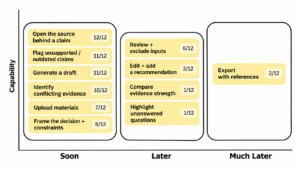
Source checking stayed in Soon for all 12 PMs, while export dropped out in 10 of 12. Participants consistently valued being able to defend a recommendation over producing a polished document.
| Feature | We started it in | Ended in Soon | Avg rank in Soon (sessions 1–8) |
|---|---|---|---|
| Open the source behind a claim | Soon | 12/12 | 1.9 |
| Flag unsupported or outdated claims | Soon | 11/12 | 2.6 |
| Generate a draft | Soon | 11/12 | 3.0 |
| Identify conflicting evidence | Later | 10/12 | 3.2 |
| Frame the decision and constraints | Later | 8/12 | 3.4 |
| Upload materials | Soon | 7/12 | 3.8 |
| Review and exclude inputs | Later | 6/12 | 4.3 |
| Edit and add a recommendation | Soon | 3/12 | 4.7 |
| Export with references | Soon | 2/12 | 5.0 |
| Compare evidence strength (new, P5) | — | 1/12 | — |
| Highlight unanswered questions (new, P12) | — | 1/12 | — |
What held. Opening the source behind a claim stayed in Soon for all twelve participants, followed by flagging unsupported or outdated claims (11/12) and generating a draft (11/12). As P1 put it, “I don’t need another document generator. I need to know which evidence I can actually defend.” This confirmed our assumption that traceability is central to the product’s value.
What moved out. Ten of twelve participants removed export with references, and nine removed editing the recommendation. Several said they already use Notion or Google Docs for the final write-up. P6: “We already have Notion for the final write-up. I care more about getting to a defensible answer.” Our original MVP put too much weight on the final document.
What moved in. Ten participants pulled in identifying conflicting evidence, eight pulled in decision framing, and six pulled in reviewing inputs. PMs wanted to see where sources disagree before committing to a recommendation. P5: “Showing me two sources that disagree is more valuable than giving me a confident-sounding summary.”
| # | Moved in | Moved out | In their words |
|---|---|---|---|
| 1 | Conflicting evidence | Export | “I don’t need another document generator. I need to know which evidence I can actually defend.” |
| 2 | Decision framing | Recommendation editing | “If I don’t define the decision properly at the start, the rest of the brief isn’t that useful.” |
| 3 | Conflicting evidence, input review | Export, editing | “The hard part isn’t writing the recommendation. It’s explaining why we’re choosing one thing over another.” |
| 4 | Input review | Export | “I would want to know if I’m accidentally using an old metric before this goes to leadership.” |
| 5 | Conflicting evidence | Editing | “Showing me two sources that disagree is more valuable than giving me a confident-sounding summary.” |
| 6 | Decision framing | Export | “We already have Notion for the final write-up. I care more about getting to a defensible answer.” |
| 7 | Input review | Editing | “I need to trust what’s going into the brief before I trust what’s coming out.” |
| 8 | Conflicting evidence | Export | “The source links would save me a lot of back-and-forth before a roadmap review.” |
| 9 | Conflicting evidence, input review | Export, editing | “If two sources are telling me different things, I need to see that before I take a recommendation to leadership. A polished brief doesn’t help if the evidence is wrong.” |
| 10 | Decision framing, conflicting evidence | Editing, export | “I’m usually trying to make a roadmap call quickly. I want the tool to help me structure the tradeoff, not make me spend another hour reviewing a document.” |
| 11 | Conflicting evidence, input review | Editing, export | “When someone challenges a roadmap decision, I need to trace the reasoning back to the original evidence. That’s what would make this worth using.” |
| 12 | Conflicting evidence, unanswered questions (new card) | Export, editing | “The value isn’t getting a recommendation written faster. It’s being able to explain what supports it, what contradicts it, and what we’re still uncertain about.” |
New cards participants wrote. Eight new ideas came up. Only P5 and P12 traded theirs into Soon. The others were seen as useful later, once the core decision workflow works.
| Participant | New card | Traded into Soon? |
|---|---|---|
| P3 | Share a read-only brief with stakeholders | No |
| P4 | Show when a source was last updated | No |
| P5 | Compare evidence strength across options | Yes, replacing a lower-priority feature |
| P8 | Customize the brief for executives | No |
| P9 | Show a confidence indicator for each claim | No, secondary to direct source checking |
| P10 | Save reusable decision templates | No, core workflow first |
| P11 | Track changes to evidence between roadmap reviews | No, matters for repeat use, not the first decision |
| P12 | Highlight unanswered questions before finalizing a brief | Yes, replacing recommendation editing |
Their language. PMs talked about “defending a decision,” “checking where a number came from,” and “getting to a defensible answer.” We had been describing the product as generating a decision brief. Their words suggest positioning it around confidence and accountability rather than writing speed.
Would they pay? Eight of twelve said yes, three said maybe, and one said no. Prices from the yes and maybe participants ranged from $10 to $35 a month, and all eight firm yeses named $15 or more. Our $15/month smoke-test price sits inside that range, though saying yes in an interview is not the same as paying.
Where PMs disagreed. Enterprise PMs emphasized traceability and evidence quality, while startup PMs cared more about reaching a usable recommendation quickly. P10 put the startup view plainly: they want help structuring the tradeoff, not another hour reviewing a document. Both groups valued verifying evidence, which suggests our target market may be broad but the underlying problem is shared.
What we’re changing
- The MVP line. Above the line: uploading materials, opening source passages, flagging unreliable claims, generating drafts, identifying conflicting evidence, and framing the decision. Export formatting and recommendation editing move below it.
- The prototype. The next version will make conflicting evidence more visible and let PMs compare the evidence behind each option, building on P5’s card. Decision framing will capture constraints before PMs review materials.
- Pricing and the smoke test. We are keeping $15/month for the smoke test rather than raising it on the strength of twelve interviews.
- The test itself. Our story map put 12 features above the MVP line, and the board allowed six. The sessions showed our MVP was too broad around exporting and editing, and too thin on conflicting evidence. The exercise narrowed it to what makes the product distinctive: making roadmap recommendations defensible.
One idea from the reading we used
Professor Wodtke writes that customers “aren’t designing your product for you, they are revealing their thinking.” So we recorded why each card moved instead of only counting where it landed. That mattered most for export. PMs who removed it weren’t saying the final document doesn’t matter. They already have tools for it. What they lack is a reliable way to verify the evidence behind a recommendation, and that is the problem we should solve first.