Assumption Map:
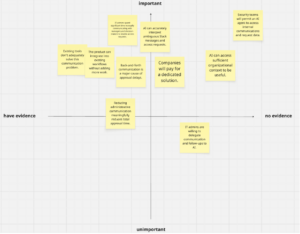
Three test cards:
Test Card 1: Willingness to delegate to AI
Hypothesis
IT administrators are willing to delegate communication and follow-ups with access approvers to AI.
Test
Show 5–10 IT administrators a prototype demonstrating AI-generated Slack messages, automated follow-ups, and interpretation of approver responses. Ask them to choose which actions they would allow AI to perform autonomously versus requiring human approval.
Metric
Percentage of participants willing to enable AI-managed communication.
Success criteria
At least 70% are willing to delegate routine clarification and follow-up messages with appropriate safeguards.
Test Card 2: Willingness to pay
Hypothesis
Companies are willing to pay for an AI solution that reduces manual access-approval coordination.
Test
Show IT managers or budget owners a landing page with the product’s capabilities and a proposed monthly subscription price. Offer an opportunity to request a paid pilot, and conduct follow-up interviews to assess purchasing intent.
Metric
Percentage of qualified buyers requesting a priced pilot.
Success criteria
At least 20% of qualified buyers request a priced pilot, with at least two agreeing to a concrete next step.
Test Card 3: Seamless integration into existing workflows
Hypothesis
The AI copilot can integrate into existing IT workflows without creating additional administrative burden.
Test
Give 5 IT administrators a simulated access request. Have them complete the workflow using their existing process and then using a clickable prototype integrated into a mock Slack and ticketing environment.
Metric
Time and number of manual actions required to process a request.
Success criteria
At least 30% reduction in active administrative time, with no increase in manual steps or security-policy violations.
Test for Test Card 2:
v0 Prototype:
https://cs177-doorman.vercel.app/
Participant 1 – Network Manager at Private High School in the Bay Area
In his current job, doing a lot of stuff with AI, but the school doesn’t assign privileges that often. They have ready set profiles and not a lot changes. In the use case of software development, he can see its value. If he were working in software development environment, he would be curious about it. They would want a 14 day demo, and be 100% sure that the product would not make any changes without approval because if it did it could screw up the entire business. Most people will Google what else is out there, so if it’s way more expensive than the competition, we would lose customers. He suggests naming your customer, and doing a little market research. How do we get Mark Zuckerberg to buy this? Put a price on it. Meet or beat competition price point.
Reading takeaway and application:
Christensen, Raynor, & McDonald in “What Is Disruptive Innovation?” defined their theory of disruptive innovation as a smaller company with fewer resources being able to successfully challenge established incumbent businesses through first focusing on overlooked segments of the market and then shifting to the mainstream as their product improves. We’ve previously used this theory to find the competitive gap, which is PMs being overlooked and losing time because they don’t receive the same priority as engineers for tool access. In this assignment, we used disruption theory when considering that existing tools don’t adequately solve this back-and-forth communication problem between IT admin and managers & decision makers, as this is an overlooked segment of the market that can lead to success, but we still needed to check our assumption that it exists and is desirable to IT admin. However, we are also cautious of disruption theory since Jill Lepore in “The Disruption Machine” showed that Christensen cherry picked case studies, defined success arbitrarily in his original research as any company that achieved more than fifty million dollars in revenue between 1977 and 1989 even if they later withdrew from the market, and created a $3.8 million fund in the year 2000 based on disruption theory that failed within a year.