
Study Dates: 1/8/26 – 1/12/26
Goal: Spend less than $25 on outside meals and sweet treats
Rate of Measurement: Check spending once a day
Data
- Thursday, January 8th:
- Daily Total: $8.98
- Late Night Pizookie: $0.99
- Late Night Chicken Tenders: $7.97
- Daily Total: $8.98
- Friday, January 9th:
- Daily Total: $28
- Split $200 bill for KFC and drinks with friends: $28
- Daily Total: $28
- Saturday, January 10th:
- Daily Total: $10.64
- Doordashed chipotle with friends
- Daily Total: $10.64
- Sunday, January 11th:
- Daily Total: $0.00
- Monday, January 12th:
- Daily Total: $0.00
Motivation
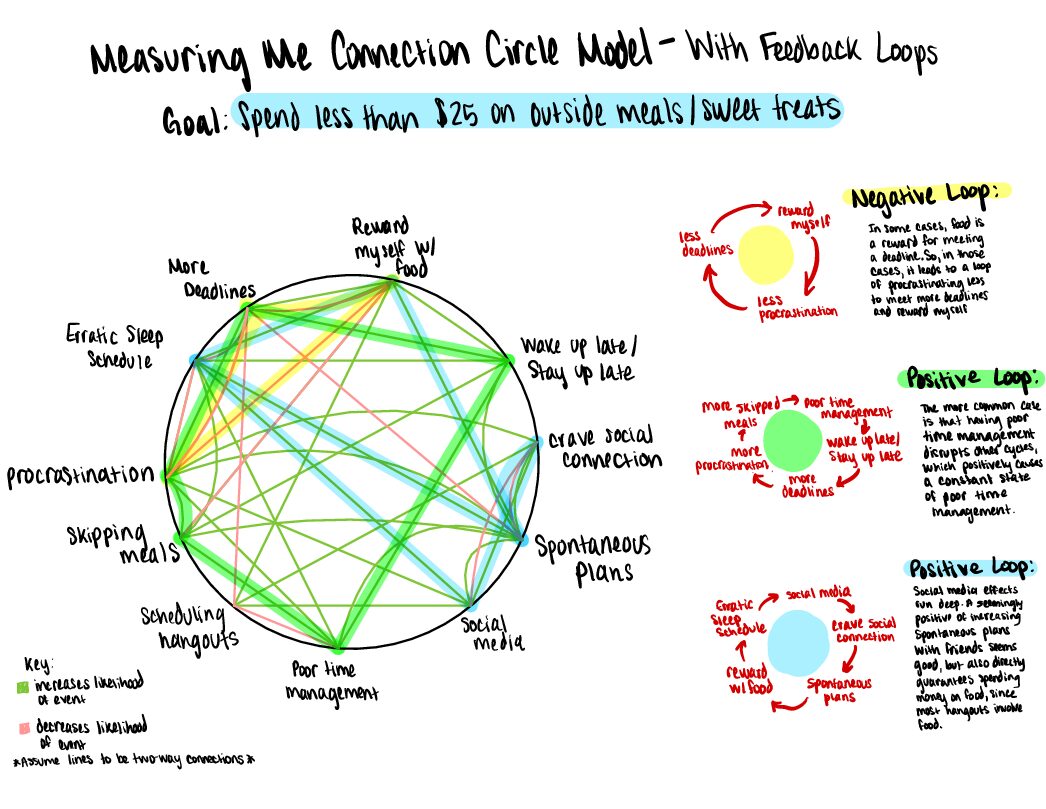
Since I am on a meal plan, and last quarter I spent hundreds of dollars Doordashing, I wanted to measure my spending in a regular weekend to gauge how serious of a problem this was for both financial and health reasons. Prior to my measurement, I had hypothesized that much of my spending comes from an extreme lack of social connection or an extreme spontaneity of it. Specifically, I noticed that when I do not make plans with someone to eat at a dining hall, or my regular dining hall is too far from my current location, I choose to skip meals. And of course, without fail, I come to regret this choice at 9pm as I battle a lethal craving while I am studying. On the other hand, it only takes one DM or text from a friend to convince me to go for a sweet treat or eat off campus. In my head, money spent on a meal with a friend is always well spent. Hence, this opposing dynamic had me intrigued to measure it a little further.
Experience
Thanks to the rate of measurement I chose, it was easy to forget that I was conducting a study on myself. I think this allowed me to collect very repeatable results. However, at the end of the day when I would log my spendings, I certainly felt shame and guilt for having done it. The log only further solidified my awareness of my lack of self-control when it comes to food cravings. Furthermore, most of my hypotheses were observed. First, a spontaneous trip to late night with some friends I ran into led to nearly $10 of spending. Second, my spending on ordering food with friends felt justified because it guaranteed a few hours of social connection. And thirdly, my spendings on Doordash came about from having skipped a few meals. But apart from those predictions, there were a few other connections I was able to draw. One, a lot of the impulse spending came as a result of nightly activities, which leads me to believe that lack of accessibility and hunger do not make a great combination for satisfying midnight cravings without money. Second, I notice that all of my justifications came about the feeling of deserving a reward. “I haven’t eaten today and lowered my calorie intake, so I can order this meal” or “I have worked hard all week, so I deserve a nice hangout with friends.” All these observations have led me to conclude that impulsive spending, like all other behaviors, are directly linked to the spontaneity and accessibility to the means of a behavior.
Takeaways for next time
Additionally, after a few days of measurement, I started thinking to myself when I would make a purchase that it would certainly have to be logged later, which was followed by a feeling of embarrassment. This made me wonder if maybe this type of study would motivate me to continue to limit my spendings. On the other hand, I think by giving yourself a numerical limit, it permits your mind to overly exceed the maximum once it is slightly over it. Hence, maybe it wouldn’t be as productive. Overall, though, these observations lead me to believe that if I wanted to measure more accurate spending, a lengthier rate of measurement would improve data collection. On the other hand, though, if I wanted to change someone’s behavior, daily awareness of spending certainly has an impact on the mind (both negative and positive).
Models
To reflect all these findings visually, I drew two models attempting to draw the connections between causes, effects, and feedback loops.



