
Description of Habit and Tracking Methodology
Since starting college, I have often felt that there is too much to do and too little time. In response, I have developed a habit of multitasking: doing textbook readings while eating, organizing my schedule during class, organizing my schedule while in class, or even replying to text messages while at a red light. While multitasking can feel emotionally comforting, creating the illusion that I am “moving efficiently” by compressing multiple activities into the same time window, I am aware, as a psychology student, that multitasking is ineffective. The brain does not truly perform multiple tasks simultaneously; rather, it rapidly switches between tasks, leading to attention fragmentation and reduced efficiency and quality. Despite knowing this rationally, multitasking has become habitual, and I often find myself engaging in it automatically.
Given this tension between knowledge and behavior, I chose to track the habit of multitasking over a three-day period. Because multitasking often occurs briefly and subconsciously, I used a combination of methods to capture it more comprehensively:
-
Momentary sampling: At 30-minute intervals, I set an alarm and recorded what I was doing at that moment and noted whether I was engaging in more than one activity simultaneously. This served as a regular prompt to check for subconscious behavior.
-
Retrospective reflection: At each 30-minute interval, I also reflected on the previous 30 minutes to identify any multitasking that may not have been present in the moment.
-
Event-based logging: Whenever I noticed myself multitasking outside of the scheduled intervals, I logged the behavior immediately to capture more conscious instances.
Logged Habit Incidents
Day 1
- 7:00am: replying to messages while brushing teeth
- 7:30am: eating breakfast while doing class reading
- 1:15pm: eating while driving to class
- 4:00pm: editing a newsletter (for my part-time job) during a lecture
- 7:30pm: replying to messages while at the gym
Day 2
- 4:30pm: waiting at red light while checking phone (Measuring Me alarm went off)
- 6:00pm: doing class reading while snacking
- 9:00pm: filling out the Measuring Me table while stopped at a red light
Day 3
- 7:00am: brushing teeth while texting and setting up the Measuring Me table
- 7:30am: eating breakfast while scrolling on my phone
- 10:47am: texting while stopped at a red light
- 11:00am: filling out the Measuring Me table while waiting in a checkout line
Key Learnings and Insights
Learning #1: Multitasking increases on busier days
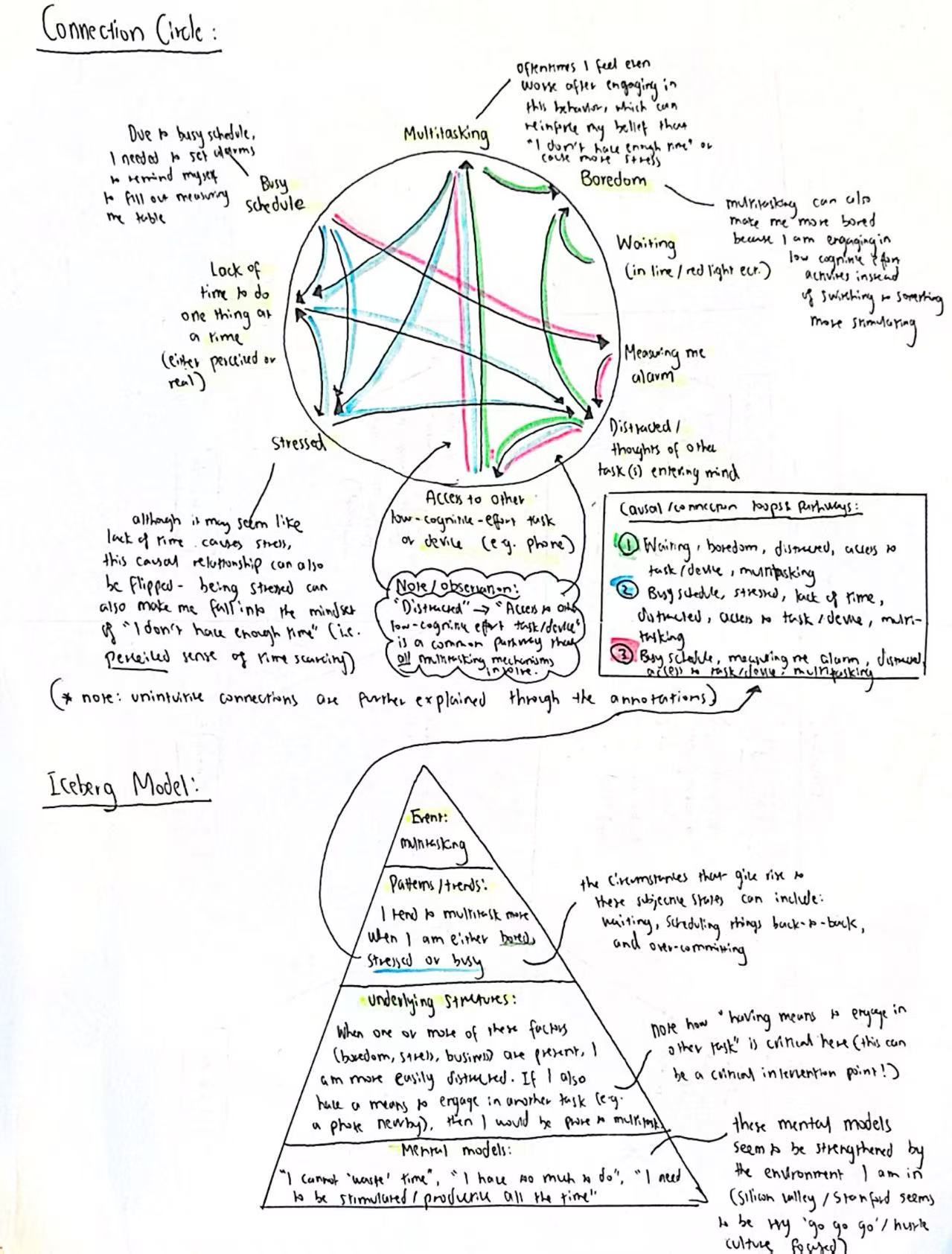
Day 1 had the highest number of multitasking incidents and was also the most packed day of my week. One interpretation is that on busy days, I experience heightened time pressure and am more likely to multitask due to the belief that “there isn’t enough time.” In some cases, this belief may be justified—for example, eating while driving was a way to avoid skipping lunch entirely. A second interpretation is that higher cognitive load on busy days leaves fewer resources available for self-regulation, making it easier to default to habitual behaviors even when I know they are ineffective. This learning is reflected in the busy schedule-> stressed-> lack of time -> distracted -> access to device -> multitasking causal pathway in the connection circle.
Learning #2: Multitasking tends to involve low cognitive-load activities.
All recorded instances involved relatively simple tasks (e.g., texting, eating, waiting, filling out the table). I did not multitask during cognitively demanding activities such as writing an essay or completing a problem set. Even the most high load activity: “editing newsletter during a lecture” required minimal cognitive effort on both fronts: the newsletter task involved only checking for consistency and grammar, and the lecture content was easy to follow despite briefly missing portions. Again, there are two possible interpretations for this pattern of engaging with multitasking only during “easier” tasks: multitasking may emerge either due to a) boredom during low-demand tasks or b) from the fact that I am only capable of splitting attention when neither task requires sustained focus, or a combination of both factors. This learning is reflected in the waiting -> boredom -> distracted -> access to device -> multitasking causal pathway.
Learning #3: Tracking itself altered my behavior of multitasking.
Several multitasking incidents involved filling out the Measuring Me table itself. For example, when an alarm went off at a red light, it prompted me to engage with my phone, which then led to additional behaviors (opening apps, logging data). This raises the possibility that some multitasking behaviors were partially induced by the measurement process. Because logging the table is a low-effort task, it became an easy activity to layer onto other moments, reinforcing the very behavior I was attempting to measure. Also because I needed to track my behavior, I needed to have my phone with me almost all the time, which reinforced another critical node in the connection circle: “having access to other task or device (i.e. phone)”.
Overall Reflections and What I Would Do Differently
Overall, this exercise helped me better understand when, how, and potentially why I engage in multitasking. However, the design also introduced limitations- most notably, the alarms on my phone may have functioned as extraneous variables that increased multitasking rather than simply capturing it.
If I were to repeat this experiment, I would eliminate the timed alarms and rely more heavily on structured retrospective recall. Instead of using fixed time-based sampling, I would adopt an activity-based logging approach, recording data after completing discrete activities (e.g., after finishing a meal, attending a lectures, or completing a drive) and reflecting on whether multitasking occurred during each. While this approach may reduce data density and introduce some recall bias, it would likely minimize measurement-induced behavior change.
Additionally, I would experiment with logging incidents on a notepad rather than on my phone. This would reduce the need to open my phone, an action that often triggers additional distractions which invites multitasking, and help interrupt the “distraction / thoughts of other tasks entering the mind” node in the behavior loop. Given that multitasking is itself a low-cognitive-load behavior, alarms and phone-based logging are particularly likely to interfere with the behavior being measured. For this reason, these design changes feel appropriate for improving measurement validity, despite potential tradeoffs in convenience or logging intensity.
Footer: By Jasmine Xu, 12th Jan 2026, Writeup: Measuring Me Take 2



