
Breaking Down My TikTok Doomscrolling Habit
And I just swiped and laughed and swiped again.
The same thing I do over and over again, usually for about two to three hours at a time, instead of actually working.
TikTok doomscrolling.
The behavior I chose to examine was my excessive TikTok usage, specifically the kind that happens when I’m supposed to be working, resting, or getting ready to sleep. TikTok has slowly become my default response to boredom, stress, or avoidance, often without me even realizing it. My moment of realization over the weekend when I was supposed to do work, is what pushed me to study this habit more intentionally.
Measuring My Behavior
I tracked my TikTok usage over two days, focusing less on exact screen time and more on when and why the behavior occurred. Each time I opened TikTok, I noted:
- The time of day
- What I was doing right before
- How I was feeling emotionally
Some specific moments stood out:
- Day 1 (Afternoon): I opened TikTok 8 times between 2–5pm while trying to start an essay. Each time, I told myself it would just be “for a few minutes,” but most sessions lasted 20 – 30minutes.
- Day 1 (Night): I stayed in bed scrolling TikTok for about 90 minutes, even though I had planned to go to sleep earlier.
- Day 2 (Morning): I opened TikTok within three minutes of waking up and scrolled for approximately 45 minutes before getting out of bed.
- Day 2 (Evening): I noticed heavier TikTok usage on a day when I had no structured commitments like class or work on my calendar.
What I noticed
Across both days, TikTok usage happened most often:
- When I felt bored, stuck, or unmotivated
- Late at night while staying in bed
- First thing in the early morning
- During moments of procrastination, especially when tasks felt unstructured or overwhelming.
- When I had nothing concrete on my calendar like classes or work etc
This made it clear that TikTok wasn’t the problem by itself, it was filling gaps created by boredom, fatigue, and avoidance.
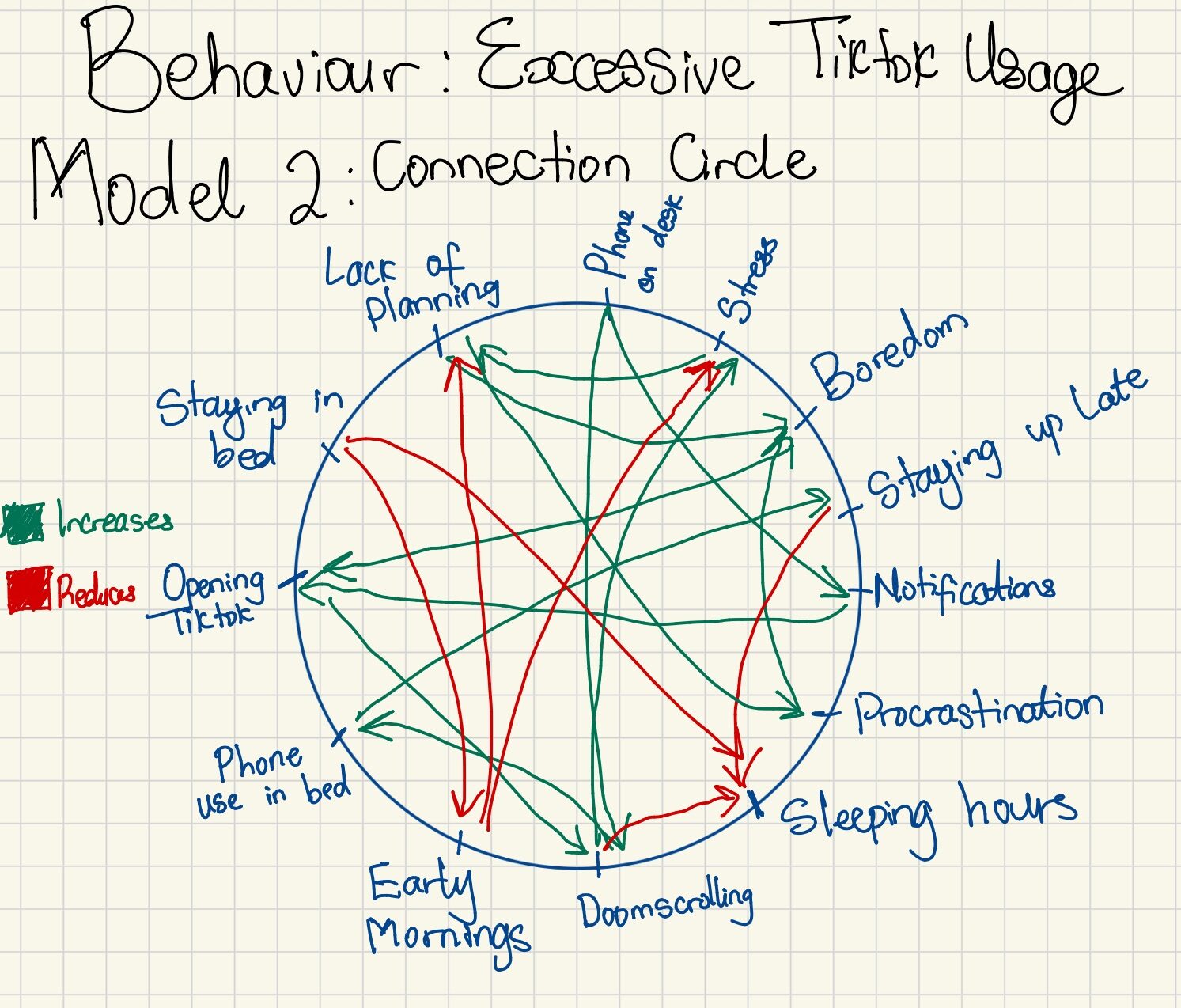
Model 1: Connection Circle (Habit Ecosystem)
The connection circle helped me zoom out and see my behavior as part of a larger system rather than a single bad habit. It kinda made me see how factors like sleep, lack of structure, phone placement, and boredom reinforced one another over time. Seeing all of this mapped out made it obvious that TikTok use is supported by environmental and emotional factors working together.
Model 2: Reinforcing Feedback Loop
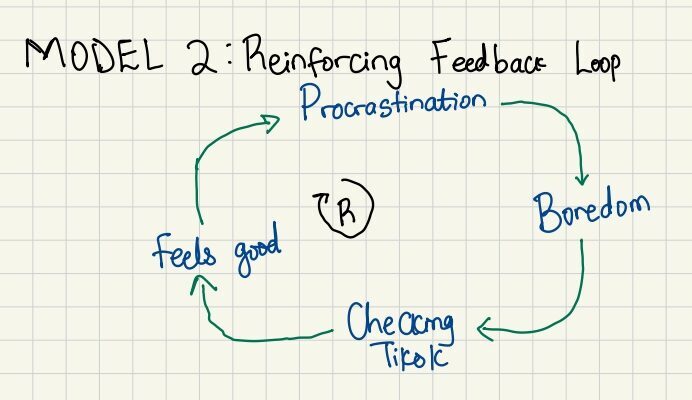
The second model focuses on the reinforcing loop keeping the habit alive:
Procrastination → Boredom → Checking TikTok → Feeling Good → More Procrastination
This loop is reinforcing because the short-term reward (laughing, feeling entertained, escaping discomfort) makes the behavior more likely to happen again. TikTok becomes the easiest way to avoid boredom, which then strengthens procrastination rather than resolving it.
Each time I go through this loop, it becomes more automatic for me and harder to interrupt.
My Experience Doing This Exercise
What surprised me most was realizing that TikTok wasn’t just a distraction, it was my coping mechanism. I wasn’t scrolling because I had nothing better to do, I was scrolling because I didn’t want to sit with my discomfort, uncertainty, or mental effort. I started seeing how sleep, task structure, phone placement, and emotional state all shaped my behavior.
What I’d Do Differently Next Time
If I were to redo this exercise, I would:
- Track my behavior for 5–7 days instead of two
- Pay closer attention to emotional triggers, not just timing
- Experiment with changing one variable at a time, such as:
- Keeping my phone off my desk
- Turning off notifications
- Breaking tasks into clearer, smaller steps
More Specific Metrics I’d Track
- Number of TikTok sessions per day
- Approximate length of each session
- Time since last productive activity
- Time of day, especially mornings and late nights
Final Thoughts
This exercise helped me understand that habits aren’t just about willpower, they’re about systems. My TikTok doomscrolling wasn’t random or lazy, it was predictable, reinforced, and supported by my environment and routines. Once I could see the pattern clearly, the habit felt less overwhelming, and more changeable.
Maybe, just maybe, I’m able to break this cycle.



