Behavior
I chose to analyze my 30-day ‘social media retreat’, where I temporarily closed all of my social accounts and removed their apps from my phone. This includes platforms like Instagram, TikTok, and others that normally make up the majority of my screen-time.
The goal of this retreat is to observe how my habits change when these apps are gone, and how I attempt to ‘evade’ the restrictions in this period. I wanted to understand how much of my phone use is without conscious effort and how the absence of social media affects my mood, focus, and task at-hand.
Even though social media feels small in the moment, over time it contributes to procrastination, brain fog, and weaker starts to my day. This test is meant to make those patterns more visible.
Measurement
Each day after waking up and putting my phone down, I logged a few simple data points: wake-up time, whether I tried to access social apps, which apps I used instead, approximate time spent, my mood when waking up (on a scale from 1-10), and the task I tried to avoid most that day.
Day 1 (1/11/26)
Wake-up time: 6:45am
Tried to access social media: Yes, 25 times
Substitute apps opened: Google Chrome browser, iMessage (safari browser), YouTube Shorts
Time spent: 60 min.
Mood: 8/10 (NOTE: This was the day of producing a 48-hour musical at Memorial Auditorium, quite different from my usual schedule)
Most avoided task: Deciding on adding/dropping final courses
Day 2 (1/12/26)
Wake-up time: 8:45am
Tried to access social media: Yes, 22 times
Substitute apps opened: Google Chrome browser, Safari, YouTube Shorts, Facebook
Time spent: 30 min.
Mood: 5/10
Most avoided task: Readings for Linguistics course
Overall Experience
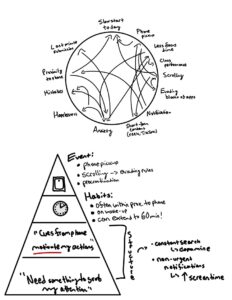
Tracking this screen-time retreat showed me that even without social media installed, my brain still tries to fill this gap in access to dopamine. As soon as I wake up, I instinctively reach for my phone and search for something to scroll.
Instead of Instagram Reels or TikTok, I found myself opening things like YouTube Shorts, Google, or web versions of social platforms like X. These still recreated the same experience of distraction and mental escape, even though I was technically following the retreat rules.
Removing the apps did not remove the habit. It simply moved it to other platforms.
Patterns Noticed
Across the days, a few things stood out:
- The urge to scroll showed up almost immediately after waking up, unless I explicitly put my phone away from my bed.
- When social media was unavailable, I searched for similar platforms.
- Short-form video was extremely tempting. Once I started, stopping still felt difficult, especially in breaks between classes. More scrolling led to slower, less focused days, and difficulties for the following day’s tasks.
Reflection
This retreat showed me that social media adjacent platforms like YouTube Shorts put me back into the same slow day and procrastination cycle. To change my habits, I need to address my urge to escape into scrolling, not just the specific apps I remove.
Iceberg Model and Connection Circle