(write up the solution ideas we discussed and the final implementation decided)
1. Take us through your solution ideation (done in 6A – sticky notes -> notecards -> paper concept sketches). Include images and summarize the key solution implementations you explored. Tell us how you decided on which solution implementation to pursue.
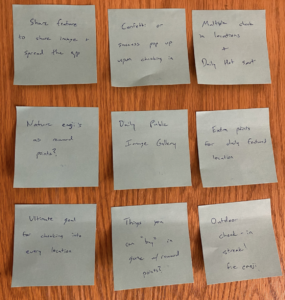
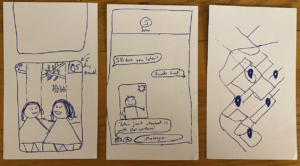
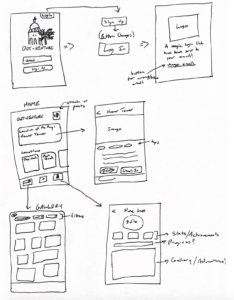
- Fire emoji showing streaks for consecutive days
- A simple and easy sharing method for users to get their friends involved and signed up
- Map system which allows users to find different locations and read more about them, or see other shared photos
(answer 9 each of the Desirable, Feasible, and Viable questions, then map them on the 2×2 and highlight the most important ones)
Mapping stuff on this board:
https://miro.com/app/board/uXjVPmTuQ9M=/
Look at your solution and map what is feasible, desirable, and viable. Take all the information from your diagram and place it a 2×2 with important to unimportant and know to unknown. Include an image of your assumption map and highlight which one’s are the most crucial to your team’s solution.
(each person make a test card for one of our highlighted assumptions)
3. Take 2-3 significant assumptions from the important and unknown quadrant and pick a test for each of these assumptionsLinks to an external site.. These tests can be short & quick. You will run the tests during Week 7, for this submissions we just want to know your top assumptions and how you will be testing them. You can follow the structure of the following testing card 🙂
Test 1 Idea:
“Our target audience wants a defined reason for going outside”
A/B test
- We believe that our target audience wants a defined reason for going outside
- To verify that, we will conduct an A/B test where one group of users will get a reminder to go outside and another group of users will get a reminder to go outside to perform a specific action (___take a picture, find a clue, etc)
- And measure the engagement rate for the two separate groups
- We are right if the group that is prompted with a specific action has a noticeable difference in engagement vs. the group who is just prompted to go outside.
Test 2 Idea:
“We can put check-in locations at relevant locations, regardless of where the user lives.
Check-In Location Frequency
- We are quite certain that users don’t care to go to high-frequency locations, regardless of where they live.
- To test that, the constant location will be X; however, one group will be close by in proximity, while the others dorms’ locations will be far away.
- I will measure the check in frequencies at those locations.
- Compare these metrics.