
Spotify
In Spotify’s organization, outlined in 2012 and later retired around 2017, the product owner decides what gets built and the order, and the rest of the squad decides how. Squads own an outlined part of the product. The PM is embedded with people closest to user. Here, proximity to user is built into the structure, and there’s a designated role whose job is to translate that proximity into decisions. Over time, Spotify loosened its vocabulary around squads to enable more collaboration across the organization.

Airbnb
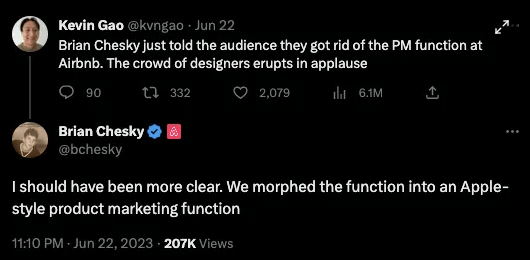
The CEO and the design leadership decides and the rodmap is centralized. The designers are closest to customer, and PMs are intentionally left outside that proximity. They are more integrated into a product marketing function; they communicate and market more than they decide.
Zappos
At Zappos, initially, there were no fixed PM title and decision rights belonged to self-governing circles, following a management style called holacracy. In theory, whoever’s closest to customer decides. However, in practice, 18% of staff left rather than navigate ambiguity, and Zappos decided to introduce microenterprises.
The reading said PMs have “lots of responsibility but little authority.” Spotify’s squad structure gives PMs authority day-to-day. Airbnb’s version makes PMs almost only communicators with no lever to pull. Zappos’ version is a tricky one. In terms of the CORE model, Zappos’ version answers Research really well by prioritizing the authority of whoever is closest to client. However, it doesn’t answer organization at all. With no organization, the day-to-day worklife can get chaotic, which explains why staff left. So I would pick the balance of authority and organization Spotify seems to maintain over other product orgs.
