
Comparative Analysis
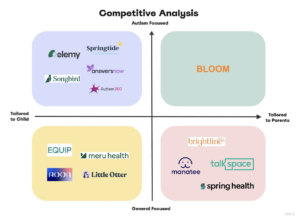
Figure: Comparative analysis for our product BLOOM
- We spent a lot of time and effort into the comparative analysis of our project because we wanted to understand how the currently-existing products in the market serve our target customers.
- However, after doing a lot of research, we found that most of the companies working in the autism space focus on the child with autism rather than the parents who also may have stressful times while taking care of their children.
- This is consistent with most of the products on our Competitive Analysis chart purple quadrant such as Elemy, Songbird, Springtide, AnswersNow, and Autism 360 which are autism-focused but tailored to the child. Insurance companies generally reimburse their services if they are deemed as medically necessary. There are generally co-pays and limits over the number of hours or years of use. The issue with most of these services being child-focused is that parents do not learn the skills they need to help their child after the therapy ends or at home.
- The research that we did for the competitive analysis made us more confident in our finding that there is a strong need for a product that focuses on the parents of children with autism.
- We found some competitors in the orange quadrant who are not autism-focused but tailored to parents, like Manatee, Brightline, Talkspace, and Spring Health. We really liked the family-centered approach to addressing issues that are commonplace in many families. While these companies are generally focused on mental health and behavioral development, we were inspired to learn about the variety of services they provide for families in need.
- We were quite fascinated by the yellow quadrant as there are a lot of companies addressing very niche segments of behavioral health like eating disorder (Equip Health), navigating complex health conditions like Glioblastoma (Roon), parent-mediated mental health for children (Little Otter), and mental health services for employees (Meru Health). We will use these companies as guides as we tailor our services for another niche: parents with autistic children.
- For example, Meru Health gave us the idea that we can probably approach employers to offer BLOOM’s service as an employee benefit to those who have an autistic family member.
- Equip Health’s model, which comprises a five-person dedicated virtual care team, was an important learning from an adjacent condition (eating disorder). Beyond a therapist and a physician, they are also helping individuals with eating disorders with a peer mentor, family mentor, and a dietician. We believe a multiple-team virtual care team might also be an interesting “later” plan for us to consider for our market.
- Roon gave us the insight into using ‘asychronous online modules’, similar to Masterclass, for patients to get information and strategies to navigate their condition. Although their patients tend to be older, and thus their app is targeted towards the patients, we found that they are also thinking of building caregiver self-help tools.
- The benefit of a model like Roon’s is that it allows ease-of-scalability but the downside is that it cannot be tailored to the needs of each individual. This could be a future addition for our market, especially when parents/caregivers of autistic children are either on the waitlist for getting a diagnosis or therapy but want to learn as much about neurodiversity. We could potentially also add custom pathways for navigating autism in schools, academic work, social settings, family sphere, travel, and employment. Since a lot of our interviewers expressed a lack of hope and certainly about their child’s future, there could be custom lessons on journeys of autistic adults and their advice to families on assuaging some of these worries on higher education, employment, sexual and romantic lives, elder care, and independent living.
As a team, we brainstormed on different aspects related to autism for the X- and Y-axis of our competitive analysis chart. We finally settled on the following:
- X-axis: Tailored to child vs tailored to parents
- Y-axis: Flexible options vs rigid
Other aspects that we considered for the axes are the following:
- Online vs offline
- Long-term vs short-term
- Expensive vs cost effective
- Individual vs family focused
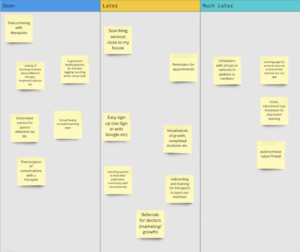
Participatory Roadmap
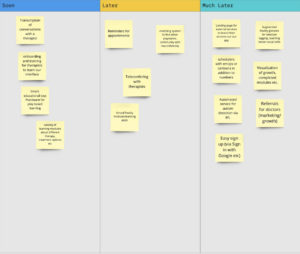
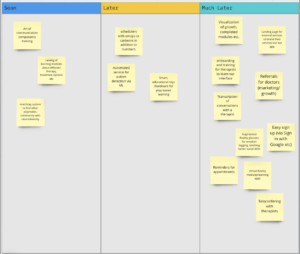
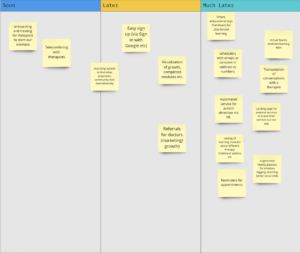
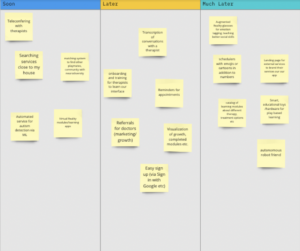
Among our interviews, the common theme that stood out the most was that people live far from good therapists in the city and want better telehealth therapy. Furthermore, parents want to utilize their time with their children to help them learn better. Parents spend a lot of time with their children in the early days of autism diagnosis. Our market research suggested the average time spent in the first few years was 40 hours a week. However, parents do not know how to give proper therapy or how to accommodate their children’s needs at that time. There’s fundamentally a lack of awareness of actions that would cause the improvement of language and communication skills, and the parents requested more training in this domain. Besides, parents suggested needing more help in navigating the caregiving space. There was interest in finding effective professionals to conduct therapy based on referrals and the reputations of the clinics. Parents even wanted babysitters or secondary caregivers who could help them get away from their caregiving duties for a while.
We also interviewed therapists and discovered junior therapists have more difficulty finding clients and scheduling therapy time with their patients. This is because of a lack of awareness about available options by the parents. Furthermore, many therapists are boutique or solo practitioners and do not have the savvy marketing needed to reach new clients. Additionally, we learned that text and writing is not the best medium to communicate with children who experience autism, and therapists use more visual elements to get the point across, so they expressed interest in advances of text-to-image state of the art of automatic tools.
An interesting aspect that was quite surprising to us was the need for belonging and finding a community of other neurodivergent people. We hadn’t thought much about this feature, but one of the interviewees insisted on having this feature.
The less desirable features placed in the much later bucket were related to robots and automatic therapy. Our target users seem skeptical of automatic and intelligent solutions for providing the best support for their children. At the same time, other use cases of AI/ML applications, such as note taking and meeting transcription, and assisting with remembering information, were more desirable but not needed urgently for the care receivers because there are other alternatives to these solutions. However, the therapists were more interested in this feature as it reduces the burden on them for recording and typing down the necessary action items and reports of the meeting.
There was interest in automating autism detection by Machine Learning based screeners. Many parents felt that they realized their children were neurodivergent much later and that an earlier diagnosis could help them. However, they were skeptical of the anxiety that they might go through for a misdiagnosis or false alarm. They want automated screeners as a precursor to visiting a doctor. The aim is not to replace medical professionals but to suggest to parents that they should visit a doctor. Such a feature could help us suggest doctors in our network to parents, which could be a vital customer acquisition tactic.
There were also concerns about the look and feel of such an app. Parents wanted an easy-to-navigate app because they were old. They emphasized the importance of a simple design and great customer service in learning the app, with accompanying video tutorials. In terms of design, they want a friendly, reliable, and easy-to-use application.
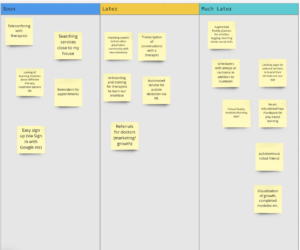
Interview # 1: Parent of autistic children
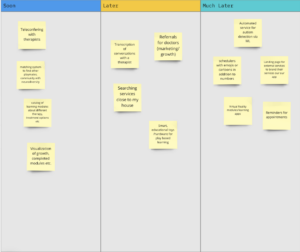
Interview # 2: Parent of autistic children
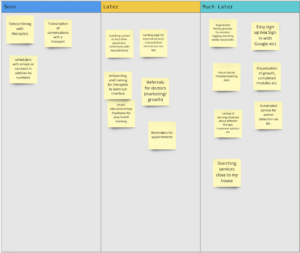
Interview # 3: Therapist
Interview # 4: Therapist
Interview # 5: Parent of autistic children
Interview # 6: Therapist
Interview #7: College student with Autism
Interview #8: Working professional at a behavioral therapy service
