
Group members: Annie Nguyen, Charlotte Yi Feng, Shina Penaranda
Hello! For those who have not been introduced to our project yet, here is a brief overview:
1. What is your project concept?
We are thinking of creating a marketplace platform to help promote local student artists and help them connect with interested buyers. Oftentimes, student artists who just start out have difficulty marketing themselves, and have to go through lots of hurdles to set up shop. In other cases, spreading word to the local community may be difficult through the many channels of communication that we have. Our project aims to design an application that can help bridge this gap.
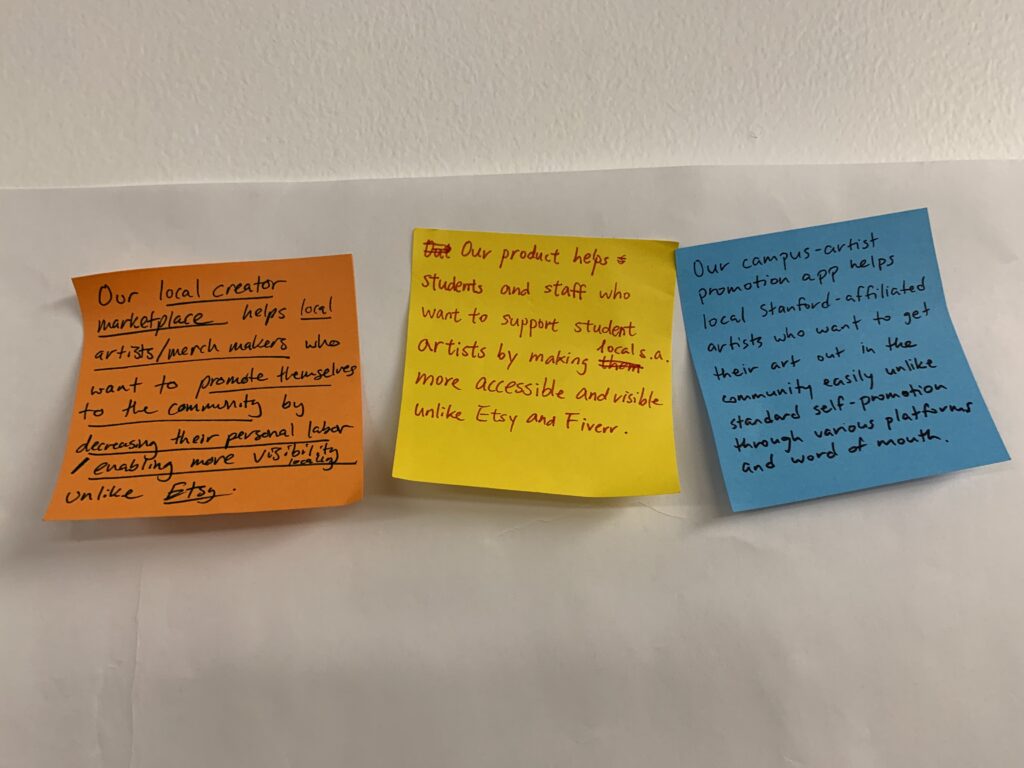
2. Why is your value proposition statement correct?
Updated value proposition: Our student artist marketplace helps student artists connect with each other and interested buyers by promoting their work to the local community and increasing their visibility, unlike large eCommerce sites or multipurpose platforms.
3. What motivated your choices for the MVP?
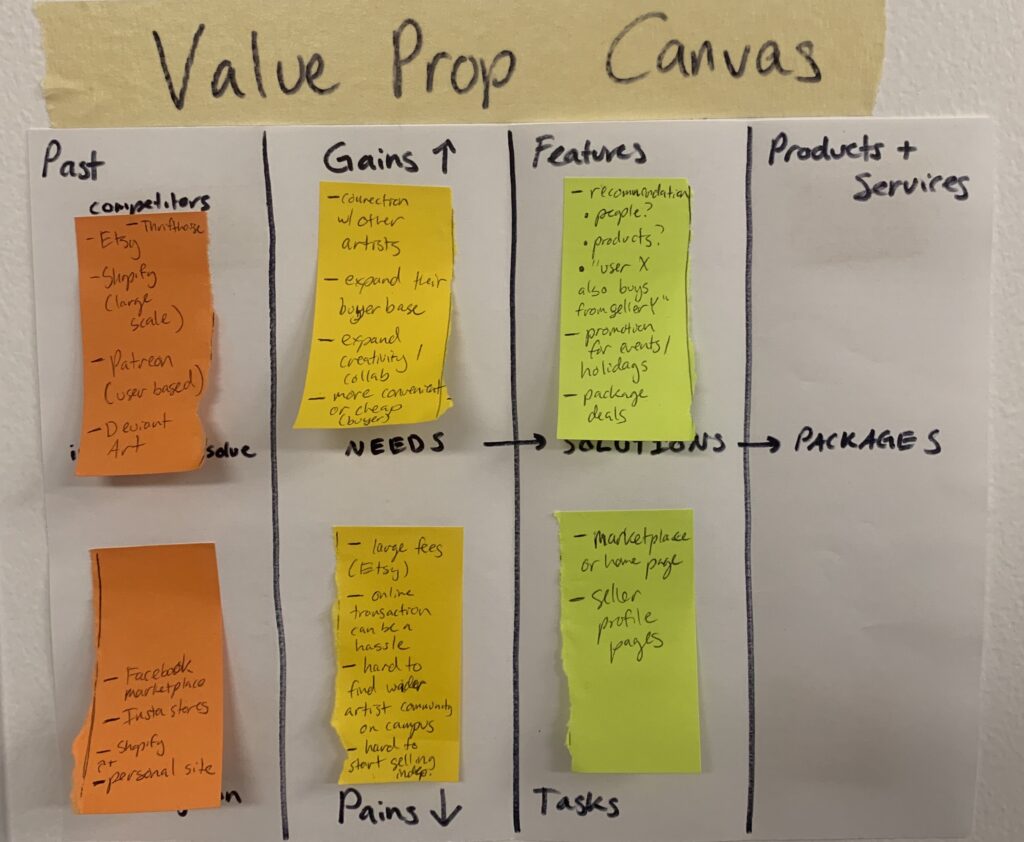
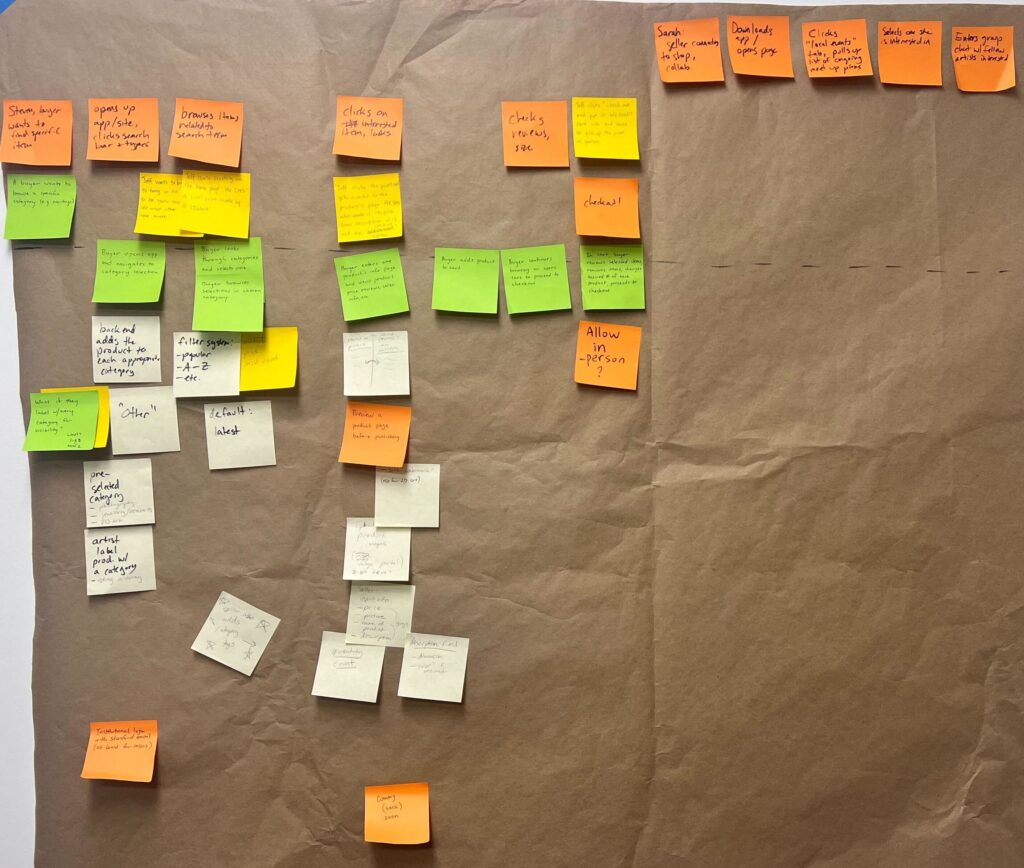
We are thinking of what is the most important experience we provide with our app. Since it is a market place, we believe that the features that enable us to connect sellers with buyers are the most important ones. To accomplish that, we would need to provide sellers with a space to exhibit their work and sell them, which leads to a storefront feature. We also need to make a collage of work from different artists to show the buyers, which leads to a homepage feature. Having the storefront and the homepage as the two backbones of our MVP, we plan to show our platform’s value by making them better than other products.
- Storefront
- Account creation for new sellers
- Putting a product on their store
- Features:
- Blocks of images of their products, past and present (we can grey out things that are sold out atm)
- Bio image with bio description, maybe emphasize more to focus on them
- Homepage
- Recommendation system
- Search system
- Category selection and filtering
- Paintings, photography, jewelry, etc.
4. What is the goal of the project; how are users’ lives changed by your product?
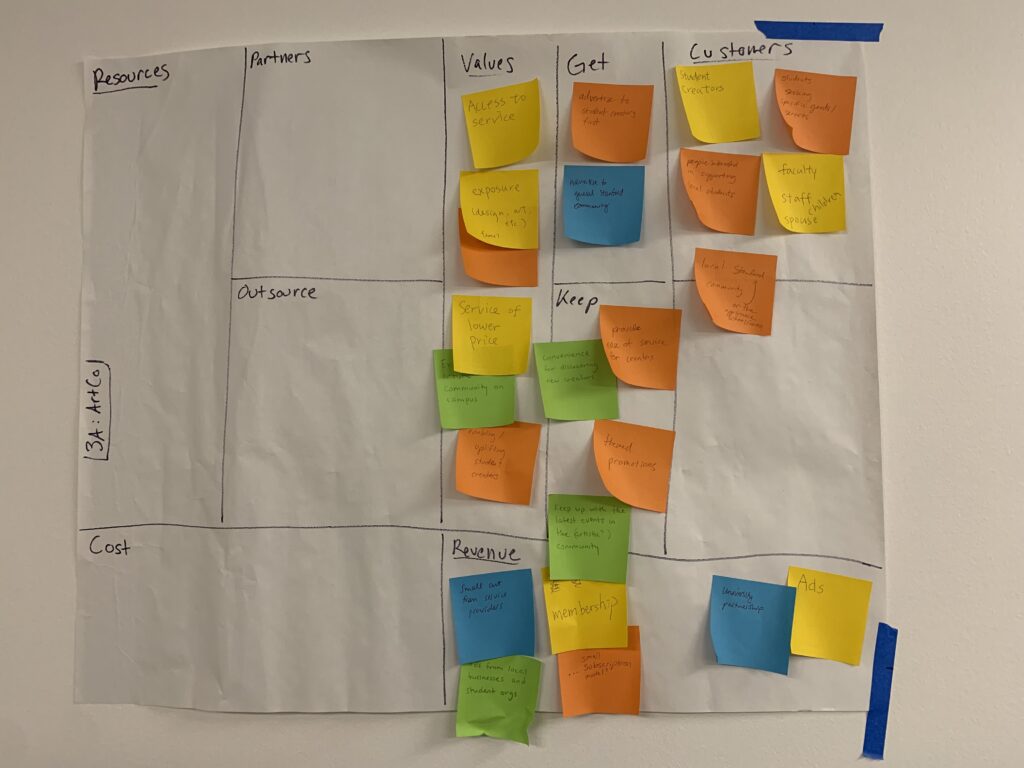
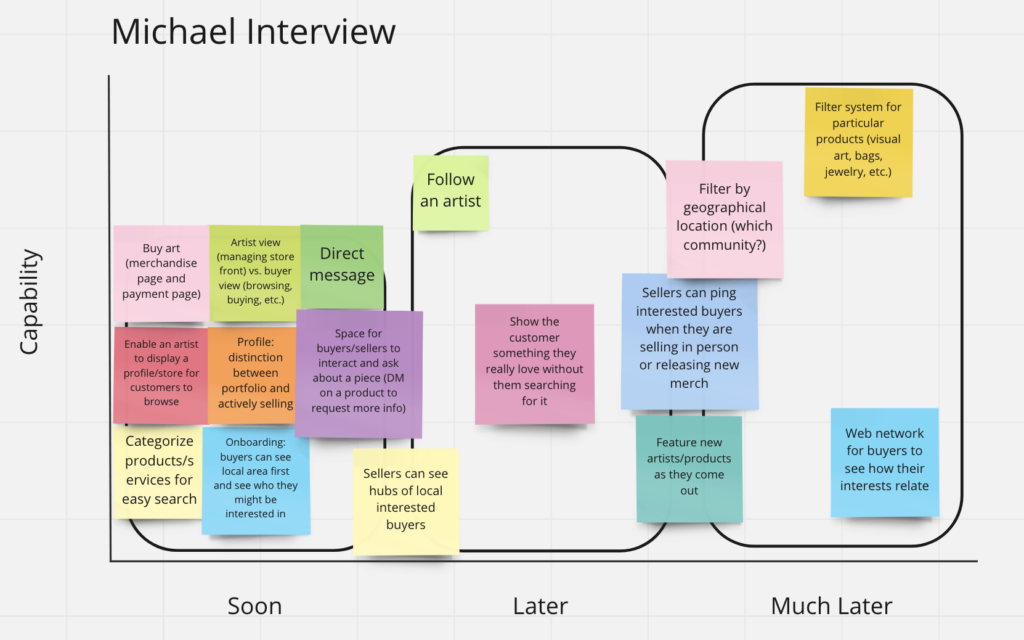
Our goal is to help foster support and community for student artists who are just starting out and sharing their work on their own. Starting a small business with something as personal as art, while being a college student, can be difficult to manage. Our student artist interviewees also mentioned how relatively separated the student artist scene felt on campus. In trying to increase the sense of community across student artists on campus, as well as trying to help them start off their business on a smaller scale, we want our product to ultimately help student artists feel supported by the smaller local community. Whether it be through purchases or collaborations, having a close community can help fuel these artists as they expand.


5. What assumptions are you still worried about?
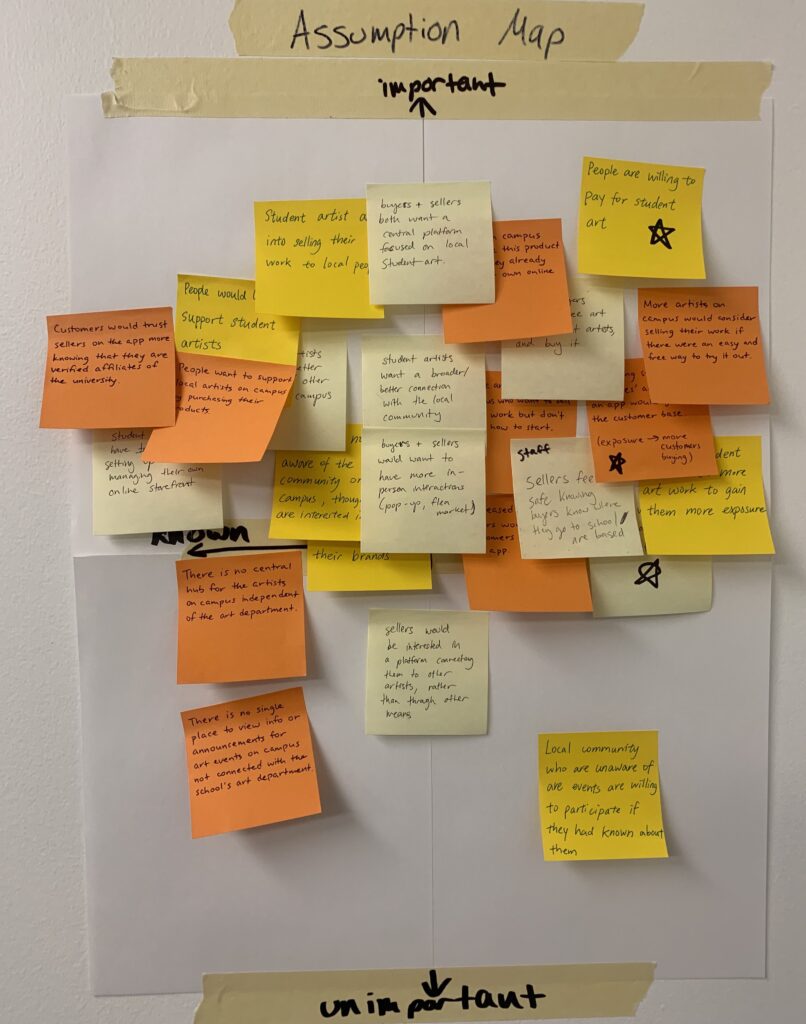
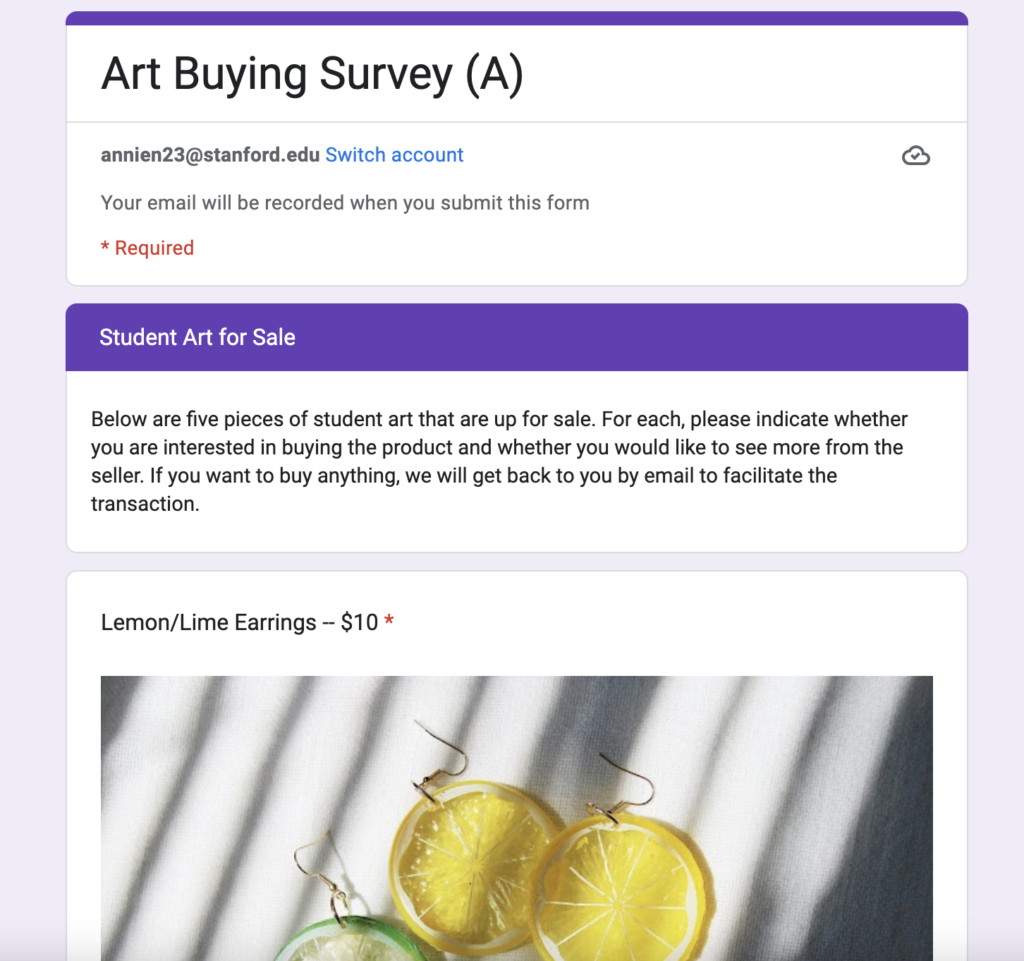
We are still worried about the scope of buyer interest in the local area. While we have seen expressed interests in our interviews, measuring the amount of people who would actually go through with a purchase is more difficult. We are in the process of trying to test that with one of our experience prototypes, by creating a mock form with student art pieces and listed prices. There are other facets to the buyer side of our market, such as if buyers are interested in learning more about the artists, if exposure to more student art would encourage them, or which advertising method would be most effective. We hope to cover some of these assumptions with our other experience prototypes.
On the seller side, we are concerned with what business model would be fair to them. Currently, we are assuming on taking 5% of their revenue on transactions, which we plan to test. This number was estimated off of Etsy’s fee (6.5% without the other fees), and we are trying to find a balance between what student artists would be comfortable with and what we need to support our platform. The revenue is particularly critical if we proceed with utilizing other tools and outsourcing, such as using Shopify, for the smaller iterations of our product. We are also concerned with seller safety; would they be comfortable knowing that buyers know where they go to school/are based? While we hope to foster community amongst student artists and buyers, there is a difficult balance in trying to be transparent about artists while also prioritizing their safety.
6. What experience prototypes have we done, and why? How did they turn out?
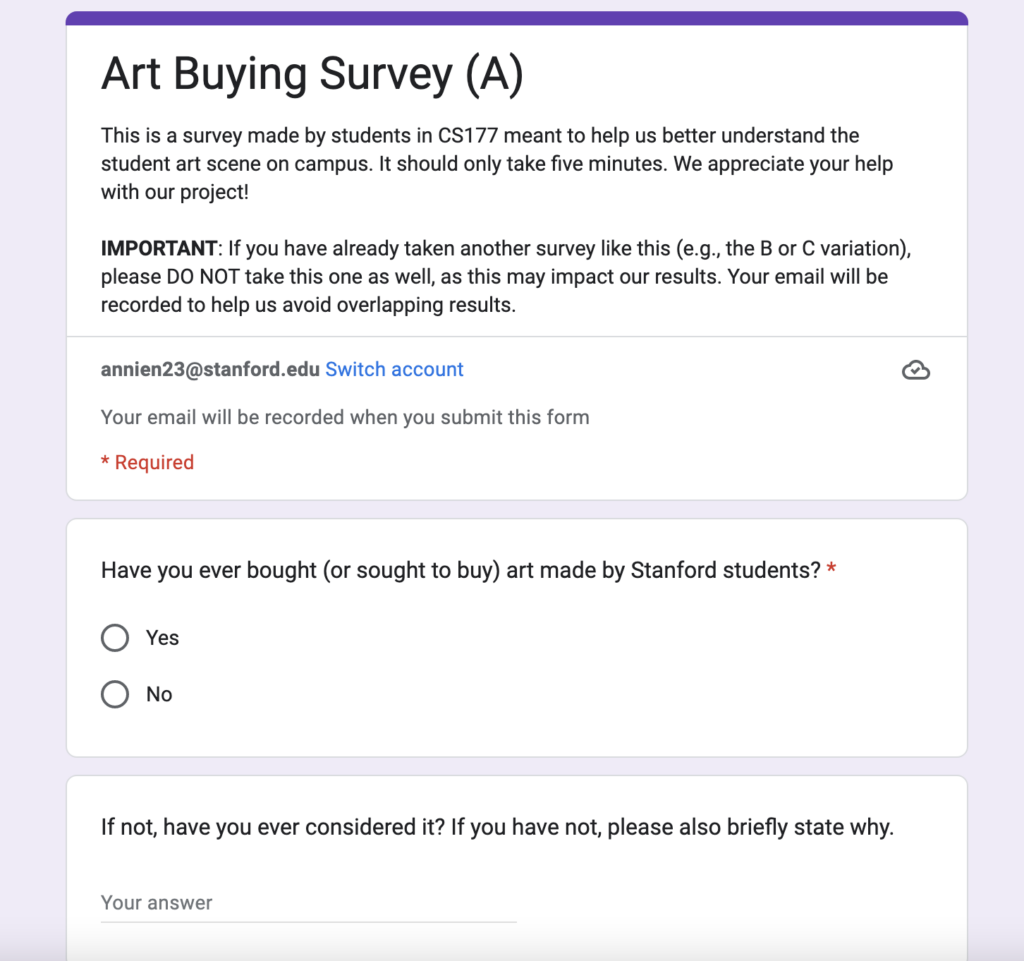
We have sent out a Google form via mailing lists and Slack channels to gauge how much mere exposure could lead someone previously not interested in seeking out or buying student art to want to make a purchase. So far, we have received three responses, and from our results, it seems that people who fall into this target category would indeed become interested in purchasing student art with exposure to the products. From feedback on the form, we learned that even those who have bought art from students in the past are not very aware of the art scene on campus or who is selling art, so aggregating the showcases and presenting them to potential customers would be useful for increasing sales even to those who have previously bought student art. We currently do not have enough data, however, to conclude that our assumption of increased exposure to student art growing the customer base is correct. We will continue to accept responses and revisit our results at a later time.
7. Are there experience prototypes that you may need to build next?
Our next experience prototype follows from the first, and it will answer the question of whether the number of purchases would increase if customers learned more about the artists when viewing products. We would add to the form a blurb about each artist whose product is presented. [see test cards for the rest: https://docs.google.com/document/d/1XthxNoxpcQP61CdQPSRV5DHP4vw995IZ2rPHE66J7-M/edit?usp=sharing ]
8. How viable is our product as far as we know, with the assumptions we currently have and the experience prototypes we have done?
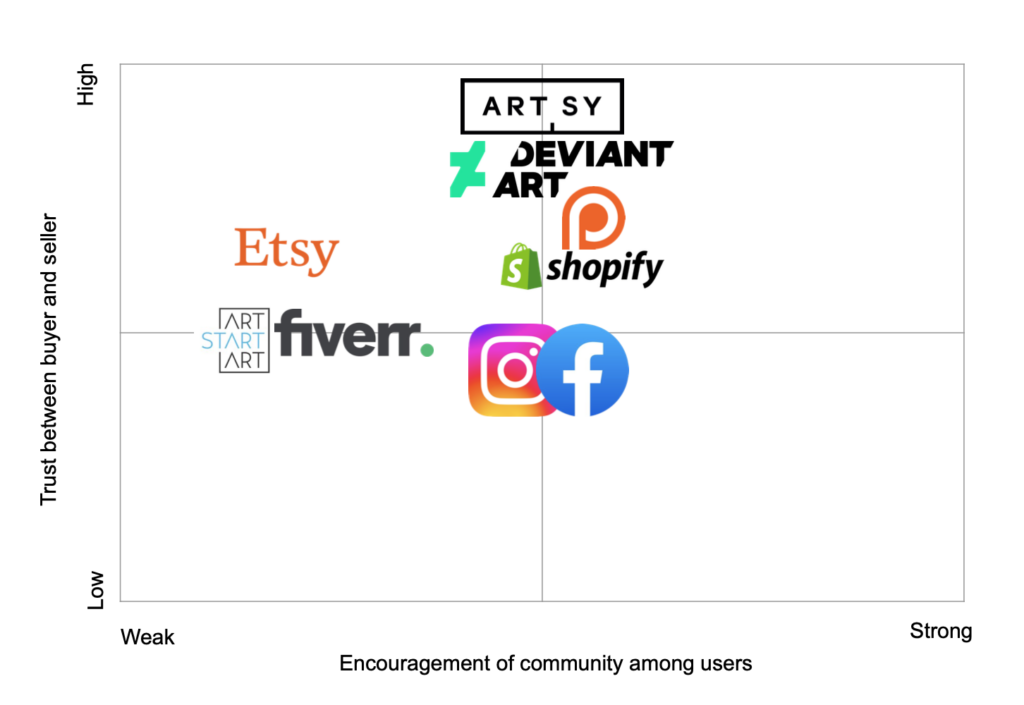
From a seller standpoint, the product is fairly viable. Student artists who are just starting out and wanting to set up their own storefront would appreciate the built-in storefront profile that we plan to implement in our product. It would have the added incentive of being able to see other student artists on one centralized platform, addressing the desire to connect with other student artists on campus that we found in our interviews. This element would differentiate us from other eCommerce platforms.
Our product stands on less reliable ground when it comes to the buyer side of the market. We have made a number of assumptions that have not all been tested yet, though we are in the process of doing so. Without a clear confirmation on the size and degree of buyer interest, there might not be a strong need for a market in this space. That being said, we are evaluating ways to gain more buyer interest as well. There could be a potential pivot in the case that buyer interest is disproved, in which we may focus more on the student artist community. We shall see!
9. What advice do you want from your reviewers?
- What seems like the best platform to deliver this idea? (web, mobile, etc.)
- What kind of business model would be most appealing to a college student, given the assumption that most don’t have the money to spend on non-essentials, or don’t want to? (taking fees from seller, subscription, etc.)
- How do we test what should go on the homepage? Do we provide multiple versions of homepage and ask users to pick/vote/comment on?
