
Slack: Mitigating Disruption in Workflow
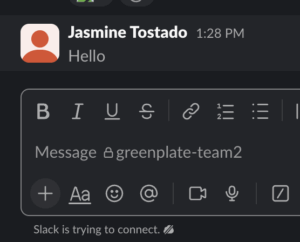
When Slack encounters an outage or failed message delivery, it keeps already loaded channels accessible, while channels that weren’t loaded display a friendly banner (“Go online to see latest messages”). This approach clearly communicates the issue, maintains user confidence, and minimizes frustration by signaling that data isn’t lost but temporarily unavailable.
Business cost: If error recovery fails, active workspace engagement drops, threatening retention across enterprise accounts.
Design insight: Slack turns friction into reassurance. The microcopy and offline cache design signal reliability, converting potential drop-offs into patience.

Uber: Protecting Completion Rates
Uber’s core KPI, ride completion, depends on how gracefully it handles failed GPS signals, driver cancellations, or payment errors. The app surfaces contextual recovery options (“Try another driver,” “Update payment method”) and keeps users within flow rather than forcing restart.
Business cost: Every failed ride = lost transaction revenue and potential churn.
Design insight: Recovery is speed-optimized. Users rarely see dead ends since Uber designs every error for conversion continuity.

Banking Apps: Preserving Trust at All Costs
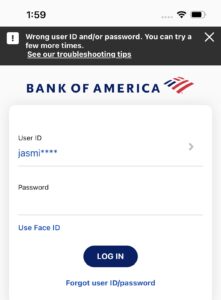
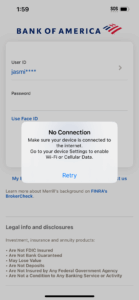
Banking apps like Bank of America treat errors as trust crises. A failed transfer or login attempt triggers detailed alerts, visual security cues, and redundant confirmation flows. While slower, this friction communicates control and compliance.
Business cost: Instant revenue loss is low, but reputational loss can cascade into account closures.
Design insight: Unlike Uber, banking apps optimize for emotional safety over speed. Friction becomes a feature when it reinforces credibility.
Key Takeaway
Each app’s error-handling design maps directly to its revenue model:
- Slack → Retention safeguard
- Uber → Transaction continuity
- Banking → Trust preservation
Designing error states is not just about recovery but also a strategic decision that protects the business engine itself.
