Team Norms
- Communicate often and honestly
- Stick to group deadlines
- Show up to group meetings or communicate absences when necessary
- Don’t take criticism personally
- Make space for everyone to share their ideas
New Questions
- How did you use AI in your work? Where did you learn about AI tools?
- How did AI change the timeline for your work?
- Did you write specs in your work? What frustrated you about writing specs?
- Tell me more about ideation and how you reach conviction in something.
Affinity Map
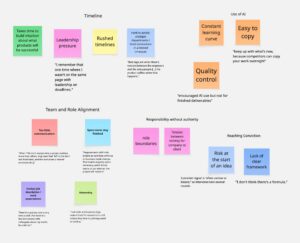
AI Comparison
AI caught that PMs faced the challenge of reaching conviction, stemming from the fact that there was a lack of clear framework. It pulled up a quote from one of the transcripts, which was true. We found the suggestions to be nuanced and not generic. It did group team, role alignment, and time pressure together, compared to how we splitted it up to different sections.
Long List
- Leadership and the team work from different information about timelines and priorities (3 of 5). Raised by the internal-tools PM, the engineer, and the CPO. The Intuit manager touched it more loosely.
- “This is always a tough situation to be in because leadership doesn’t always have visibility over what the team is working on and the challenges they are facing.”
- Unclear role boundaries and shared authority (3 of 5). Raised by the internal-tools PM, the CPO (CPO vs. GM tension), and the intern (role was “not narrowly product management”).
- “What does internal tooling mean and how much of the AI push falls under my team.”
- Reaching conviction when the signal is noisy (3 of 5). Raised by the Intuit manager, the internal-tools PM, and the engineer (product intuition).
- “I don’t think there’s a formula.”
- Prioritizing and saying no in a way you can defend (3 of 5). Raised by the intern (arbitrary weights), the CPO (says no about 95% of the time), and the Intuit manager (can’t keep every user happy).
- “Not wise to assign arbitrary weights based on how important I personally thought each variable was.”
- Engineers lack context on why work matters (2 of 5). Raised by the engineer and, indirectly, the internal-tools PM, whose fix was adding the engineering manager to meetings for visibility.
- Engineers feel “left in the dark.”
- Speed vs. quality friction between product and engineering (2 of 5). Raised by the CPO and the engineer (scope that nearly doubles build time).
- Engineering chases perfection while product pushes new features quickly.
- Specs and documentation go stale (2 of 5). Raised by the internal-tools PM and the engineer.
- “I honestly think specs are becoming less and less important.”
- Ideation and judgment are now the bottleneck, since building is cheap (2 of 5). Raised by the Intuit manager, plus the CPO (same-day implementation of feedback).
- “The expensive part is now ideation.”
- New AI-era risk and keeping up (2 of 5). Raised by the internal-tools PM (data, reliability, regulation) and the intern (AI use allowed, but not for finished deliverables).
- “As a PM, I have to think a lot about data, reliability, and risks.”
- Aligning many functions with different incentives (2 of 5). Raised by the CPO (sales, engineering, finance, PE owners) and the intern (supply chain and engineering).
- Aligning interests and workflows between sales, engineering, and finance is challenging.
TAM
How many PMs are there?
The best headcount comes from Product Focus, a PM training firm that counts PMs on LinkedIn. In October 2023 they found about 427k in the USA, 567k in Europe, 140k in China, and 110k in India, for roughly 1.6M worldwide, up from about 1M in 2021. They note that LinkedIn isn’t widely used in some countries, so the true number is likely higher. On the conservative side, a recruiter using LinkedIn Recruiter data found 2.4M people who have ever been PMs, but only about 0.85M active ones. So a fair range is 0.85M to 1.6M PMs, but likely more. [Product Managers Across the World]
What gets spent on tools for them?
Top-down, market reports vary based on what they count. Tools built just for PMs come to about $1.314B in 2025, while broader PM software estimates run from $4.15B to $6.61B, likely because they include tools engineers and project teams also use.
Bottom-up, Aha! is a common PM tool with public pricing: Roadmaps starts at $59 per user per month and Discovery, for managing customer interviews, at $39. That’s about $700 a year per PM for roadmapping, or about $1,200 with discovery. [product management and roadmapping tool market]
Taking the average of each range, about 1.2M PMs at about $950 per year gives a TAM of roughly $1.2B, close to the $1.3B market report.
Reflection (w/ Reading Incorporation)
After the two weeks of class and doing more rounds of interviews, we felt more equipped with asking more specific questions that would draw out more insights from the interviewees, as well as when to probe for elaboration/follow-up on a specific question. We found answering them the key questions on an average/good/bad day. Between our first and second round of interviews, we focused on sharpening our follow-up questions. Tessa Toress, in her article on customer interviews, emphasizes that follow-up questions add value, as they encourage elaboration and guide interviewees toward specific experiences rather than settling for a quick, generalized first answer.