
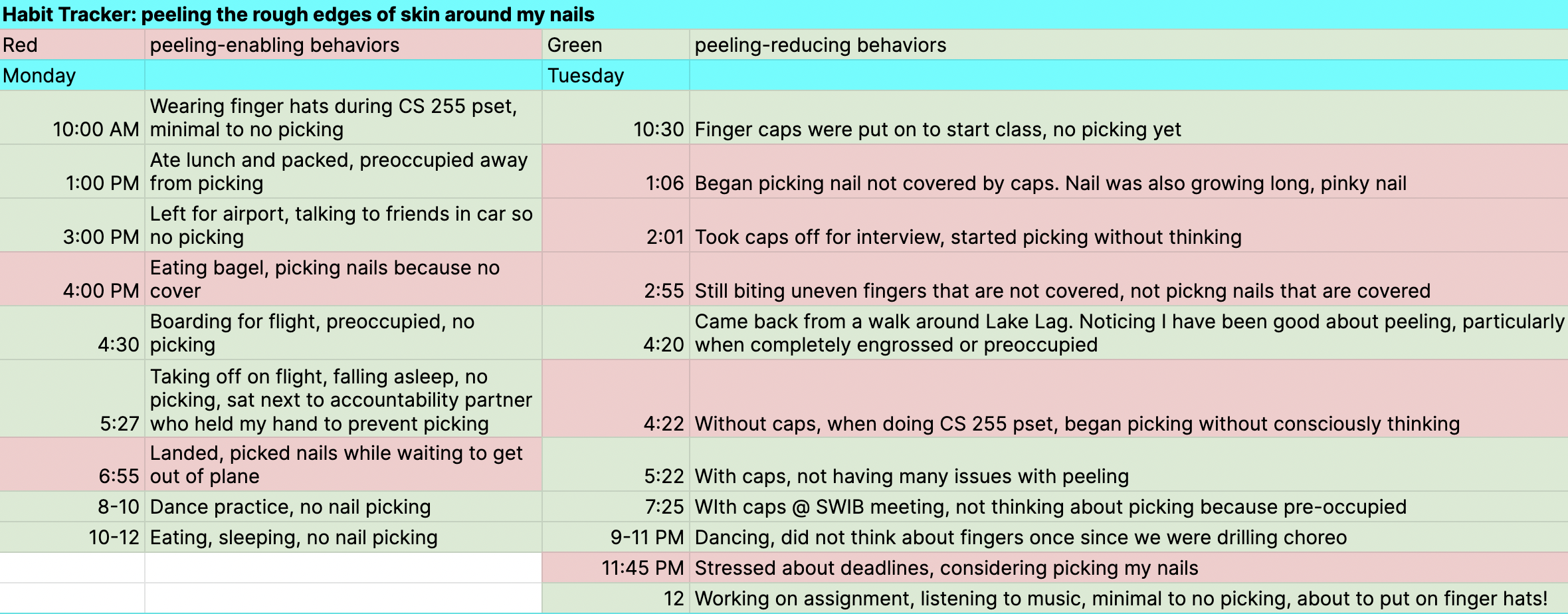
During this measurement round, the habit I wanted to change was stopping myself from peeling the skin around my nails, which is a bad habit that I formed from high school, where I used to bite my nails when stressed. In an effort to discover the root causes of this stress and how this behavior manifests, I logged my behavior at any moment when I thought about peeling or was making an conscious effort to take an anti-peeling action (e.g. putting on caps on my fingers, partaking in a different engaging activity). This self-reporting I found was most effective because I became most conscious of when exactly I thought about the act of peeling and this acted as an immediate trigger for myself to take note on the spreadsheet so that I can look back and observe patterns.
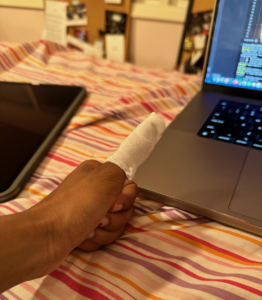
Experience: Over Monday (1/16) and Tuesday (1/17), I was beginning to observe how when I consciously remembered to take note, I was actually more cognizant of the negative effects of peeling my nails. Overall, this exercise was also easier to conduct during the end of a relatively chill week 1, and may not truly represent the difficulty of controlling the peeling behavior during the height of stressful times. However, one thing I found interesting in the observed notes was that there was a strong correlation between wearing my finger hats and not having the opportunity to peel my skin at all.
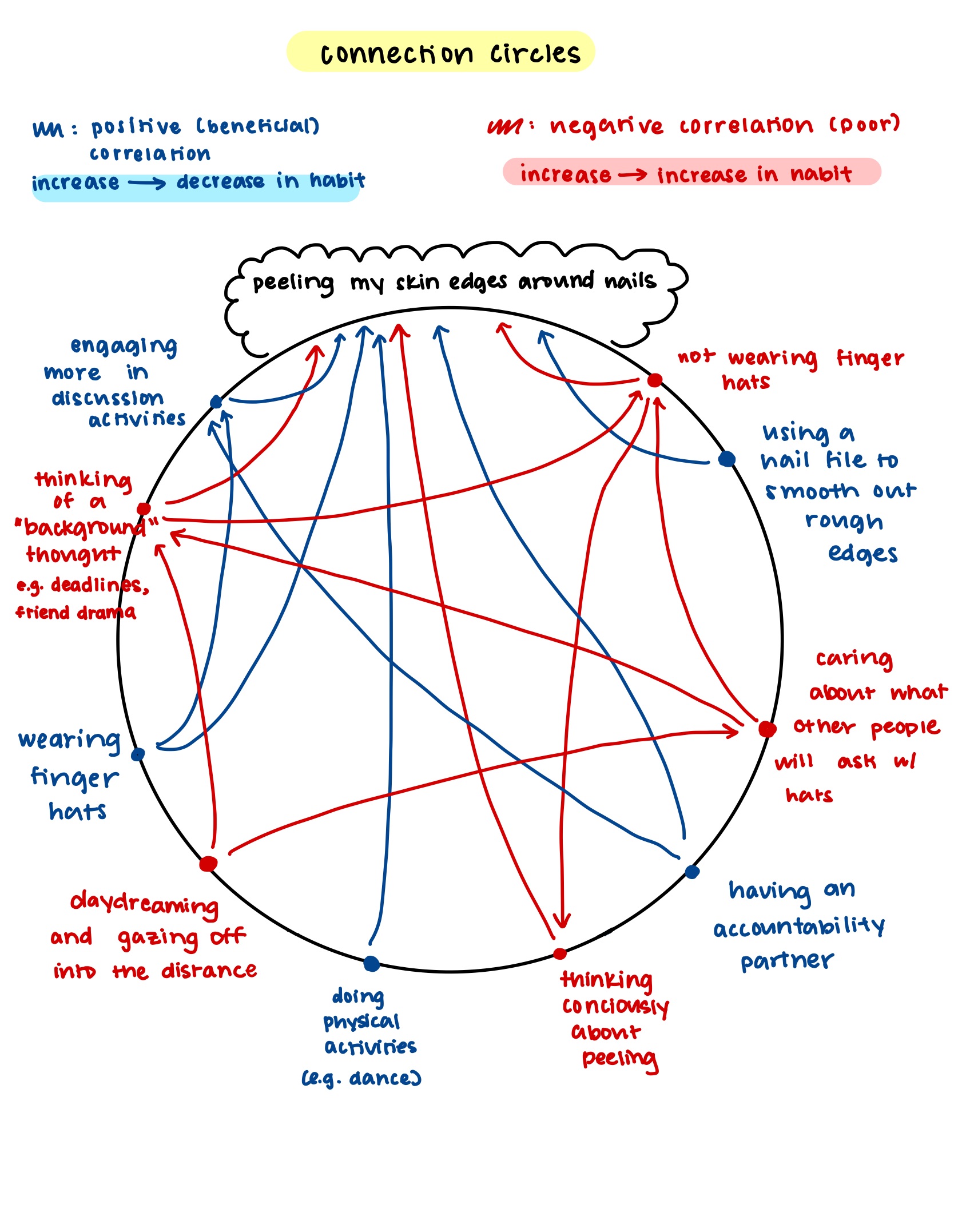
Connection Circle: From my connection circle, some observable patterns were that whenever I had any “background” thought or anxiety running in the back of my brain, this was typically a trigger for several other cascading negative consequences leading to more peeling. Additionally, any action that lead to me consciously thinking about peeling or looking at my fingers (a toxic action that is not represented in my chart!) for any reason leads to more peeling. On the flip side, I found that two very effective deterrents were getting entrenched/engaged deeply in activities that required me to physically participate, and using my cotton “finger hats.” For instance, at the SWIB meeting on Tuesday, I found myself so deep in conversation that I forgot about peeling. It seems effective to take on activities where I am 100% engaged and preferably with others, either in the sense of having an accountability partner nearby to hold my hand when negative actions or observed, or just someone to physically dance/use my hands in discussion with.
One caveat with using finger hats was the observable public reaction that negatively influenced me after a bit of time. When I started wearing them more often to the dining hall, class, and the SWIB meeting, I realized that some people felt curious why I had these hats on both thumbs. Also, this doesn’t seem like a sustainable solution, given that I would sometimes peel any finger that did not have a cover.
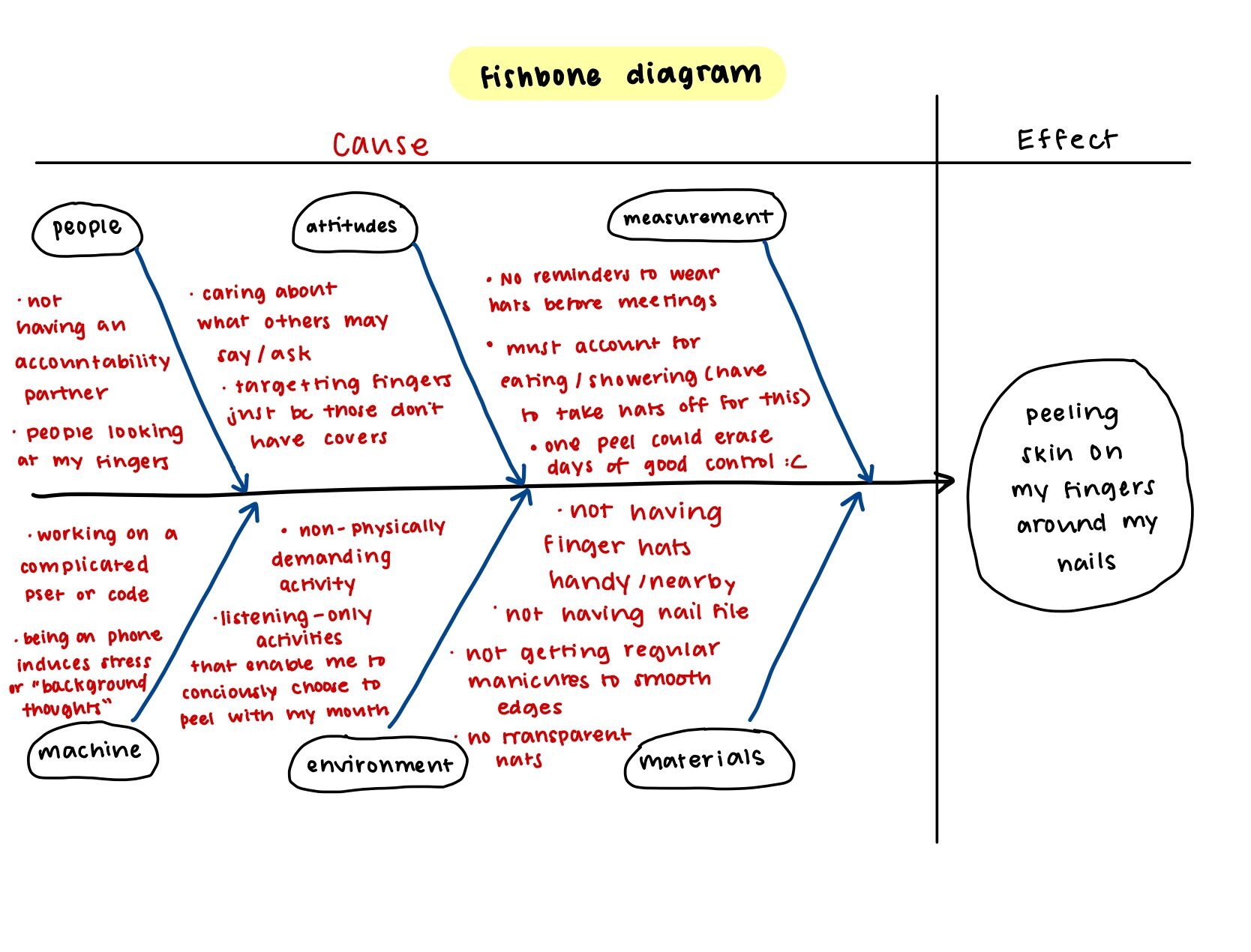
Fishbone Diagram: Creating the fishbone diagram also enabled me to think outside the box at which factors (out of the observed factors in the connection circle and experience journal) are rooted in my own attitude, and which are rooted in external environmental factors. I recognized that some experiences in the environment (eating at the dining hall, in a professional setting, showering) would all be instances where I would potentially not be able to wear my finger hats for control. However, even in these settings, I can switch to physically demanding or engaging activities that could distract me away from peels. Overall, the hidden stress underneath that roots from caring about people’s opinions, thinking about solving a complex PSET problem, or reminders of a conversation with a friend over something emotional on the cellphone, all appeared as additional triggers that would act as “background thoughts” that triggered peels.
What I’d Do Differently: Now that I have narrowed the cause down to “background thoughts” and the solutions down to “productive distraction” and kinetic therapies with my finger hats (which are notably less sustainable across environments), I would like to note down whenever these background thoughts occur over weeks 6-9, when work really speeds up and personal/academic stress becomes inevitable. I want to learn, when does this mental multi-tasking occur, how much engagement in my physical setting is required to take me away from peeling, and what are the types of thoughts I am having? Are they filler thoughts (head empty, just daydreaming), or are they tangible stressors in my life that I should be reducing?
