
In Product Management in Practice, LeMay establishes the notion that product managers must adapt to different roles and needs based on the day and their project. Looking at Spotify, Airbnb, and Zappos, we see that the PM’s role and authority can also dramatically change based on organizational structures.
At Spotify, the notion of “squads and tribes” entails a high-autonomy framework where small “squads” have startup-like flexibility in how they want to achieve their end goals. A “tribe” consists of several squads working on related projects [1]. At Spotify, the PM has high flexibility and authority within their squads and tribes, but these groups may be small and decentralized to the point where the PM’s influence is more limited across the organization-at-large. The level of modularity would make it easy for me to be siloed as a PM, as the Spotify model can assign each squad a narrow, hyperspecific goal. Each squad may have to “reinvent the wheel” as opposed to access knowledge shared across the organization [2].
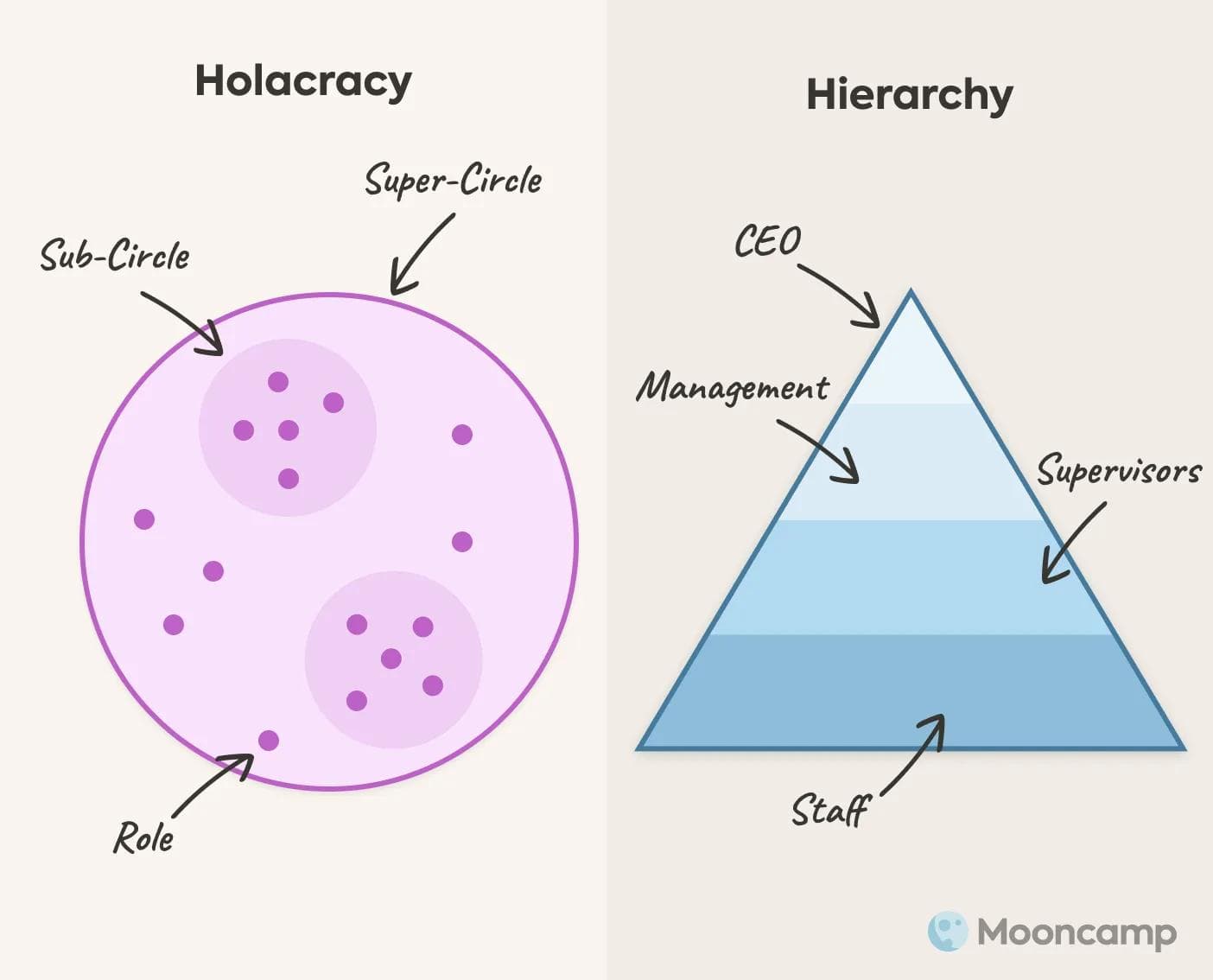
Zappos’ “holacracy” eliminates traditional managerial roles in favour of distributed ownership. PMs were decoupled from the management chain, and instead owned processes instead of teams. Though controversial (18% of the company left after holacracy [3]), Zappos brings a compelling case of embracing uncertainty as a PM alongside the rest of the organization. However, non-defined roles may cause friction or unspoken hierarchies.
Airbnb’s CEO Brian Chesky, a RISD-educated designer, pushes for a design-centric strategy. The company restructured in 2024 to use “40% fewer management layers” [4] to instead allow product development to be design-driven and top-down. The PM exists to execute on designers’ decisions, allowing for clean directional implementation but less authority over product vision and strategy. Though design is important to me, I prefer end-to-end ownership above a top-down approach with set constraints.
As a PM, I prefer Zappos’ holacracy as it is neither overly siloed nor top-down. Holacracy allows early-career PMs to assume authority and engage in end-to-end processes without overreliance on formal titles. Holacracy would push me to stay flexible and mission-driven as a PM.
Sources Used
[1] Spotify model (squads, tribes, chapters, guilds)
[2] Why Spotify Squads Are a Popular Failure for Product Teams
