
Spotify
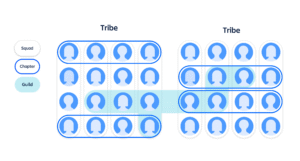
At Spotify, teams have autonomy, where each Squad of 6-12 people can choose the framework they want to follow and focus on one feature area. Each Squad is cross-functional, has its own goal, and has a product owner meant to guide it toward that goal. The Spotify product owner sits within the cross-functional team structure and guides a squad, but the squad makes many of the decisions.
Airbnb

At Airbnb, it is very different, as the CEO plays a large role in how the company functions. All major product work lives in one roadmap that shapes how projects are handled, so the product manager role was merged with product marketing. PMs work with designers to define the project and outline the goals and the problem they want to solve. PMs have a lot of influence, but the CEO has ultimate authority.
Zappos

At Zappos, they use Holacracy, where authority is distributed across roles and circles rather than the management titles most other companies use. Each role has its defined set of responsibilities and decisions they can make. A PM role at Zappos would have a specific set of responsibilities that might be distributed across multiple circles. In this case, their authority covers those responsibilities. I was surprised that Zappos doesn’t use the traditional titles other companies do, and that it has a system built around roles, circles, and responsibilities.
What I’d choose
As I read through these, I thought a lot about the LeMay reading and how he said that PMs can have a lot of responsibility but little authority. Each company has its own way of doing things, so authority looks different at each one. I would most like to work in the Spotify structure. As a PM, I think I would enjoy being part of a cross-functional team where I can guide product direction without making every decision myself, since engineers can be skilled and provide strong input.
Sources:
