
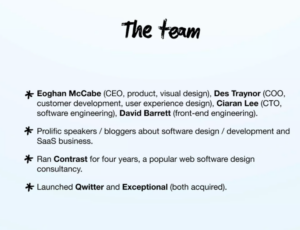
Intercom’s first deck had zero user data and still raised $600K. I think the reason sits on slide 2: before touching the problem or solution, they led with the team — four founders who had already sold two companies. In 2011, that was the bet. Investors weren’t buying evidence; they were buying people they trusted to go find it.
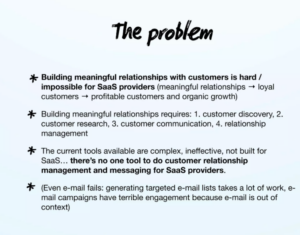
Slide 3 states the problem plainly: for SaaS companies, building customer relationships is hard. The logic runs from relationships to loyalty to profit and growth, and the tools around then were, in their words, “complex, ineffective, not built for SaaS.” Compelling, but still a claim.
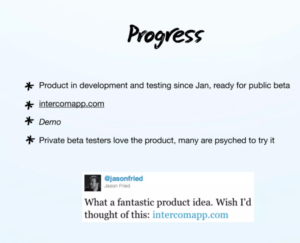
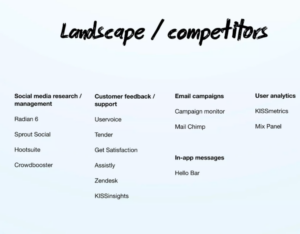
The proof side is thinner. Slide 7 says “private beta testers love the product” — love how? Weekly logins? Messages sent? We never learn. Ironically, the strongest evidence hides on the competition slide, which lists more than a dozen tools. SaaS teams were already stitching that patchwork together and paying for it. That behavior says more than any testimonial.
Slide 5’s “$21 billion market, $93 billion by 2016” sounds impressive, but it measures SaaS providers’ revenue — and SaaS providers are Intercom’s customers. Fine as a growth signal. Broken as market sizing.

An investor would push: how many would pay, how much, what did beta users actually do, why switch from many tools to one.
What I’m stealing: turn the competition slide into the problem slide. We’re looking at scheduling and workload conflicts, and 10 of 16 PMs we interviewed juggle calendars, Slack, and AI trackers. I’d draw that patchwork and put the number on it. I’m also taking the problem-to-money chain — a conflict delays a review, the delay slips a launch — with interview quotes at each link.
AI note: I used AI to brainstorm the evidence section and polish this draft.
https://www.slideshare.net/slideshow/intercoms-first-pitch-deck/60630417
