
Uber starts by identifying the pain points. They introduce aging radio-dispatch tech, lack of GPS coordination, and heavy “dead-time” as what makes the cab experience painful and low-quality. They then proceed to introduce the taxi monopolies and the medallion system as the root cause for how incentives are misaligned, and therefore, the service quality is destroyed.
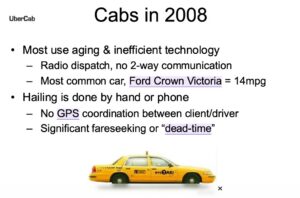
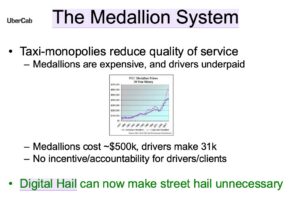
After problem slides, Uber goes through the solution and how digital hail can change things. They size the market with following slides:


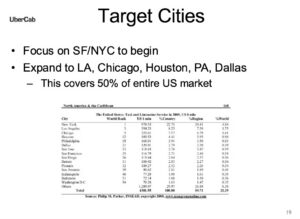
The market size is framed as a $4.2B annual industry, dominated 64% by non-airport retail trips. Uber maps out geographic expansion starting in SF/NYC, showing that conquering just seven cities captures 50% of the entire US market, which makes the market feel more obtainable.
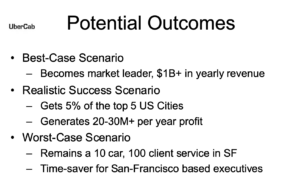
Uber closes its pitch with a slide that goes over best, realistic, and worst case scenario.
An investor analyzing this deck would ask
- How do you bypass city medallion laws without getting shut down by local taxi commissions?
- Why would drivers take a risk on a new platform before demand is established?
- Who covers insurance, driver background checks, and mobile data plans?
Especially because Uber introduces the medallion system, I would certainly expect it as a follow up question. The deck also doesn’t highlight anything around the driver experience, other than the financial incentive misalignment with the medallin system where we see $500k medallions vs. $31k driver earnings.
For our sanity check, I’d take Uber’s broken benchmark slide where the legacy incumbent’s metrics are against the modern software lever as an inppiration for how we should present our problems. I also liked how Uber gave us a concentration map with 7 cities, we can also think about where our ICPs are concentrated.
