
Note:
Images cannot be loaded properly in this post, please find them in the pdf here: Milestone 2
VPC, BMC, MVP:
VPC (Value Proposition Canvas):
This is our Value Proposition Canvas (VPC).

BMC (Business Model Canvas):
This is our Business Model Canvas (BMC), available on Figma.
Madlib’s Value Proposition Statement:
Our application helps young Americans who want to to grow their fashion style and sense by curating outfit inspirations and recommendations while learning their preferences, unlike existing social media and information discovery solutions which can be noisy or unpersonalized.
Comparative Research Findings:
For our 2×2 competitor matrix, which can be found here on Figma, we chose two axes to measure our competitors.
- Noisy vs. clean: How noisy is the amount of data that is shown to the user? How easy is it to sift through all the information? We believe that many sources of inspiration/fashion out there have a lot of noisy data–we hope to provide a source of clean data through Quinn.
- General vs. personalized: How personalized is the data/content that is presented to the user? We believe that people have their individual sense of style, so Quinn aims to present personalized inspiration to our users.
We looked into 8 different competitors that we deemed to be relevant and direct or indirect competitors to Quinn. We found that many products that have high intent for fashion (Pinterest, Stylebook, StitchFix) were quite personalized but could be less noisy. On the other hand, we found that many e-commerce websites or general search engines are inherently noisy and not very personalized.
- StitchFix
- Personal styling service that uses your preferences and social media outlets to select and ship five items (you choose shipping frequency)
- Recommendations are made with the combination of a professional stylist and data science/machine learning
- Stylebook
- #1 paid Lifestyle app on the App Store
- Wardrobe organization and closet management tool that offers 90+ features spanning outfit collage creator, owned clothes importing, outfits using shared item features, and outfit repeating features
- Primarily a content management system, rather than a recommendation tool
- Amazon
- #1 retailer of e-commerce, which includes clothing bought online
- Large variety of vendors hosting their products on Amazon platform
- Amazon offers the most competitive pricing for goods and best deals for delivery/returns (which is very important for buying clothes online)
- ThredUp
- #1 thrifting app on the market
- High quality clothes at low prices
- Allows for any user to sell their clothing
- Pinterest
- Image sharing and social media service, users can create boards full of images
- Many of the interviewees we talked to mentioned Pinterest as a place where they went to in order to get outfit / style inspiration
- Feed is curated by users
- Search bar and save feature similar to what we hope to create with Quinn
- Two-step moderation process: AI-based moderation and human moderators
- Instagram
- Image/photo sharing service, feed is generated by users
- Can save / like / comment on photos
- Searching keywords can allow you to pull up similar posts, hashtags are a main way to search
- Heavily moderated by AI
- Google
- Commonly used to search for fashion inspiration or outfits to build around certain items
- Uses web scraping to produce results
- Results can often be noisy or low quality
- TikTok
- Many fashion trends/microtrends are birthed from TikTok
- Influencers and everyday creators post outfit inspiration
- Uses algorithm to learn user preferences and cater to tastes
Participatory Roadmap:
We conducted a total of 8 user tests for our participatory roadmap. We created a FigJam file with a “Features” bank, and had the participants divide it into the “Soon,” “Later,” and “Much Later,” categories. We also created our own version of the participatory roadmap to see how closely our assumptions of what features we should implement soon/later/much later matched those of our test participants. See the results of all the participatory roadmaps on FigJam here.
User Story Map:
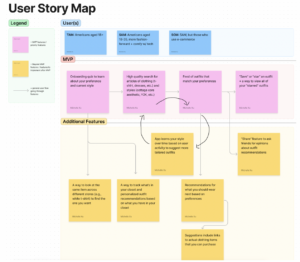
Below is a screenshot of the user story map that was developed. We took our features that we brainstormed for our participatory roadmaps, split it into which we wanted for our MVP, and created a user flow to lead from one feature to the next. For a more in-depth look at our user story map, please visit the FigJam link here.
Assumptions Map:
Assumptions (riskiest assumptions are highlighted):
Can we do this
- Looking through a feed isn’t overwhelming with information overload
- There are enough people out there who have the same aesthetic
- Users are willing to spend money on new clothes for the sake of fashion.
- Users buy clothes online
- People have the time to browse through a feed
Should we do this
- Users are confident that an ML model could accurately learn or predict their taste
- Users feel comfortable with their data being fed into an ML model
- People are open to new closet item suggestions
- People get inspired by what they see around them
- Users are sometimes unsure how to choose between similar clothing items.
Do they want this
- Users know which items they want to see styles for
- People care about finding their own style over keeping up with trends
- People are always looking to improve their style
- Users care about fashion trends
- Users use other people’s outfits as inspiration
- Users want and think it is a delightful experience to see content aggregated from different sources
- Users want to reuse and maximize value from a single clothing item
- Users care about putting together nice outfits.
- Users like experimenting with new styles, even if they don’t end up adopting them.
- Users have clothes in their closet they don’t know how to style.
- Users respect the fashion style (overall) of fashion influencers and trends.
- Users value the opinion of their social circles when it comes to fashion style.
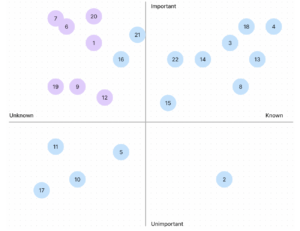
Corresponding assumptions map
Riskiest assumptions are in purple
Experience prototypes / experiment board
Experience prototype test card:
- Key assumption: We believe that users have clothes in their closet they don’t know how to style.
- Driving motivation: We want to be able to help users style clothes they don’t know how to style.
- To verify that, we run the following experience prototype: we will pick out 5 items in someone’s closet and ask them how they would style it.
- And measure the number of items they’re not sure how to style. We will also write down observations (do they take a lot of time to decide, are they pondering really hard, etc.) and notes about how often they wear the piece.
- We are right if each person has a couple pieces they don’t know how to style confidently.
Test #1:
- Tester: Annie Ma
- Participant: Carina Fung (20yo female college student who loves fashion)
- Items selected (participant did not consent to photos):
- black ruched long sleeve top
- style with jeans, white pants, or beige skirt
- confidence score: 5/5
- how often worn: once every 2-3 weeks
- yellow and blue plaid skirt
- style with white or black sweater
- wishes there was more things she could wear with it
- confidence score: ⅘
- how often worn: once every month or two
- white and green checkered pants
- style with black tank top
- wishes there was more things she could wear with it
- confidence score: ⅗
- how often worn: once every month or two
- pink t-shirt
- not really sure what to style with, since it’s a weird shade of pink
- confidence score: ⅕
- how often worn: pretty much never
- blue tank top with tulle detail
- style with black jeans or white pants
- confidence score: ⅘
- how often worn: once every 2-3 weeks
- black ruched long sleeve top
- Conclusion: This test was consistent with our key assumption that people have clothes in their closet they don’t know how to style.
Test #2:
- Tester: Joseph Ngo
- Participant: Tracy Ha (20yo female college student who loves boba)
- Items selected (participant did not consent to photos):
- Maroon pullover
- White turtleneck under
- 10/10
- 2 times a quarter
- Khaki skirt
- baggy sweater
- 6/10
- 1 time a quarter
- Light blue skinny jeans
- baggy sweater
- 4/10
- 2 times a year
- Light blue sweater
- white skirt, white jeans, anything
- 8/10
- 5 times a quarter
- Black Jeans
- tank top
- 9/10
- 10 times a quarter
- Maroon pullover
- Conclusion: This test was consistent with our key assumption that people have clothes in their closet they don’t know how to style.
Results & Next Steps
Based on our experience prototypes we built to test our assumption (users have clothes in their closet they don’t know how to style), we have concluded that this assumption is true. In both tests, we selected random items from the interviewee’s closet at random and found that we consistently found items they couldn’t style.
The next key assumption we should test is “people care more about their own style than what is trendy”. I think building out this prototype would complement our previous research because we are looking to provide a service to help our users style the clothes they currently struggle to style. Now that we know style clothes is a common problem amongst our target demographic, we need to decide how we are going to give style inspiration to our users: more personalized or more based on clothing trends/fads?
