
Comparative Research
| Value Proposition | Gaps | |
| Google and Outlook Calendar |
|
|
| Doodle |
|
|
| Calendly |
|
|
| When2Meet |
|
|
| Messaging Apps |
|
|
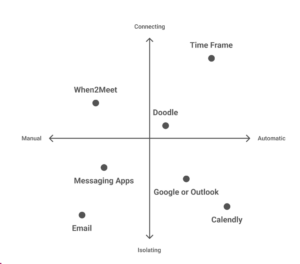
The competitive landscape of group scheduling tools is large but lacking a critical combination: a tool that is integrated with a user’s calendar and is optimized for collaborative scheduling outside of a shared organization.
Our primary competitors are Google, Doodle, and When2Meet. Google integrates across many apps and makes it easy to enter information once meeting details have been hashed out. It also has advanced scheduling features but these are only available for users in the same organization. It is therefore not very helpful when scheduling across those lines. When2Meet enables some collaborative work but its feature set is very simple, its UI makes for an incredibly frustrating UX, and it offers no integration with calendar for non-manual availability entry and notification systems to stay updated on the process status. Doodle does a better job at focusing on the group dynamics with several helpful features in the early stage of scheduling. It is not perfect however as the process flow is quite linear which leads to long wait times for process closure.
The most frequently used home grown solution is manual scheduling via messaging applications like iMessage, Whatsapp or Slack. They allow for rapid and seamless exchange of information which can be perfect for scheduling simple social events with few constraints. These solutions scale poorly however and are very inefficient when people are busy and do not know each other well. You are limited to word exchange and no other supporting tools.
Our last related competitor is Calendly. It is only really useful for 1-on-1 scheduling when the role structure is clearly defined (a scheduler vs a schedulee). It is therefore very effective for that use case but provides little value in the context of group scheduling.
We believe that each of these competitors tackle at least one pain point in the group scheduling process. That usually comes at the cost of sacrificing another facet of the experience. By combining these together, we believe we can create a superior experience. Specifically, we want to automate information entry to the max, keep users in the loop about progress, and circularize the process to accommodate the time uncertainty of scheduling and the required flexibility from multiple stakeholders.
Participatory Roadmap
Insights
- Game mechanisms feel more human than standard calendar invites–this can be a good or bad thing depending on the context. However, a puzzle might not be the best incentive to get people to respond faster – we need to dig deeper and see what people really care about gaining/losing
- The weight of scheduling is partly due to set-up work, but mostly due to the mental burden of unfinished business.
- Reminders feel like being chased–they can be uncomfortable even when you want a task to be completed.
- The scheduling dynamic is dictated by the familiarity of the group–power dynamics and willingness to engage with a game change the closer the group is.

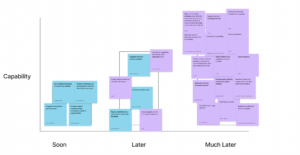
Above figure displays a summary of the distribution of features across all collected participatory roadmaps
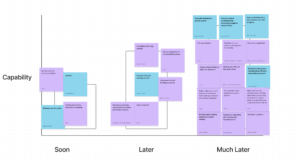
Some individual roadmaps

Some interview Notes/Quotes
- “I imagine a lot of external partnerships are with senior folks who don’t care about completing puzzles.”
- “The more people, the more schedules you have to balance…your best bet is to propose a time”
- “The game element is nice but it needs to work first…integration is the most important thing to me.”
- “What is the reward? The reward is either doing something fun like happy hour or getting the scheduling over with”
- “The amount of hours [that I spend scheduling] isn’t heavy but the frequency of referring back to it is impactful”
- “I don’t like being chased–it makes me feel like I’m not on top of it”
- “I want a nudge that comes from myself…I don’t want an app chasing me to do something”
- “I don’t mind signing up with Google calendar if I can set up with my constraints and preferences”
- “I would only use my Calendly link with someone I’m not super close to…there is an undertone of professionalism when you send someone your Calendly link, a tone of ‘I’m a busy person.’”
- “I didn’t really like that, I don’t like people really seeing my calendar…I got comments about what I was doing…I’m not hiding anything, I just have a lot of blocked time for me…I don’t want people to grab time because they don’t think its academic”
- “I like to be in control, that’s why I take the role of the scheduler.”
- “Scheduling gives me the agency that the meeting won’t interfere with other things I have planned.”
- “The punishment for people who don’t submit times should be that they don’t get to see the final picture.”
- “We are meeting to meet people after all and this tool feels more human than when2meet.”
- “I want to have a deadline for inputting availabilities without the anxiety that comes with deadlines.”
- “There are all these unspoken norms when providing availabilities. I like that your tool addresses them.”
- “A puzzle or picture is not incentivizing enough. If someone doesn’t want to do it, that wouldn’t push them. They don’t gain or lose anything here”
- “Money is the best way to incentivize people”
- “It is important to me to rank times because not all times are as free as others”
- “Adding and removing attendees as well as scheduling recurring meetings is a very basic need and feature”
- “The process of the puzzle unlocking seems too much”
- “I hate when people don’t respond fast”
- “I take initiative because I want things done fast”
- “Some people need to constantly be reminded”
- “There need to be consequences for not responding on time”
- “I don’t want anyone to see my time slots”
- “The stakes need to be higher, people who don’t care are quite indifferent and really need a big push”
