In design thinking, you go through the design process in the following way:
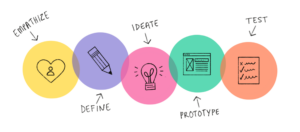
[Empathize –> Define –> Ideate –> Prototype –> Test]
Certainly, there are some dazzling “pros” about design thinking:
- Cyclical: allows you to make continuous changes/improvements.
- Starts with empathy: tries to put people first, before any technical stuff.
- A clearly defined process: tries to prevent you from going off-track and losing focus.
- Requires interaction with user base at the start and the finish: you can’t empathize/test without this.
- Savvy and trendy! It’s all the hype right now, which I suppose could be seen a as a pro.
But there are also some perils that cannot be ignored, many of which are called out in the article “Was Design Thinking Designed Not to Work?”
- Hero and white-savior complex.
- Considering user base as just a channel for feedback and inspiration, rather than building alongside them.
- This is the idea of building for vs. building with. Why shouldn’t the people you’re “building for” have a say at every step?
- Rigidity, ignoring the humane aspect of people at each step of the way.
- Selling process for profit, which can diminish the importance of the process in the first place.
- Compressing a months-years-long process into 5 steps or 5 days and removing a lot of the intention of design thinking in the first place.
- Unrealistic, a fantasy that you can do what the best designers do.
- Focusing more on the how than the why and for whom.

A big real-world example that immediately comes to mind when thinking about the perils of design thinking are the problems with Apple’s FaceID, and more broadly facial recognition algorithms. This could make total sense with design thinking: Empathize with people who think TouchID is cumbersome; Define the problem that people want more immediate access to their phone’s contents; Ideate a face ID product; Prototype it; then Test it.
Upon a closer look that goes beyond the steps, some questions come up: along the way from empathy to testing, who did you lose? What are the demographics of people you’re testing on? Who can afford iPhones in the first place at the moment?
There were problems here that weren’t illuminated by the design thinking process: the algorithms weren’t trained on inclusive datasets, since the standard databases are predominantly white and male-identifying. Moreover, default camera settings aren’t optimized for darker skin tones, which can result in lower-quality photos of darker-skinned individuals.
There’s a lot that can get lost along the way of the steps in design thinking, but the framework itself isn’t the only thing to blame here: it’s alarming that the many folks working on this weren’t able to catch this before its release. I believe it absolutely was within the scope of the problem domain they set off to tackle, and this is a clear example of how inclusion is often an afterthought in Silicon Valley design thinking.