
Spotify:
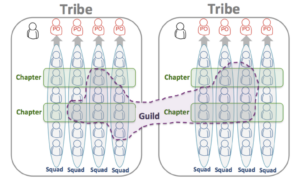
Image Source: Scaling Agile @ Spotify
At Spotify in 2012, the organization was split into squads, tribes, chapters, and guilds (Scaling Agile @ Spotify). Leadership chose direction by assigning squads specific missions, while product owners (PO’s; Spotify’s product managers) were responsible for deciding what to build by setting work priorities for the product backlog. The PO does not decide how the squad does it.
Airbnb:
In 2023, Airbnb was rebuilt to a functional organizational structure with different departments based on skill such as design, engineering, and marketing (Medium). Within this structure, leadership gets the final say on the product roadmap, but works together with design, engineering, and product marketing to decide what gets built. Product managers (PMs) are replaced by product marketing managers (PMMs), which is “product management plus outbound marketing… they will work with the designers and us to establish what is this project, what are the goals, what are we trying to solve” (YouTube).
Zappos:
In 2014, under Zappos’ holacracy the person with the role associated with each feature has the final say on what gets built (Holacracy Constitution). Within holacracy, PMs would not have the job title, but instead multiple roles with the responsibilities of a traditional PM belonging to different circles within the organization. No role has authority over another’s accountabilities.
My critique:
Airbnb’s collaboration between departments to decide what to build is clever because it allows for an interdisciplinary approach. Spotify’s POs deciding product features and work priorities alone seems flawed as that gives them too much outcome accountability. Zappos’ holacracy is clever because it prevents authority over others, but is flawed because collaboration is more difficult when everyone has different accountabilities. For these reasons, I could best perform my CORE skills as a PMM at Airbnb.
