
Round 2 PM Interview Screener
- What is your current role/title?
- How long have you worked in product management or a closely related product role?
- What type of company/product do you currently work on?
- Which groups do you regularly work with?
- Engineering
- Design
- Data
- Sales
- Marketing
- Customer Success/Support
- Leadership
- Customers
- Other
- Are you currently involved in product prioritization or roadmap decisions?
- Yes
- Sometimes
- No
- Are you comfortable discussing specific recent examples from your work without sharing confidential information?
- Yes
- No
Interview Script
Introduction
Thank you so much for talking with me! We’re trying to understand the problems product managers actually encounter in their day-to-day work. I’m especially interested in specific recent experiences, so I may ask follow-up questions about examples you mention. You don’t need to share anything confidential.
Background
1. Could you briefly tell me about your current role and what you work on?
Possible follow-ups:
- How long have you been working in product?
- What teams or functions do you work with most often?
- What kinds of decisions are you responsible for?
Information Gathering and Product Discovery
2. Tell me about the last time you started working on a problem or request and realized you didn’t have all the information you needed.
Possible follow-ups:
- What information was missing?
- When did you realize it was missing?
- What did you do next?
- Who did you have to contact?
- Where did you look for the information?
- How long did that take?
- How much did it slow down the work?
- How often does something like this happen?
3. Where does the information you need to make product decisions usually live?
Possible follow-ups:
- Is anything particularly difficult to find?
- What happens when you can’t find the information you need?
4. What have you tried to make that process easier?
Possible follow-ups:
- Do you use documents, spreadsheets, dashboards, Notion, Slack, AI tools, or another system?
- Who maintains those systems?
- What works well about your current approach?
- What still doesn’t work?
Cross-Functional Alignment
5. Tell me about the last time two people or teams you worked with wanted different things from the product.
Possible follow-ups:
- Who was involved?
- What did each side want?
- Why did they disagree?
- What did you actually do?
- How did you communicate with each group?
- What happened next?
- Did everyone eventually agree?
6. When people still disagree, how do you determine who ultimately makes the decision?
Possible follow-ups:
- Can you think of a recent example?
- Was the decision actually yours?
- Were there people who could effectively veto the decision?
- How did you get people to support the decision afterward?
Prioritization
7. Tell me about the last particularly difficult prioritization decision you had to make.
Possible follow-ups:
- What were the competing options?
- Why couldn’t you do both?
- Who was affected by the decision?
- What evidence did you use?
- Did anyone disagree?
- What did you ultimately choose?
- What did you have to give up?
- Looking back, do you think you made the right choice?
8. What factors tend to matter most when you’re prioritizing?
Possible follow-ups:
- Number of users affected?
- Severity of the problem?
- Revenue?
- Engineering effort?
- Strategic fit?
- Customer requests?
Uncertainty and Evidence
9. Tell me about the last decision where the data didn’t give you an obvious answer.
Possible follow-ups:
- What made the decision ambiguous?
- Did different sources of evidence point in different directions?
- What information did you wish you had?
- What did you use besides quantitative data?
- How did you know when you had enough evidence to act?
- What happened after you made the decision?
10. Can you think of a time when you made a decision without enough evidence and it didn’t work?
Possible follow-ups:
- What went wrong?
- What did you learn?
- Did you change anything about your process afterward?
Reactive vs. Planned Work
11. Tell me about the last time something urgent interrupted work you had planned.
Possible follow-ups:
- What happened?
- Where did the request come from?
- What had you planned to work on instead?
- Why did the new issue take priority?
- What did it cost you or the team?
- How often does this happen?
12. What type of work usually gets pushed aside when unexpected things come up?
Manual and Repetitive Work
13. What part of your job feels more manual or repetitive than it should?
Possible follow-ups:
- When did you last have to do that?
- Walk me through what you did.
- How long did it take?
- What tools did you use?
- Who else was involved?
- How often do you do this?
- What have you tried to make it easier?
- Do other PMs you know experience the same problem?
Tools and AI
14. Are you currently using AI or any other tools to make parts of your product work easier?
Possible follow-ups:
- What do you use them for?
- Where do they work well?
- Where don’t they work well?
Affinity Map — Four Broad Groups
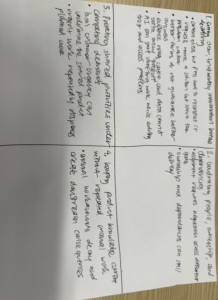
Map Takeaway
The four broad groups are connected: PMs need trustworthy context, coordinated delivery, explicit priorities, and current shared knowledge. The strongest central problem is the work required to get to a well-grounded decision and keep teams acting on it.
These groups organize the interview evidence; they do not establish how common each problem is across the PM population or demand for a universal tool.
AI Reflection
What did AI catch that I missed?
The AI linked finding information to trusting it, a connection I hadn’t made. Maya said a fast summary of the wrong document doesn’t help her, and Daniel worried about information that was outdated, sensitive, or contradictory. So the real problem isn’t only that information is scattered; a solution would also need to show provenance, recency, source quality, and conflicts between sources. The AI also pointed out how closely the consumer and B2B interviews matched, which I had noticed but not stated.
What did AI flatten into something generic?
It turned specific behaviors into broad labels like “information overload,” “stakeholder management,” and “prioritization.” “Information overload” is less useful than “I spent 40 minutes finding an old experiment that turned out not to be relevant” or “I spent 2.5 hours assembling material for one roadmap review.”
It also reduced alignment to “cross-functional communication.” That label misses the more interesting pattern: both PMs learned that a joint meeting made disagreement worse, so each talked to every function separately first.
Did AI assert anything that isn’t in the transcripts?
Yes. The AI said the opporsite of what the transcripts say: Maya wants the context but still wants to decide, and Daniel said judgment is the reason a company has a PM.
Long List of Candidate Problems
Support lists name distinct accounts rather than repeating the old 2/3 and 3/3 figures. “Existing” indicates the original document’s summary; “executive notes” indicates the conversational rewrite. Problems can share supporting incidents, so rows are not independent observations.
| Candidate problem | Supporting accounts | Evidence / workaround (paraphrased) |
|---|---|---|
| 1. Decision context is fragmented across tools and people | Aidan; Sejal; Anduril; Charlie; executive notes; existing Maya/Daniel | Roadmap reviews require requests, usage, estimates, obligations, and previous decisions from separate systems. Running docs and Aidan’s discovery agent help assemble them. |
| 2. PMs repeatedly assemble information that already exists | Aidan; Anduril; Charlie; existing Maya/Daniel | Anduril and Charlie each report about 2.5 hours for one roadmap review. Their manually maintained pages are incomplete substitutes. |
| 3. Requests omit the underlying problem, users, outcomes, or constraints | Aidan; Kanan; Anduril; Charlie; executive notes; existing Maya/Daniel | One-line wishes trigger stakeholder clarification. “Better track management” meant duplicate tracks; “more granular alerting” meant harmful noise. |
| 4. Waiting for people stretches discovery far beyond active work | Anduril; Charlie; executive notes; existing Maya | Anduril: roughly two hours across three weeks; Charlie: roughly two hours across two weeks. Contact chains, availability, and approvals delay understanding. |
| 5. Required intake fields accept unusable answers | Anduril; Charlie; existing Daniel | N/A, TBD, generic compliance labels, and uniformly critical urgency leave structured forms without useful evidence. |
| 6. Improving upstream intake requires another team’s cooperation | Aidan | The form-owning team initially resisted intervention. Manager sponsorship and a presentation gained agreement on an intake-agent approach. |
| 7. Functions defend competing goals before understanding constraints | Anduril; Charlie; existing Maya/Daniel/Genevieve | Separate conversations turned launch pressure, technical risk, and legal concerns into concrete conditions for a limited release. |
| 8. PMs carry delivery responsibility without unilateral authority | Anduril; Charlie; Aidan; executive notes; existing Daniel | Legal and Security limits, engineering estimates, and other teams’ ownership constrain decisions. Influence and negotiated commitments are needed. |
| 9. Approvals and cross-team dependencies delay delivery | Kanan; Anduril; executive notes | Kanan explicitly names business, architecture, compliance, and infrastructure dependencies. Documentation and follow-up are recurring work. |
| 10. Cross-product incidents lack a clear owner and escalation route | Executive notes | Issues stayed in informal discussions or development queues. Clear routing, technical leadership, and responsibilities were needed. |
| 11. Teams cannot trace failures across a multi-system workflow | Executive notes | Logs and monitoring were split across application, platform, and support teams; correlation information was incomplete. Better end-to-end visibility was sought. |
| 12. Workload and service assumptions remain undocumented until escalation | Executive notes | Volume, concurrency, document size, retries, failure thresholds, and response-time expectations were missing from the initial isolation request. |
| 13. Customer-specific requests fragment shared products | Anduril; Charlie; executive notes; existing Daniel | Reusable integration frameworks reduced one-off work, but broad connectivity or performance improvements still slipped. |
| 14. Prioritization forces tradeoffs across severity, revenue, reach, and strategy | Anduril; Charlie; executive notes; existing Maya/Daniel/Genevieve | Contract or renewal work competes with improvements for many users; high revenue does not erase the cost to the wider roadmap. |
| 15. Loud or high-value customers are mistaken for representative demand | Anduril; Charlie; Sejal | Claims about all branches or banks shrink when named accounts are requested. Manual counts and segmentation help assess actual reach. |
| 16. Buyers and users can want different outcomes | Anduril | Program offices, leadership, and operators have different needs. Field conversations and deployment evidence help distinguish them. |
| 17. Quantitative usage and qualitative research do not settle segment priorities | Anduril; Charlie; existing Maya/Daniel | Experienced users want advanced detail; newer or smaller teams are overwhelmed. Simpler defaults reflect a strategic choice. |
| 18. PMs must act without knowing whether evidence is sufficient | Anduril; Charlie; existing Maya/Daniel | Waiting for perfect information misses opportunities; reacting to anecdotes destabilizes the roadmap. PMs choose acceptable uncertainty. |
| 19. Literal feature requests lead to low-use builds and rework | Anduril; Charlie | Display customization and adjustable risk weights missed the real jobs: attention under pressure and explainable scores. Months of work preceded redesign and earlier prototyping. |
| 20. Reactive escalations crowd out roadmap and strategy work | Anduril; Charlie; executive notes; existing Maya/Daniel | Weekly unplanned work and customer incidents displace planning despite on-call processes, runbooks, and protected time. |
| 21. Roadmap versions disagree and create incorrect customer commitments | Prenna | Jira said April while slides said March. Sales repeated the old date; fixing expectations took about half a day and reduced trust. |
| 22. Synchronizing roadmaps depends on unreliable manual upkeep | Prenna | A Jira-to-slides plugin broke formatting and was dropped. Friday reminders fail during busy periods; sync ownership remains unclear. |
| 23. Important feedback is discovered after dependent work has begun | Sejal | Confusing-feature tickets stayed in a support tool until the next version was underway, making a base-feature correction costly for the timeline. |
| 24. Feedback tagging and sprint reporting repeat substantial manual work | Sejal | She tagged and counted tickets in a spreadsheet for an afternoon and repeats summaries every two weeks for her manager. |
| 25. AI summaries flatten details and overstate the evidence | Sejal | Generic summaries were unhelpful; one speed complaint became a broad claim. Manual verification eroded the time savings. |
| 26. Stale and contradictory sources make synthesized context hard to trust | Anduril; Charlie; existing Maya/Daniel | PMs want sources and disagreements exposed. Aidan’s agent labels evidence, inference, and assumptions as a related workaround. |
| 27. Sensitive information cannot be used in unrestricted AI tools | Anduril; Charlie | Classification/export controls and incident or vulnerability sensitivity restrict usable tools and data access. |
| 28. Decision records save time only while PMs keep them current | Anduril; Charlie; existing Maya/Daniel | Long running documents and Notion/Confluence pages create recurring maintenance work. |
| 29. Product teams repeat analysis or build overlapping capabilities | Executive notes | Separate roadmaps can hide shared capabilities. Portfolio review and coordinated planning are used to find reuse. |
| 30. Promised production dates bypass readiness and capacity lead time | Executive notes | A partner named a date before documented reviews were allowed for. The response clarified remaining work and assigned one technical lead. |
| 31. Information-transfer meetings substitute for accessible shared context | Existing Maya summary only | The original map notes meetings with multiple people because one holds needed information. Retained as a narrower lead, not new cross-interview evidence. |
Said vs. Did
Intake forms promised clearer information, but Anduril and Charlie still received placeholder answers. Prenna tried automated synchronization, then abandoned it when formatting broke; the manual reminder fails when she is busy. Sejal used AI to reduce synthesis work but then verified it herself after an inflated claim.
Aidan’s discovery agent reached organizational adoption; the separate intake agent had approval to move forward, which should not be confused with demonstrated deployment or measured time savings.
Surprises and Contradictions
The added accounts show consequences beyond time spent searching: wrong dates reach customers, useful feedback arrives after dependent work starts, and unclear ownership prolongs incidents.
AI is neither uniformly rejected nor automatically trusted: Aidan built and deployed a discovery agent, while Sejal described unreliable summaries and regulated-domain PMs described access constraints. Several accounts favor decision preparation with human judgment.
Similar structure and phrasing across some interviews should not be treated as independent proof of prevalence; these materials support hypotheses for further validation.
TAM
There are about 1.6 million product managers worldwide. Product Focus counted them on LinkedIn in October 2023 and found 427k in the USA, 567k in Europe, and the rest spread across Asia, the Americas, the Middle East, Oceania, and Africa [1].
The count is directional: LinkedIn underrepresents PMs in countries where it isn’t widely used, and the role has grown since the 2021 snapshot of 336k in the USA [1, 2].
Analyst estimates of spending on PM tools range from about $1.3B for narrow roadmapping tools to $4.15–6.61 billion for broader PM software in 2025 [3–6]. A bottom-up check lands in the same range. Productboard charges $19–59 per PM per month on its standard plans and about $300–400 for enterprise, with a $20 AI add-on [7].
A blended cost of about $1,860 per PM per year across 1.62M PMs gives a TAM of roughly $3B globally (about $0.8B in the US). This is potential spend, not current spend. In a 2017 SiriusDecisions study, only 30% of B2B PMs regularly used purpose-built PM tools [8].
Sources
- Product Focus — Product Managers Across the World, 2024 infographic
- Product Focus — Product Managers Across the World, 2021
- Spherical Insights — Product Management and Roadmapping Tool Market
- Intel Market Research — Management Software Market
- WiseGuyReports — Product Management Software Market
- ReportPrime — Product Management Software
- Produktly — Productboard Pricing
- Forrester — What Tools Are Product Managers Using? Results from Our 2017 Study
Comparing Cold and Round 2 Interviews
Compared with my cold interview, our Round 2 interviews were much more focused on getting specific stories rather than asking broad questions about what a PM’s job is like. We asked more follow-up questions about the last time something happened, what made it difficult, what they actually did, and what workarounds they used, which gave me much more concrete problems to pull out afterward.
Reading: We used Torres’s idea of asking about specific past instances, in our Round 2 question: “Tell me about the last time you started something and realized you didn’t have the information you needed.”
