
Interview Transcript: Link
New Questions
- Deciding what not to build
- He finds scoping features and finding the ROI sweet spot the hardest part of the job, and he faces it on every feature, every one to two weeks.
- Sunsetting a legacy product gracefully.
- This meant user notices, compensation, team buy-in, and rebuilding old capabilities to about 80% parity through dozens of test runs.
- Prioritizing when everything matters.
- He has to match features to the company’s current need, and back his gut calls with data.
- Making calls on thin early data.
- When a feature ships and metrics don’t move the next day, he has to decide whether to wait, pull it, or kill it.
- Keeping pace with AI-accelerated engineering.
- Engineers ship 10–20x faster, so he makes far more decisions and also pushes code himself.
- Evaluating models and prompts.
- He tests which model or prompt works best for a feature.
Round 2 questions
- Can you walk me through your current role and what kind of product you work on?
- How big is your team, and who do you work with most closely day to day?
- How did you end up in product management?
- Walk me through what a typical day looks like for you.
- What takes up more of your time than you think it should?
- Tell me about the last feature or project you shipped. How did it go from idea to launch?
- How do you decide what to prioritize when everything feels important?
- How do you gather user insights or data before making a call?
- Tell me about a time you had to make a decision with incomplete information.
- Has AI changed how you work in the last year?
Affinity Map
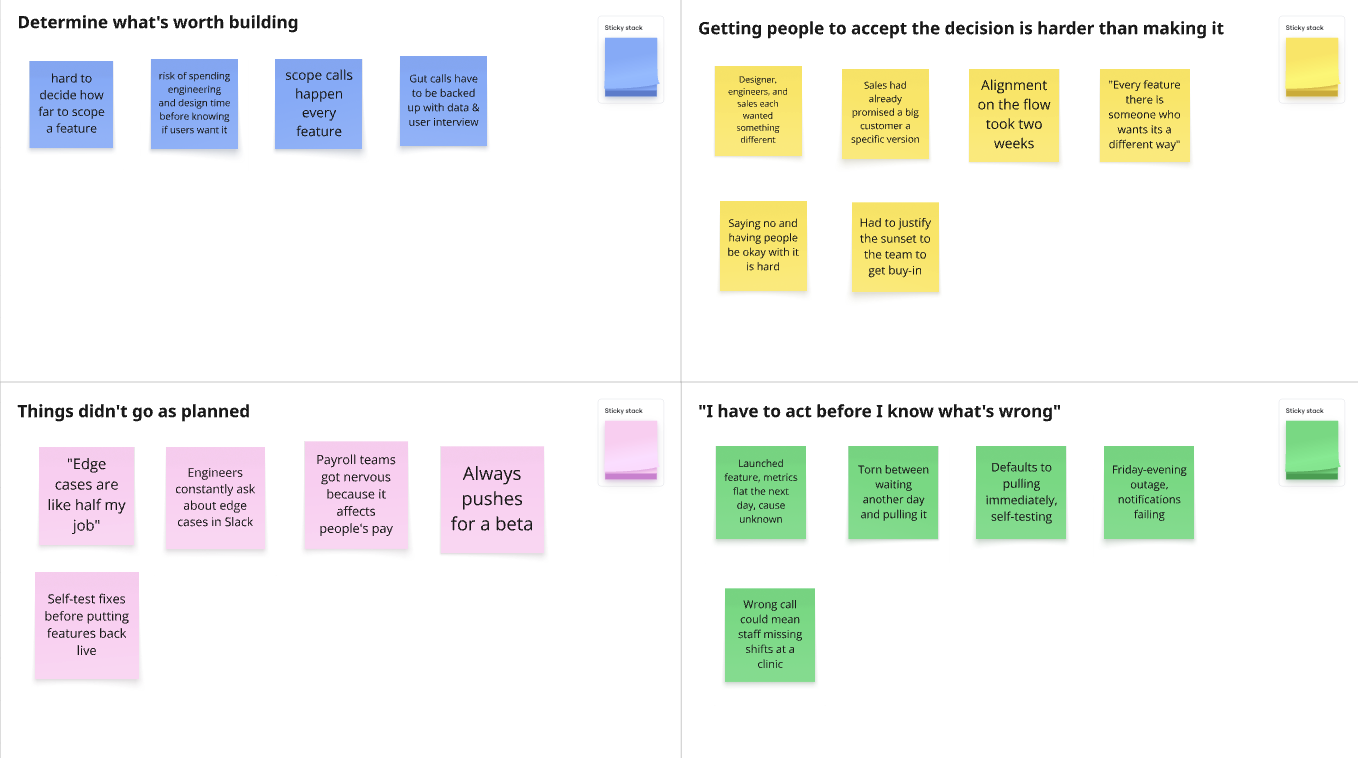
Affinity Map using AI:
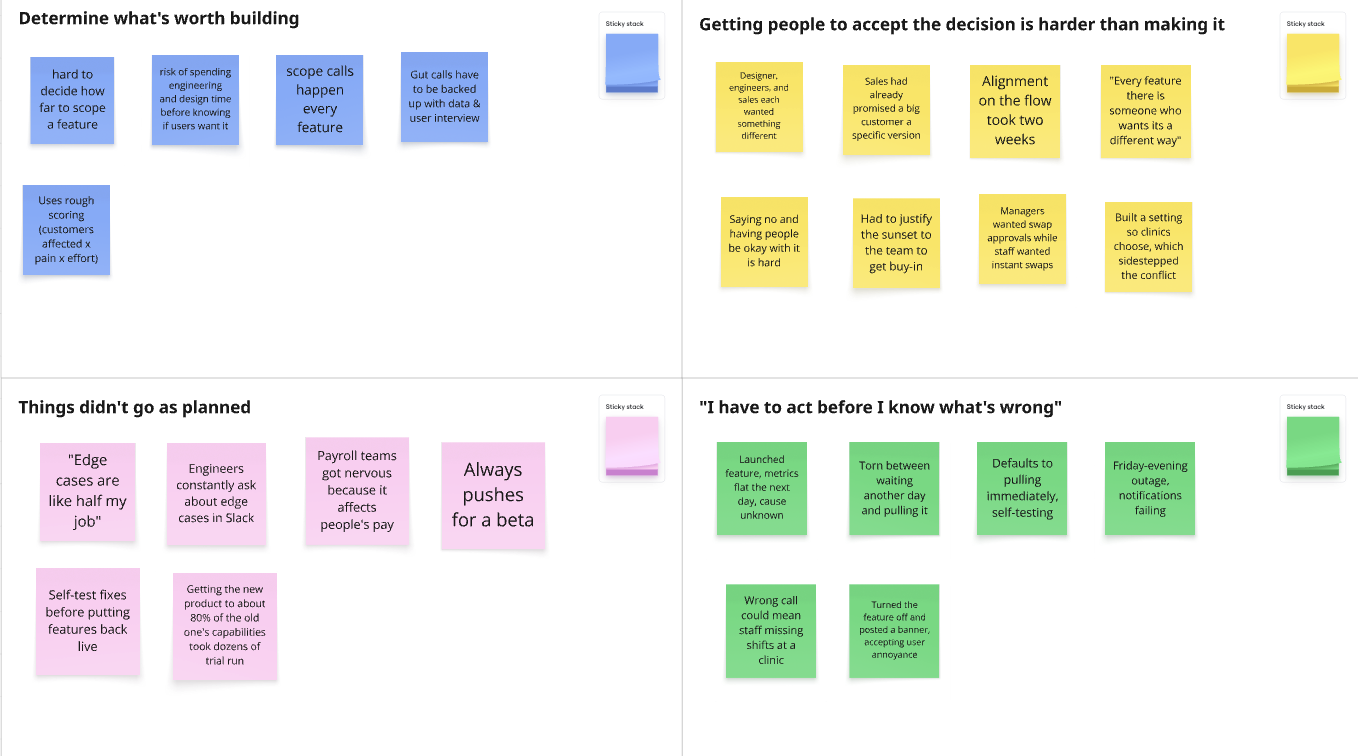
Compare
What did it catch that you missed?
The AI tagged every sticky by participant, which showed whether a problem came up for both PMs. It also kept details I dropped, like Adma’s rough scoring method, the managers-versus-staff conflict, and Yichi’s dozens of trial runs to match the old product.
What did it flatten into something generic?
The AI folded sales overpromising and the manager-versus-staff conflict into general “stakeholder alignment”. It hides that one is a structural problem and the other is a conflict between two kinds of users.
Did it assert anything that isn’t in the transcripts?
Yes. It claimed AI reliability was a problem for both PMs when only Adam raised it, framed Yichi as blocked on others when he said the opposite. AI also added words like “constatly” that “patient impact” that none of the PMs used.
Long List
| # | Candidate problem | Raised by | Anonymized Quote |
|---|---|---|---|
| 1 | Deciding what to build, and how much, without solid evidence | 2/2 | “Adding is actually always easier than removing things and not doing certain things.” (P1) |
| 2 | Getting stakeholders to accept a “no” or a tradeoff | 2/2 | “The hard part isn’t picking, it’s saying no to people and having them be okay with it.” (P2) |
| 3 | Making high-stakes calls before knowing what’s wrong | 2/2 | “It was a Friday evening, and we didn’t know yet why.” (P2) |
| 4 | Problems only surface in testing or beta, not planning | 2/2 | “That flag wasn’t in the original plan, it came out of the beta.” (P2) |
| 5 | Edge cases consume a large share of PM time | 1/2 | “Edge cases are like half my job.” (P2) |
| 6 | Sales commits to customers before product decides | 1/2 | “Sales was promising one big customer a specific version of it.” (P2) |
| 7 | Decision volume outpacing the PM as engineering speeds up | 1/2 | “You’re gonna make 10x more decisions to keep up with the engineers.” (P1) |
| 8 | Synthesizing customer feedback is slow and manual | 1/2 | “Pull out the themes, which used to take me hours.” (P2) |
| 9 | AI output can’t be trusted without checking | 1/2 | “It’ll sound really confident even when it’s wrong, so I always check the numbers.” (P2) |
| 10 | Removing a product without hurting users | 1/2 | “Sunsetting something is always easy. Gracefully is not.” (P1) |
TAM
There are about 1 million product managers worldwide. A 2023 LinkedIn search of job titles containing “Product Manager” returned 1,060,000 people worldwide [1], consistent with a 2021 Product Focus study that found over one million people working in product management roles [2]. A more conservative count using only active profiles puts the total at about 850K, with the US accounting for the largest share at 200K (47%) [3]. The count is directional, since it relies on self-reported LinkedIn titles. For spending, Zylo’s 2026 SaaS Management Index puts median SaaS spend per employee at $9,455 [4], and Vertice reports a similar average of $9,324 as of Q2 2026 [5]. Multiplying 1 million PMs by about $9,500 per year gives a TAM of roughly $9.5B globally. Analyst estimates of the product management software market land in the same range, with Dataintelo valuing it at $8.4 billion in 2025 [6] and Business Research Insights estimating USD 10.09 billion in 2026 [7]. This is potential spend, not current spend, and the per-employee figure is a median across all roles rather than a PM-specific number.
Sources
[1] https://www.linkedin.com/pulse/how-many-product-managers-world-pau-yanez
[2] https://www.productfocus.com/wp/wp-content/uploads/2021/07/Product-Managers-across-the-world.pdf
[3] https://corpwaters.substack.com/p/how-many-product-managers-are-there
[4] https://zylo.com/2026-saas-management-index
[5] https://www.usecarly.com/blog/saas-statistics/
[6] https://dataintelo.com/report/global-product-management-software-market
[7] https://www.businessresearchinsights.com/market-reports/product-management-software-market-129242
Cold vs. round 2: I used nearly the same questions in both interviews, but round 2 produced much richer stories. The cold interview mostly got general answers (“every feature,” “quite a lot,” “I normally just take it out”), while round 2 got specific past events with concrete details, like a 3-week alignment fight, an 8% clock-in failure rate, a 3-clinic beta, and a Friday-evening outage. Next time, I’d follow up on general answers more by asking for the most recent specific instance, since the reading notes that people often flip-flop between a specific story and generalities.
Reading idea used: We used Torres’s “tell me about the last time” approach, which asks about a specific instance rather than inviting people to summarize and speculate, in our questions about the last feature shipped and a time the PM decided with incomplete information.
