
BuzzFeed’s 2008 pitch deck does a great job showing how the company was approaching viral content, but I think it’s less convincing when it comes to proving the business opportunity behind it.
Slides 1-3 barely explain the customer problem, instead jumping straight to traction. With 700,000 monthly unique visitors, 2.5 million page views, and just two editors, the numbers are very impressive. But while they prove people are paying attention, they don’t necessarily prove that existing ways of discovering content are inadequate or that advertisers are willing to pay.

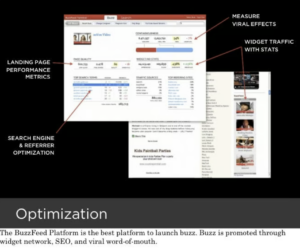
Slides 4-11 are essentially a product tour. The algorithmic content detector, user-generated posts, and optimization dashboard make the technology feel tangible rather than hypothetical. I like that the deck shows rather than tells, but it also highlights a gap from Dan Olsen’s The Lean Product Playbook. Olsen argues that the strongest opportunities address important customer needs that existing solutions fail to satisfy. BuzzFeed demonstrates what its technology can do, but never quite proves that advertisers have an underserved need worth paying to solve.
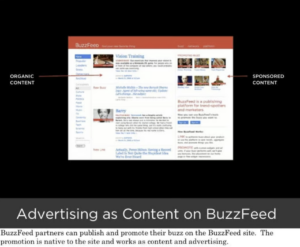
Slides 12-17 finally explain how BuzzFeed plans to monetize attention through advertising that resembles organic content. The visual explanation is clever, especially because it makes a relatively unfamiliar business model immediately understandable.
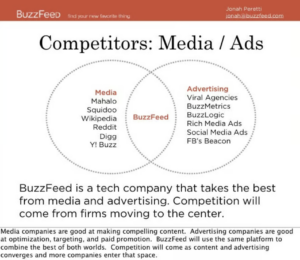
Slide 18 positions BuzzFeed between media and advertising, and slide 19 imagines a massive global platform. Yet neither quantifies the market. The competitor slide even acknowledges that other firms could move toward BuzzFeed’s position, but doesn’t explain what would stop them.
As an investor, I’d ask about advertiser willingness to pay, repeat business, and achievable market size. For our Sanity Check pitch, I’d borrow BuzzFeed’s specific evidence and visual storytelling, while making our customer problem explicit and building a bottom-up market estimate from realistic channels and conversion assumptions.
