
Airbnb’s 2008 pitch deck explains how the company planned to change the way people travel by letting them book rooms with local hosts instead of hotels.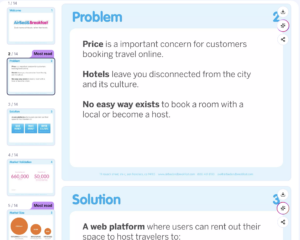
Problem and solution (Slides 2–3): The deck identifies three problems: hotel stays can be expensive, hotels can disconnect travelers from local culture, and finding a room with a local host is difficult. So Airbnb proposes a web platform that helps travelers save money, hosts earn money, and both share local culture. I like how the solution directly addresses the problems instead of introducing unnecessary features.
Market validation and size (Slides 4–5): Airbnb uses existing demand to support its idea, citing 660,000 Couchsurfing users and 50,000 temporary housing listings on Craigslist per week. It then estimates a much larger potential market. This is a useful approach because it shows that people already seek alternatives to hotels. However, existing demand does not automatically prove that people will trust Airbnb or pay to book through it.

What an investor would ask: How will Airbnb build trust between strangers, ensure safety, and attract enough hosts and travelers at the same time? I would also ask whether the market-size assumptions are realistic and how quickly the company can acquire paying customers.
What I would steal: For my own pitch, I would borrow Airbnb’s simple problem-solution structure and its use of market evidence. I would also make the product’s value clear in one sentence before presenting technical details. The deck reminds me that a strong pitch needs to explain not only what a product does, but also why people need it and why the opportunity is worth pursuing.
