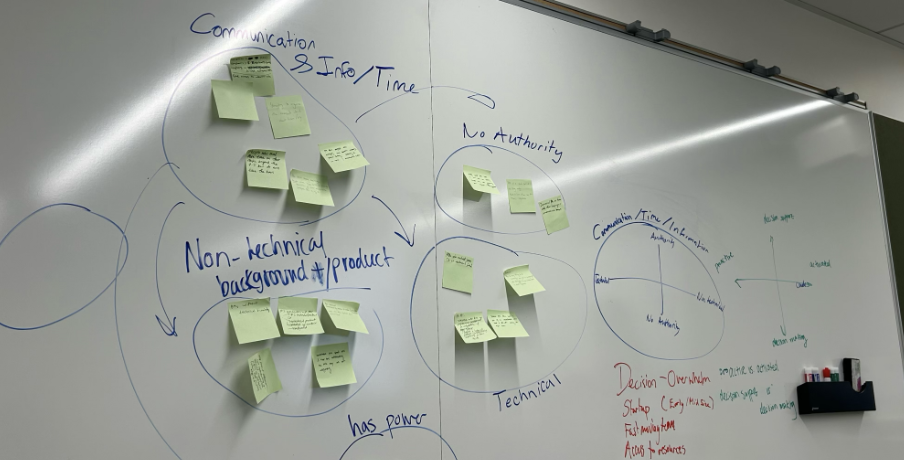
Three problems from our long list to dig into
- Decision-making overwhelm: Execution is now cheaper with the assistance of AI tools, so the decision-making turnaround between engineering teams and PMs is now in the span of days rather than weeks.
- AI as a new teammate: AI tools offer new affordances and possibilities for PMs and their team, but agents introduce additional supervision needs and introduce uncertain possibilities for co-working.
- Prioritization of tasks: PMs experience significant task loads where they have a growing backlog of tasks, requests, and ideas competing for their limited time, so they need to constantly decide what to work on first and what to drop.
Problem we are leaning towards
We are leaning towards the problem of decision-making overwhelm. This was an issue that came up over and over again in our interviews, with one PM describing it as where “most of my mental energy goes,” and we think it is fairly unique. It is a pressing topic that is timely and emerging, but it also applies to many fields outside of PMs. While we aim to start with a very niche and small ICP initially (as suggested by the Rachitsky reading), we believe that a solution to this problem would be applicable for a much larger customer base. This problem does have clear weaknesses. It has the weakest evidence of our three problems, since only 5 of 16 interviewees raised it, compared to 9 for AI as a teammate and 8 for prioritization. Also, our key competitor, Claude/ChatGPT, is already part of many PMs’ daily workflow, so we would need to show why a dedicated tool is worth switching to. One interviewee saw their decision overload as temporary, so we still need to validate that this is a consistent problem year round. We plan to test these weaknesses in follow-up interviews with our ICP.
Ideal Customer Profile (ICP)
Our ICP focuses on product managers and product owners. More specifically, our “ideal customer” contains traits such as: forward-deployed PMs at early-to-mid-stage startups with fast-moving, AI-driven engineering teams. Our 16 interviews showed that PMs face increasing pressure to keep up with AI-accelerated development while managing competing priorities and supervising AI-generated work. Overall, nine of our interviewees discussed challenges with AI as a new teammate, eight raised prioritization and scope creep, and five highlighted decision-making bottlenecks.
We are particularly interested in startups because we hypothesized that their faster workflows, higher likelihood to be “AI Native,” and potentially greater flexibility in adopting new tools make them look like a promising early customer base. On a more meta-level, we believed that startups are more likely to try tools and solutions from smaller companies like ours. However, do earlier-stage startups have the necessary budget flexibility and willingness to adopt new tools? Those topics still remain assumptions that we need to validate through additional customer research.
SAM / SOM for each
TAM: ~1.6M PMs worldwide, based on LinkedIn data collected in October 2023 (Product Focus, Product Managers Across the World).
1. Decision-making overwhelm due to AI-accelerated engineering
- SAM: ~237,000 PMs (14.8% of TAM). According to Atlassian’s State of Product 2026, 37% of product professionals report increased pressure to deliver faster. Based on our interview numbers (5 out of 16), we estimate that 30% of these professionals specifically experience decision-making overwhelm due to AI speeding up engineering workflows, resulting in a SAM of 1.6M × 37% × 30% = 236,800 PMs.
- SOM: ~290 PMs within three years. We target PMs and PM-like roles at early-stage AI startups reachable through the Stanford and YC networks. Stanford graduate alumni founded 3,286 VC-backed companies in the past decade (PitchBook 2025), and YC adds ~1,580 AI startups over three years (Extruct). We assume ~1.5 people doing PM work per startup and a typical 4% conversion rate to us (ChartMogul/ProductLed), so we estimate ~290 PMs.
2. AI as a new teammate
- SAM: ~412,000 PMs (25.8% of TAM). Atlassian’s State of Product 2026 reports that 46% of PMs struggle to integrate AI into their workflows. We estimate that 56% of them (9 out of 16 interviewees) also take on significant extra work supervising AI outputs and managing AI tools. 1.6M × 46% × 56% = 412,160 PMs.
- SOM: ~120 PMs within three years. We target new PMs entering tech from Stanford. About 35% of the 268 job-seeking Stanford GSB graduates go into tech each year (Clear Admit), and about 18% of Stanford undergrads go into computers/IT (Stanford Destinations, 2014). That’s ~1,200 new tech hires over three years. Since we can reach them through our own network, we assume a 10% conversion rate based on our networks and connections (ChartMogul/ProductLed), giving ~120 PMs.
3. Prioritization of tasks, projects, and meetings
- SAM: ~800,000 PMs (50% of TAM). Atlassian’s State of Product 2026 found that 39% of product professionals struggle to balance multiple projects, competing priorities and team capacity. Our interview numbers estimate this as slightly higher at 50%, as 8 out of 16 interviewees mention prioritization as a point of friction, which we use instead. 1.6M × 50% = 800,000 PMs.
- SOM: ~385 PMs within three years. We target Stanford alumni PMs in the San Francisco Bay Area, starting with large teams at big tech companies and reaching them through alumni networks and referrals. LinkedIn shows 9,633 Stanford alumni in the Bay Area matching “product manager,” including 1,753 at Google, Apple, Meta, Microsoft and Amazon alone (LinkedIn Stanford alumni search). We assume a typical 4% freemium conversion rate (ChartMogul/ProductLed), so we estimate ~385 PMs.
Competitive landscape
Decision-Making Overwhelm
Alternative/Current Solutions:
- Working longer hours (nights, weekends, 6-day weeks, etc.)
- Constantly checking Slack and email
- ChatGPT / Claude for summarizing and testing decisions
- Slack AI (daily recaps and thread summaries)
- Microsoft 365 Copilot / Gemini in Google Workspace
- Delegating decisions to whoever is closest to the work
- Granola / Otter.ai (meeting notes and action items)
- Glean (enterprise search and assistant)
- Decision frameworks (DACI, one-way vs. two-way doors, time-boxing)
- Productboard / Linear AI (prioritization and roadmapping)
- Talking to your manager for a second opinion
- Notion / spreadsheets to organize decision context
- Blocking off focus time (e.g., meeting-free Fridays)
- “Shooting from the hip” on in-the-moment decisions
Key Competitor: Claude, Claude Cowork (Using AI to synthesize context / Using AI to pressure-test decisions or generate pros/cons)
| ACTIVITIES
Researching, training, and improving AI models, safety research, and building products like Claude, Claude Code, and Claude Cowork. Used for figuring out your task list, identifying task dependencies, ranking the task list |
PARTNERS
Corporations such as Accenture, Infosys, Hitachi, LG Consulting firms such as BCG, Bain and Company, and the Big Four Cloud and infrastructure providers, including Amazon and Google; technology integration partners; and developers building with Claude. |
VALUE PROP
Unlimited use cases, broader work outside of PM tasks, allows PMs to use tools to quickly prototype, implement, and manage workflows. |
GET
More ethical than competitors, better quality than other models on the market, customers use it for other use cases so easily transfer over this use case |
CUSTOMERS
Enterprises with enterprise-level plan, individuals – for this goal, we target PMs explicitly |
| OUTSOURCE
Compute and storage (data centers)/ TPUs, areas of research with research grants and academic collaborations (e.g., Anthropic’s well-being research grants) |
KEEP
By having the best model on the market, by being easier to use than a specialized product, but also allowing AI native people to do more complex tasks |
|||
| COSTS
compute/ storage/ data centers/ researchers |
REVENUE MODELS
subscription / usage-based, Team and enterprise subscriptions. Usage-based API fees. |
|||
Where it’s weak: Claude is general-purpose, so PMs have to prompt it and paste in context each time, it doesn’t keep track of past decisions, and it lacks an understanding of where the PM is vital versus not.
AI as a Teammate
Alternative/Current Solutions:
- All-or-nothing AI use (avoiding AI entirely or fully relying on AI)
- ChatGPT / Claude as prompt-based assistants for small tasks
- Claude Cowork / ChatGPT agent mode (agent tools that carry out tasks)
- Glean (enterprise search and assistant with company knowledge)
- Microsoft 365 Copilot / Gemini in Google Workspace
- Notion AI / Notion agents (company knowledge tracking)
- Atlassian Rovo agents
- ClickUp Brain
- Hiring AI-native people (transitioning to AI-forward company workflows)
- Online AI classes (Maven, Reforge, Coursera)
- Internal dog-fooding of AI tools
- Reviewing the extra AI-generated work by hand
Key Competitor: Glean (Using AI assistants that respond to prompts but lack task ownership/proactivity)
| ACTIVITIES
Work on searching across company apps, answering questions with company context, summarizing documents, building AI agents for workflows |
PARTNERS
Cloud providers e.g. Google Cloud, Microsoft Azure, AWS (data storage) LLM providers such as OpenAI, Anthropic, Google App integrations e.g. Slack, Google Workspace, Microsoft 365, Jira, Confluence, Salesforce |
VALUE PROP
Overall AI assistant that knows everything across your company’s apps and finds answers without cross-app switching |
GET
enterprise sales, security, cloud infrastructure |
CUSTOMERS
Mid-size to large companies with a lot of data to manage and the PMs inside those companies |
| OUTSOURCE
Foundation models (OpenAI, Anthropic, Google), cloud hosting and compute |
KEEP
Deep connectors and company knowledge index that are hard to replicate, enterprise-grade security and permissions |
|||
| COSTS
engineers/ connector development/ LLM API costs/ cloud hosting/ enterprise sales team |
REVENUE MODELS
enterprise subscriptions, annual contracts |
|||
Where it’s weak: Glean answers questions but doesn’t take ownership of tasks. It’s sold top-down to large enterprises, so it’s pretty heavy for an individual PM.
Prioritization
Alternative/Current Solutions:
- Spreadsheets with scoring (RICE, ICE)
- To-do lists
- Jira
- Check-in meetings with managers and stakeholders
- Prioritization frameworks (RICE, MoSCoW, Eisenhower matrix)
- ChatGPT / Claude for ranking tasks
- Productboard
- Linear
- Jira Product Discovery
- Naming what the team is not going to do
- Blocking calendar time
- Living with the backlog
Key Competitor: Jira / Atlassian (Tracking and organizing tasks, but not telling PMs what to prioritize)
| ACTIVITIES
Atlassian’s Jira mostly focuses on issue tracking, backlog management, sprint planning – another big feature is roadmaps (Jira Product Discovery) – now, there are AI-native features through Atlassian Rovo |
PARTNERS
Atlassian Solution Partners (consultancies that implement and customize Jira) Atlassian Marketplace app developers Cloud infrastructure provider AWS; integrations including Slack, Microsoft Teams, GitHub, GitLab, Figma; LLM providers powering Rovo. |
VALUE PROP
every task, bug, and sprint in one place, highly customizable, and connected to the whole dev toolchain. |
GET
Often B2B style bottom-up adoption (free tier for small teams spreads company-wide) industry-default reputation among many engineers and corporations in status quo convenience and speed across teams |
CUSTOMERS
mostly software and engineering teams, product people, enterprises (i.e., 300,000+ or so Atlassian customers), PMs who work on managing backlogs and some other company-based artifacts |
| OUTSOURCE
Cloud infrastructure (AWS), AI model, implementation partners, niche features (Marketplace apps) |
KEEP
high switching costs, network effects across engineering teams, integration ecosystem, bundling with Confluence |
|||
| COSTS
engineers/ cloud hosting/ AI model costs/ sales and marketing/ partner programs |
REVENUE MODELS
per-user subscription tiers (Free, Standard, Premium, Enterprise), data center licenses. Companies more often than not pay for Jira/Atlassian on behalf of their teams Very B2B-structured sales model in most cases |
|||
Where it’s weak: Jira tracks and organizes work but doesn’t recommend what to do first or what to drop. It’s also built around engineering tickets and isn’t individualized to PM tasks and meetings, so prioritization happens outside of it in meetings.
Comparison table
| Problem 1 | Problem 2 | Problem 3 | |
| The problem (one sentence, in the PM’s words) | Decision-making overwhelm
“Lots and lots and lots of micro decisions just flying at me… sometimes I’m a day ahead at best.” (PM, workflow automation startup) |
AI as a teammate
“My biggest pain point at the moment is figuring out how to deal with all this AI stuff.” (de facto PM, Series B AI infrastructure startup) |
Prioritization
“Because everything is competing for resources, what gets prioritized is what will get shipped.” (UX and product lead, large enterprise) |
| Evidence strength (said it, did it, or paid for it? How many interviews?) | Said it: 5 interviews
Did it: working nights and weekends, blocking focus time Paid for it: none |
Said it: 9 interviews
Did it: reviewing extra AI-generated PRs, using AI search instead of asking coworkers, company-wide AI upskilling Paid for it: none |
Said it: 8 interviews
Did it: to-do lists, ranked quarterly feature spreadsheets, declining meetings with no agenda Paid for it: none |
| Current workarounds (what do PMs do today?) | Overtime; talking to your manager; Notion; coin-flipping; frameworks/spreadsheets | All or nothing; Glean; ClickUp Brain; hiring AI-native people; online classes | Spreadsheet; to-do list; Jira; check-in meetings |
| Competitive gap (where do today’s options fall short?) | Existing tools like Notion, Jira, and spreadsheets help organize info, and ChatGPT/Claude can summarize and pressure-test decisions, but manual judgment is still needed | Existing solutions like ChatGPT or Glean act as assistants that respond to prompts; they lack task ownership/proactivity | Existing tools like Jira, spreadsheets, and others help PM track/organize tasks but don’t tell them what to prioritize/ Prioritization still relies on meetings, manual judgement based on business goals. ChatGPT/Claude can rank a list, but only using the context the PM pastes in. |
| ICP (role, company stage, trigger) | Forward-deployed PMs/POs at fast-moving, AI-native early-stage startups. Trigger: engineering ships faster than the PM can make decisions | PMs who are new at a tech company, and long-time managers at legacy companies. Trigger: their team starts using AI agents in daily work | PMs on large teams at big tech companies who are short on resources/capacity. Trigger: requests and backlog grow too fast |
| Market size (SAM and SOM, mark every guess) | SAM: ~237,000 PMs (14.8% of TAM) (we estimate 30% of PMs under pressure to deliver faster)
SOM: ~290 PMs within three years (we assume 1.5 PMs per startup and 4% conversion) |
SAM: ~412,000 PMs (25.8% of TAM) (we estimate 56% of PMs struggling with AI)
SOM: ~120 PMs within three years (we assume 10% conversion) |
SAM: ~800,000 PMs (50% of TAM) (we estimate 50% from interviews)
SOM: ~385 PMs within three years (we assume 4% conversion) |
| Buildability (could your team build a working version this quarter?) | Yes | Yes | Yes |
| AI fit (strong, maybe, or weak? One reason) | Maybe/Medium: Our interviews point toward PMs trusting AI decisions partially, rather than relying on AI to make the final call. | Strong: AI agents can now take ownership of tasks and report back to PMs for approval, which wasn’t possible with prompt-based assistants before. | Maybe/Medium: AI may help with prioritization, but personal and company-level context can extend beyond agents. |
Concept from Reading
Upon reading Lenny Rachitsky’s “How to identify your ideal customer profile,” we noted that finding an ideal customer profile is counterintuitive compared to the common adages of selling products and services for broad appeal to maximize profit. Rachitsky’s thesis pushes us to work toward an ICP that is “comically narrow,” focusing on hyper-specializing toward a very specific segment of users as opposed to achieving mass appeal. The article relates to the idea of the “atomic network” in social computing, where even large corporations (such as Airbnb and DoorDash) began with hyper-specific, local customer bases. Therefore, we worked toward narrowing down our customer profile even though the initial problems we identified affected PMs (and others) very broadly. Rather than focusing on all PMs, we chose to focus on the subset where we can start addressing more specific needs.
Google Drive Link
Access our Week 3 Milestone folder here.