The Behavior
The behavior I chose to measure is over-researching: spending significantly more time building context, frameworks, and analysis around a decision or task than the task actually requires. This is different from procrastination or avoidance. I’m not putting things off. I’m actively working on them, often with real focus, but going far deeper than necessary before committing to a course of action. The marginal benefit of additional research shrinks well before I stop, but I keep going because I want the decision or output to be thorough and well-grounded.</p>
I chose this because it was week 1 of the quarter and I was in the middle of course shopping, applications, and getting organized for the term. These are all tasks where some research is genuinely useful, which makes it harder to notice when I’ve crossed from productive research into over-research.
Measurement Methodology
I tracked over two days: Sunday, January 12 and Monday, January 13. Each time I noticed I had gone deeper into research or preparation than a task required, I noted what I was working on, what a “sufficient” version of the task would have looked like, what I actually did, and a rough time estimate for the time spent beyond sufficiency. I tracked in the moment when I could, though some entries were filled in shortly after.
The Data
Sunday, January 12 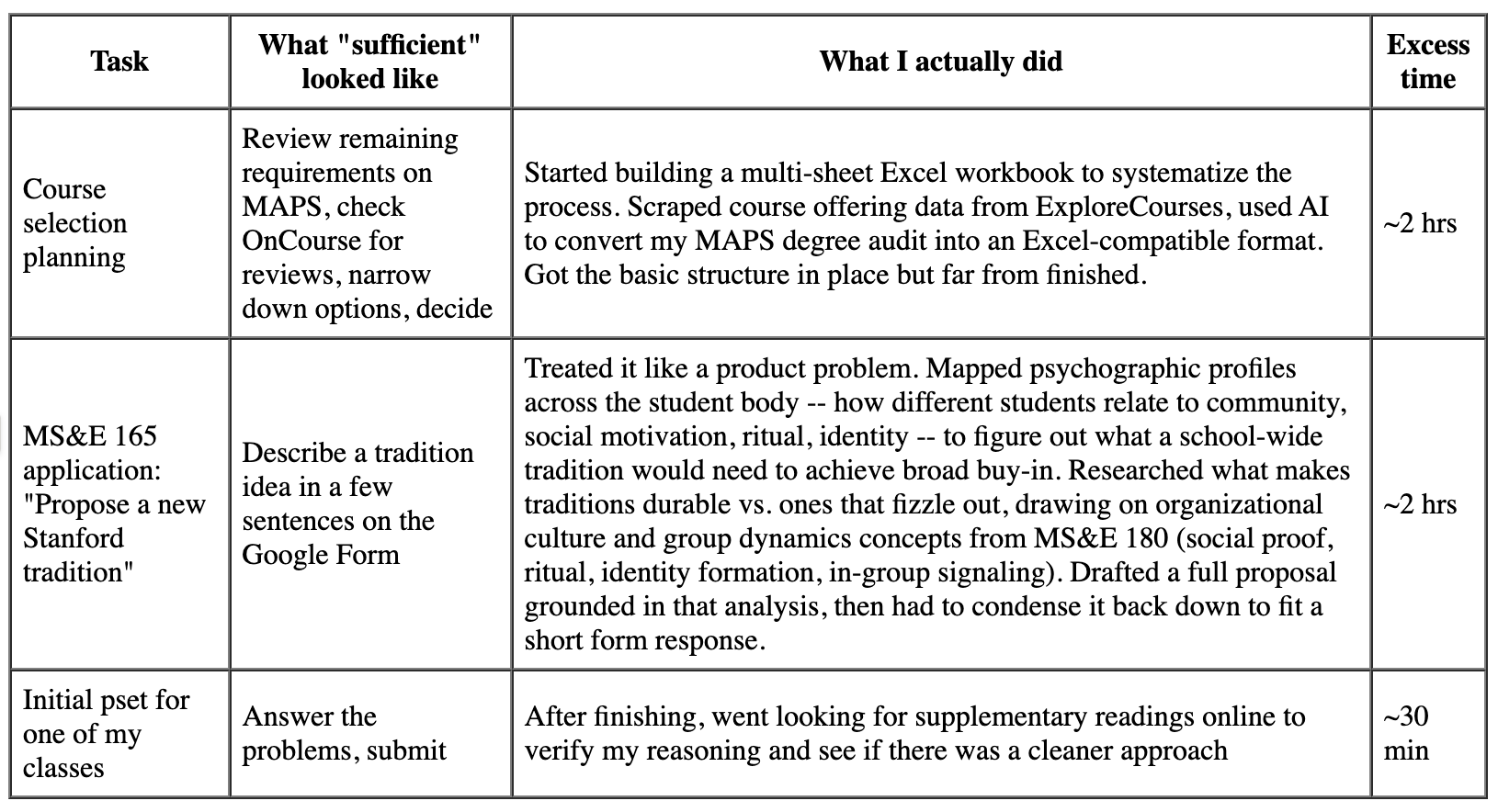
Total excess time: ~4 hrs 30 min
Monday, January 13
Classes: MS&E 121 (9:30-11:20 AM), MS&E 165 (3:00-4:20 PM)

Total excess time: ~5 hrs 55 min
Patterns
The clearest pattern is that over-researching happens most when the task has no natural stopping point. Course selection is open-ended by nature: there is always another review to read, another constraint to model, another scenario to evaluate. The same was true of the MS&E 165 application question. A Google Form with a short text box should take fifteen minutes. But because the question was open-ended (“propose a new tradition”), I treated it as an opportunity to do real analysis. I went through psychographic mapping of the student body, researched what distinguishes traditions that last from ones that die out, and drew on organizational theory to ground my proposal. Was the output better? Probably, marginally. Was it two hours better? Definitely not.
A related pattern is that the research itself generates new research. While building the course planning workbook, scraping ExploreCourses led me to notice offering inconsistencies, which led me to add more columns, which led me to build more formulae to account for edge cases. Each step was locally rational but the scope kept expanding. I was not second-guessing decisions; I was postponing them until the research and evaluation felt comprehensive enough. The problem is that “comprehensive enough” is a moving target when you keep discovering new dimensions for which to account.
Monday was actually worse than Sunday despite having classes. The classes themselves imposed breaks, but the time between and after them was almost entirely consumed by the workbook and application forms. The initial structure built on Sunday seemed to lower the barrier to going deeper on Monday rather than raising it.
The behavior also produced genuinely good outputs. The course planning workbook is something I will use for the rest of my time at Stanford. The MS&E 165 response was probably stronger for the analysis behind it. This is part of what makes the behavior hard to change: the excess research isn’t wasted, it’s just disproportionate to the task at hand.
Models
Model 1: Connection Circle

This maps the ecosystem of factors around over-researching. The core reinforcing loop runs from desire for thoroughness through the deep research phase, which produces a sense of progress, which feeds back into more research. Scope expansion enters when the research itself surfaces new questions or angles. On the other side, perfectionist standards and fear of making a suboptimal choice both feed reluctance to commit, which drives further research. The downstream effect is time pressure on other tasks, which creates stress, which reinforces the perfectionist standards that started the cycle.
Model 2: Causal Loop Diagram

This focuses on the core causal structure. The reinforcing loop (R1) captures the self-perpetuating dynamic: more research depth leads to more understanding, which increases the desire to go deeper, which expands the scope, which increases research depth again. All connections in R1 are positive (same-direction), meaning there is no natural balancing force inside the loop. The consequence chain at the bottom shows how excess time on one task creates time pressure on everything else, ultimately reducing the quality of other work.
What I’d Do Differently
The intervention I think would actually work is building in a periodic check: would anyone notice the difference if I stopped here? The core issue is that each incremental step of research feels productive in the moment, but the marginal improvement to the output is often invisible to anyone but me. If I had paused an hour into the MS&E 165 application and asked whether a reviewer would meaningfully prefer the version backed by psychographic analysis and organizational theory over a solid but quicker response, I think I would have recognized that the answer was probably no. The trick is making that question a habit rather than something I only think to ask in retrospect.
Related to that, I’d want to actually test whether the over-researched outputs are noticeably better. Next time I’d try doing one task at my natural depth and a comparable task after asking the “would anyone notice” question early, and see if the outcomes are meaningfully different.
Finally, I’d track for longer. Two days showed a clear pattern, but I’d want a full week to see how this behavior changes as the quarter picks up and deadlines start competing. My guess is that external pressure eventually forces me to stop over-researching some things, but at the cost of not starting others.
Note: Claude (Anthropic) was used for minor phrasing and copy-editing of this writeup. All content, data, and analysis are my own.