Habit which I targeted and tracked: short-form media consumption, specifically, Tiktok.
Motivation: I average around 7 hours of screen time per week, which amounts to approximately 48 total hours a week with 27 of those hours spent scrolling through Tiktok. This has been a lousy battle I have created countless excuses for, like Tiktok being a necessary “brain break” in between work sessions or it being my fashion dictionary (I use Tiktok to genuinely be influenced or search up quick fixes), and I’ve also attempted several controls on my behavior in the past that have not entirely worked (I’ve set screen time limits on my phone which I’ve continuously pressed “ignore limit” to and have even gotten other people to set a passcode for me). But why this habit in particular for this assignment? It’s an easy habit to measure with multiple causes that can be identified or uncovered with this assignment. I’ve already listed two examples above for my “excuses” for defaulting to this habit.
Data collection: I measured this behavior over the course of three days (Friday, Saturday, Sunday) and used 30 minute intervals for my own convenience – if I attempted or underwent my habit multiple times during an interval, I’d jot it down along with the context of which I opened the app rather than the amount of time spent doing the habit. This is because it’s more important to me to know what causes me to pick up the phone and start scrolling rather than how long I scroll. I currently have the screen time limit still on Tiktok, which I set to an hour max before it asks me for the passcode. A valid data point, then, would be each time I successfully open up the app or ignore the screen time limit. I opened the app exactly 20 times on Friday, 11 times on Saturday, and 15 times on Sunday. On Monday, I asked my boyfriend to set a random passcode for my screen time that I would not know to track how many times I would open the app and click on “ask for one more minute”, to which I clicked on this option twice.
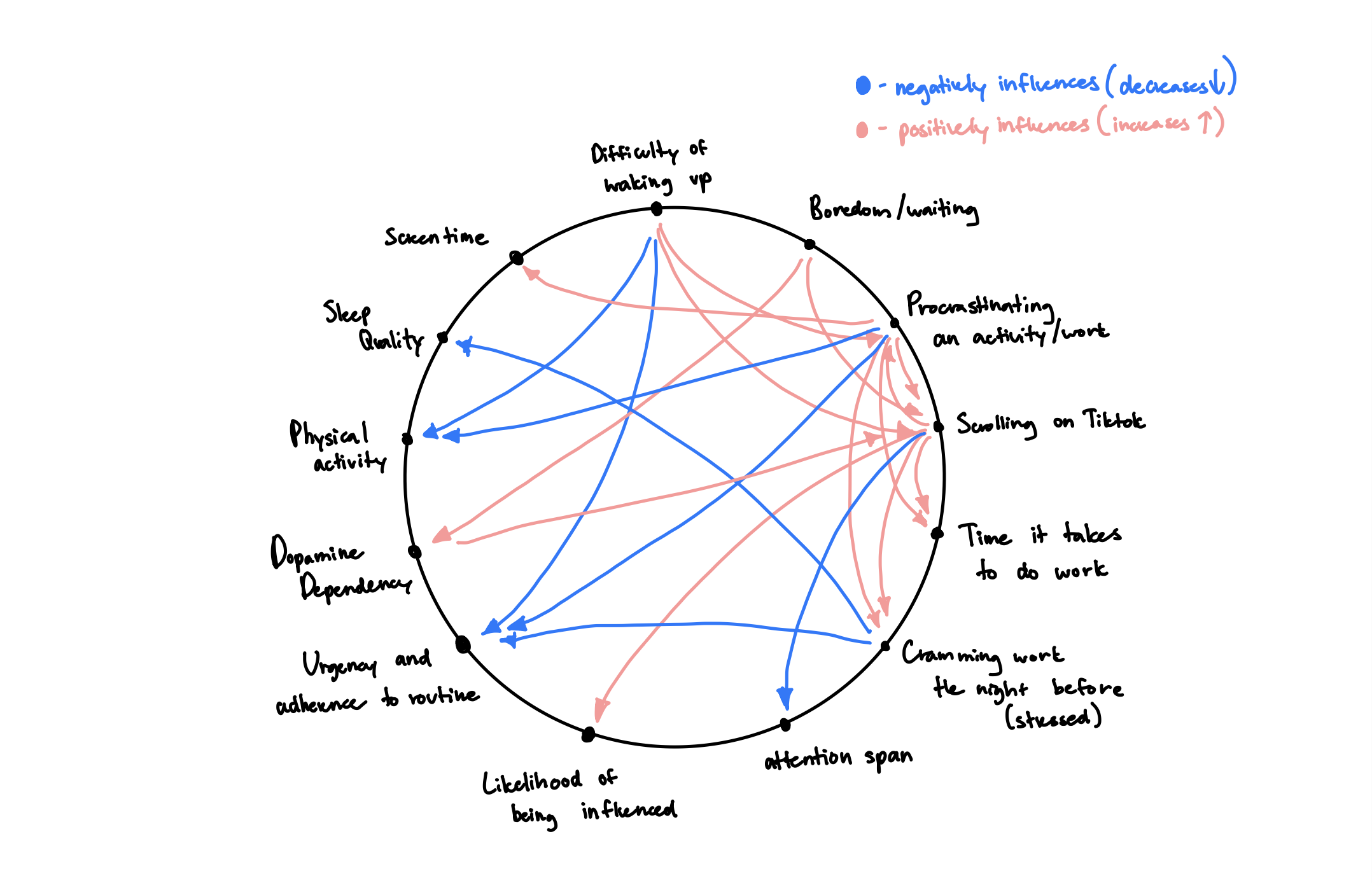
Experience and summary: The first insight I had uncovered from tracking my habit of opening up Tiktok is that it has embedded itself as part of my morning routine to get myself up. Across all three days, I woke up reaching for my phone and scrolling for approximately 30 minutes to fully feel awake. The contexts which I’d use my phone the most frequently in are when I’m bored (like when brushing my teeth… that’s a big problem), waiting for something (like in line at the package center), or when I need a mental break when doing work for an extensive amount of time. Some rare contexts in which I’d use Tiktok “with a purpose” (so when I’d open up the app to search something up rather than to watch the first 30 videos in my FYP) would be to get influenced or when I’m going shopping. I was at Sephora this weekend and needed lip color recommendations, and Tiktok has been my preference for that. Another interesting part of my habit is that I use Tiktok more when I have sudden or new interests, such as picking up a new game, which I would search on Tiktok just because I’m curious as to what the community might be saying on there. Like in the connection circle below, these causes for opening up Tiktok created multiple feedback loops (or moments in the circle where two arrows point at each other in opposite directions) where negative habits influenced more negative habits. Waking up late and needing Tiktok to fully wake myself up, for example, is influenced by me staying up late and scrolling through Tiktok because I can’t sleep or I was bored.
The second insight was that although keeping count did make me aware of the amount of times I picked up the phone, it was not as big of a deterrent as I would have thought. This was evidenced by the several times I would open up Tiktok, scroll and watch just 3-5 videos before considering it to be a waste of time, closing the app, and then opening it right back up again because I realized a couple more videos wouldn’t hurt. However, what did work was the friction I put on this behavior to make Tiktok less accessible. On Monday, when I asked my boyfriend to set a passcode to Tiktok that I couldn’t crack, I found myself giving up the second I saw the screen time limit passcode screen. I had realized that Tiktok was quite invaluable in my life, and it’s only purpose was for my own entertainment or to pass the time – and it was quite enjoyable at that. However, I had also found alternatives to Tiktok on Monday when I couldn’t access it, such as going on Youtube, but even then, Youtube was not a good replacement as I got bored watching long-form videos and so I would just be productive instead. Since Youtube primarily consists of longer fleshed-out videos, committing to watching one full video felt like more of a waste of time than Tiktok, which goes to show that I had an underlying mental model that a couple of Tiktok’s 15 second videos wouldn’t hurt.

If I were to repeat this habit tracking exercise, I would do so with new controls to limit the amount of times I open up and use Tiktok. I added friction, screen time limits set by my boyfriend, a bit late this weekend but found it to be the most effective in limiting my Tiktok use. What I want to track next time is what alternative behaviors would arise from not being able to use Tiktok. Would I go on Youtube, and in what contexts would I feel more of an urge to use Tiktok? I could imagine myself reaching out to my boyfriend and asking for the screen code if I had a video saved in my collection that I would need at the time, such as a specific shade of a lippie I want if I’m at Sephora. I’m especially curious to see whether these controls would influence and increase good habits, such as starting work right away knowing that Tiktok is inaccessible, or influence bad habits that are workarounds to getting entertainment.