
As a group, we identified three key assumptions that our GreenPlate project hinges on, and tested them. Our learning cards are below:
Learning Card 1: Willingness to Pay for Premium Frozen Meal
Tester Names: Jasmine and Carmel
We believed that:
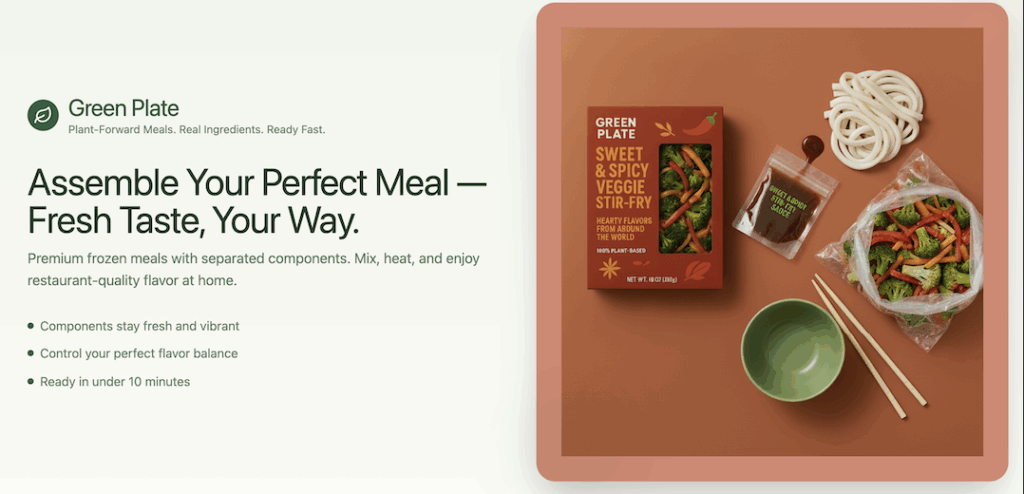
Flexitarians will pay $10–12 for a premium, assemble-style frozen meal because the format feels higher quality and worth the price.
We observed:
- Vanessa (27, former vegan) was initially confused about the difference between assembly-style and ready-to-heat, but ultimately preferred the assembly-style stir-fry for control over preparation (“I like to control how crunchy I want my broccoli”). She was willing to pay ~$3 more for that flexibility.
- Briant (23, gym-focused professional) preferred ready-to-heat due to time constraints (“I only have 30 minutes for lunch”), but said if prep time were equal, he’d choose the enchiladas for flavor. Price point “didn’t matter” for him, but convenience did.
- Addison (26, triathlete) chose stir-fry because it seemed more practical for reheating (“enchiladas could get soggy”). He actually pre-ordered two at $11.99, finding the price “reasonable compared to eating out” and worth it for convenience, though he said he could see himself choosing the cheaper ready-to-heat option if prep time was identical or less.
- Jazmin (23, health-conscious professional) gravitated toward the stir-fry because it looked easy to assemble (“only three main steps”). She found $11.99 “reasonable” for a quick, full meal but ultimately preferred ready-to-heat options for time efficiency: “I’m able to get three meals for $27”, which felt like better value.
- Miguel (23, landscaper and gym-goer) liked the assembly-style stir-fry for its perceived freshness (“it involves a bit of cooking, so ingredients should be fresher”). However, he questioned whether portion size justified the $12 price point, comparing it to Panda Express. Ultimately, he opted for the cheaper ready-to-heat bowls, buying two because they felt like a “better bang for your buck.”
- Across all tests, participants compared the two styles mainly on prep time and texture, not price. Price sensitivity was moderate: users justified higher cost only if the convenience or control was evident. Users were open to paying $11.99 if the tradeoff in time and quality was explicit, but when ordering more than one meal, 2/5 participants defaulted to cheaper, ready-to-heat meals.
From that we learned that:
Users’ perception of value comes primarily from convenience and freshness control, not simply the label “assembly-style.” While some perceived the assembly-style as higher quality, this perception only mattered if the added effort felt minimal. The price tolerance of $11.99 was acceptable when users could rationalize it against eating out or customization, but only if the prep effort seemed minimal. Clarity in differentiating between the two meal types is critical for communicating why one costs more.
Therefore, we will:
- Revise product messaging to clearly explain what “assembly-style” means, using visual comparisons and short taglines like “Quick toss, restaurant-fresh taste in minutes.”
- Reframe pricing communication to highlight time savings and customization value (e.g., “Ready in 8 minutes—your way”).
- Add portion visuals or comparisons to reinforce value perception (“Full meal, restaurant-sized portions”).
- Test updated messaging with 3-5 new users to see if clarity improves understanding and willingness to pay above $10.
- Iterate prototype so assembly-style meals visually emphasize convenience (e.g., “3 easy steps” instead of “assemble-style”).
Learning Card 2: Health-Forward Messaging vs. Vegan Messaging
Tester Names: Pratham and Anisha
We believed that:
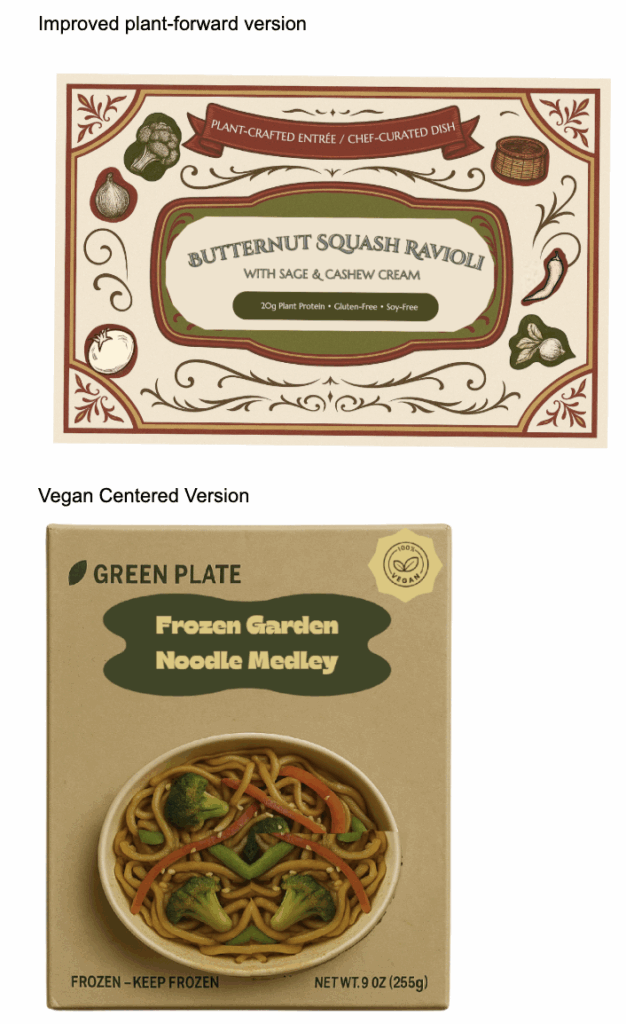
An outer packaging that focused on the quality and healthy aspects of our frozen meal would be more preferable to customers than a design that centered around a vegan identity.
Picture of our prototype for this test:
We observed:
Overall, the interviewees all preferred the new plant-based/health focused design more appealing than the initial vegan centric one. The interviewees pointed out that the highlighted health aspects that were highlighted on the new design would motivate them to purchase that meal over the other one based on packaging. One interviewee said “[I prefer] plant-crafted to me, who is not vegan, I would go for the second one because of that” – for those who aren’t vegan, the idea of not having the vegan identity gives a perceived higher quality and makes it feel more “fancy” and “fun.” Having the “vegan” label has that othering effect – the interviewees mentioned that if they were vegan they may appreciate it but as a non-vegan they preferred the new design.
Multiple interviewees pointed out that though the new design had less emphasis on the vegan meal itself and more on health/plant-crafted aspect, they would be hesitant to buy the meal without seeing a picture of it on the front. That’s something we can reintroduce from the previous design – having insight into what the actual food looks like.
From that we learned that:
Customers seem to prefer the new branding in the outer packaging compared to the vegan focus. It also seems that those who eat frozen meals (even those who are flexitarian or often go for vegan/vegetarian options) are more persuaded by the perceived health and quality of the product as opposed to whether it is vegan or not.
Along the lines of highlighting the quality of the meal, customers like to see an image of the food product itself – so they are further convinced of what the product is before they buy it.
Therefore, we will:
We will move forward with this “plant-forward” and “plant-crafted” brand messaging since it feels more inclusive and effective. We will further highlight the health benefits by increasing the size/presence of the health facts, and will incorporate either transparent packaging or an image of the food to address user feedback that our new design does not show the product that they are buying on the package.
Learning Card 3: Convenience of assembly-style frozen meal
Tester Names: Fadumo and Ari
We believed that:
We believed that people choose frozen meals primarily for speed and ease, and that adding small assembly steps would make meals feel fresher without sacrificing convenience. We also assumed that premium packaging and storytelling could elevate the perceived value and healthiness of frozen food.
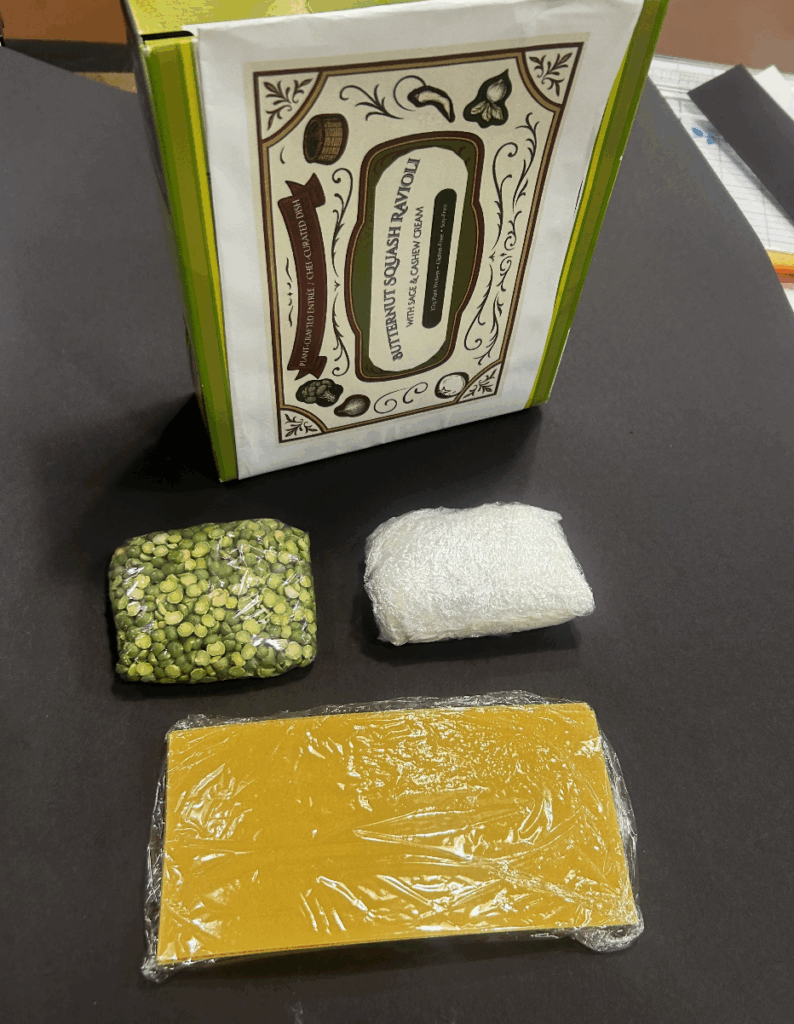
Pictures of our prototype for this test:
We observed:
Visual Appeal Matters: All three participants were drawn to the modern, sophisticated packaging. They said it stood out from typical frozen meals, which often “look cheap” or “the same.”
Separation Suggests Freshness: The idea of separate components made participants feel the meal was fresher and more intentional, something closer to a home-cooked dish rather than a pre-made block.
Convenience Is Relative: While some saw the extra steps as a bit more work, most felt it was a good trade-off because it made them feel more engaged in preparing their food.
Health and Transparency: Labels like “plant-crafted entrée” or “chef-curated” signaled intentionality, health, and care, qualities that made participants more willing to pay a premium.
. Price: All participants liked the product but hesitated at the $13 price point. They said they’d pay around $10, or more if the portion were larger or came in bulk.
From that we learned that:
Consumers associate freshness, effort, and quality with intentional design, both in the product’s visual presentation and its preparation steps.
Therefore, we will:
Emphasize the “crafted convenience” balance, keeping preparation steps simple but meaningful. Highlight freshness through separated components and intentional labeling. Maintain premium visual storytelling, but adjust pricing or portion size to align with perceived value. Center health transparency to make it easy for users to trust what’s inside.
Team Discussion and Next Steps
Our three assumptions we tested were 1. willingness to pay $10-$12 for the frozen meal (verifying our marketing ads strategy through the landing page), 2. the effectiveness of health-forward branding over the previous vegan messaging with our prototype’s new packaging, and 3. the convenience of the new assembly-style preparation of the frozen meal.
After reviewing our learnings from the three assumption tests, we have concluded that our strategy to rebrand Green Plate as high-quality, health, plant-forward frozen meals instead of a vegan brand is still a good direction to go – we will incorporate the feedback gained from the interviews to improve our prototype, making our outer packaging further reflect the quality of the product and improving the assembly-style form factor (as discussed more specifically in the learning cards below). Our next steps will be to follow through on the “Therefore, we will…” steps outlined in the learning cards below – particularly solidifying our outer packaging design and inner form factor of the meal – and to conduct further tests to validate the next iterations of the prototype before exploring how to bring this prototype into production for more large-scale distribution and testing in retail.
Notes and Interview transcripts
Our other discussion notes, as well as interview transcripts, can be found at this link.



