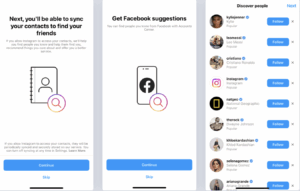
Instagram utilizes the user’s social graph at the start of the onboarding process. During the signup period, it takes an information gathering step, where it nudges the user to sync contacts, so it can generate follow suggestions. However, users can skip this step and go straight to the feed, leading to immediate value delivery for them. The information gathering step demonstrates that Instagram prioritizes learning about the user’s current connections first.
Notion

Notion asks the user a few questions focusing on what they will use the platform for and how. Subsequently, Notion takes the user to a workspace and gives them a checklist of actions to perform to familiarize themselves with the platform and a tailored set of templates, emphasizing immediate value delivery over information gathering. Through this process, Notion prioritizes learning about one’s use case for the platform to inform its template generation.
Venmo

Venmo first has to verify the user’s identity to unlock a Venmo balance and the user’s funding source. It emphasizes mandatory information gathering steps, such as the usage of Plaid for instant bank verification or micro-deposits as a backup, rather than immediate value delivery, to meet regulatory standards and avoid fraud. Venmo’s priority of learning who the user is and how they will pay drives this process.
Business cost of friction points
When Instagram asks for contacts, users have the option to skip the step, so a minimal number of users will drop off. At this step, there may be a 1-2% drop, corresponding to 10-20 users dropping off per 1,000.
On the other hand, when Venmo requires bank verification, micro-deposits can result in a 49% drop off, whereas instant account verification can be only 1%, leading to 490 vs. 10 users dropping off per 1,000.