1. Spotify
I am not a Spotify user, so upon downloading the app and logging into an old account, I encountered the time-old “premium subscription” ad. It was interesting to see that it had a value as low as $0! Analyzing this, I believe that Spotify relies on soft, annoyance-based friction to drive premium conversion without interrupting the listening experience. The free tier allows users to form strong habits and develop a personalized music profile, but imposes constraints like ads, limited skips, and no offline access that create ongoing, low-level frustration. This makes upgrading feel like relief rather than a discretionary purchase. The approach maximizes lifetime value by converting only after personalization moats are deep, making churn less likely.

2. Figma
I have had a Figma account for a long time and never realized that it had premium features. Upon reviewing their different subscription levels (depicted below, it makes sense I never realized as I am not a very frequent user — I have only really interacted with it for a couple of classes. Figma’s freemium strategy minimizes friction for individuals while introducing scaling friction only when teams expand. The free tier is intentionally generous, allowing users to design, prototype, and collaborate in small groups without restriction. The paywall appears only when organizations need additional seats, shared libraries, or administrative controls, all of which go beyond individual use. This structure maximizes lifetime value by enabling bottom-up adoption: individual designers bring Figma into their workplaces, and organizations ultimately pay for multi-seat plans. The calculated risk is delayed monetization, but the reward is large, stable enterprise contracts fueled by organic usage expansion.

3. The New York Times
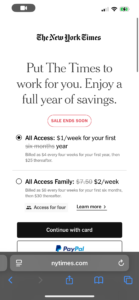
The New York Times employs hard-stop friction through a metered paywall that interrupts reading entirely. I have experience this myself, as before I had the Stanford subscription, I was often frustrated by not being able to scroll past the first two paragraphs of the NYT article I was reading. Unlike Spotify or Figma, NYT forces a binary choice: subscribe or lose access to the content you have already begun consuming. This approach sacrifices reach but filters for high-intent readers willing to pay for journalism, puzzles, and lifestyle products. Once subscribed, users often remain engaged across multiple verticals, like Games and Cooking, raising lifetime value through bundled consumption. The calculated risk is steep drop-off at the paywall, yet NYT’s strategy assumes that a smaller base of deeply engaged subscribers yields higher, more predictable long term value.