
Spotify:
Spotify’s 2012 model groups squads into tribes working on related areas. The basic unit that deploys is the squad. Squads act like mini startups in a way and each squad’s product owner (PM-like) prioritizes the backlog and coordinates the roadmap with others. The squad controls how it works and the chapter leads are the ones handling people management.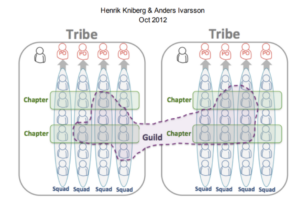
Airbnb:
Airbnb’s approach gives PMs a substantial amount of product responsibility and senior leadership coordinates what the company builds. Therefore, owning the product area and having priority decision making are different kinds of authority. People are organized around expertise “functionally”. Instead of divisions pursuing many separate roadmaps, there’s more of a centralized roadmap following Chesky’s vision. Design also has authority early on. Chesky explicitly puts designers and PMs as equal partners.
Zappos:
Zappo’s holacracy organizes work into these nested circles. The circle leads set the priorities and role owners decide within the defined boundaries. However, this means that if your role gives you authority over a decision, you can make it within the rules without back and forth approvals. Senior titles doesn’t give someone the right to overrule you. PMs in the typical sense still kind of exist but their roles are defined within their circles, giving a considerable amount of autonomy.
Decision:
I would personally go with Spotify’s structure. In the previous company I interned with, we were just starting to implement something called “pods” and this reminds me of their tribe structure. Our pods were of course smaller and we didn’t have traditional PMs but the idea that these smaller collaborative subunits acting like their mini startups resided with me the most. I wouldn’t like Zappo’s model because collaboration with other circles would be very challenging as roles are defined within circles. For companies that don’t require that much collaboration between specialties for products, this could make sense, but it wouldn’t be a thing for me. I also like Airbnb’s organization and think it would be very fruitful as well, but if my vision doesn’t align with the central authority that much, it could be a little more of a problem with this style of organization. I would like some amount of autonomy.



