
Team 3: Alahji Barry, Elyse Cornwall, Kaitlin Peng, Anooshree Sengupta, Cecilia Wu
Synthesis
Baseline Study
Our team is focusing on decision making, as we identify as indecisive people who want to explore behavior around decisions. In our baseline study, we recruited Stanford students and recent grads who identified as indecisive. For our pre-interviews, we asked participants about their existing decision making strategies and the outcomes they’ve had using these strategies. Then, during the diary study, participants logged up to 5 decisions that they made every day for 5 days. At the end of each day, we asked participants to reflect on their decisions.
After some initial investigation of the data, we found that our participants’ pain points in the decision making process fell into three main categories:
- Making fast decisions
- Making “the right” decision
- Feeling confident in their decisions
Secondary Research
These categories helped inform our literature review and comparative analysis. We read articles about decision making confidence like, “Cross-cultural Differences in Self-reported Decision-making Style and Confidence” and “Subjective Confidence Predicts Information Seeking in Decision Making”. These papers illustrated how people from different backgrounds have different decision-making styles, and that perceived confidence doesn’t always correlate with accuracy in decision making. Another area we investigated in our literature review was fast decision making: “Making Fast Strategic Decisions in High-Velocity Environments” suggested that rationality and analysis can actually speed up the decision making process, while “Spontaneous Giving and Calculated Greed” indicated that forcing quick decisions increases people’s cooperation. These papers suggested that different strategies might be useful in different decision making situations (low versus high stakes, with versus without a deadline) and that our solution would likely need to narrow in to address a more specific need within decision making.
Our comparative analysis made it even clearer how important it would be for us to choose a specific need within decision making, rather than try to tackle all types of decisions with one solution. We found that existing decision making solutions fell along a continuum from slow processes for making long-term decisions to fast processes for making short term decisions. One example, Chooser, is an app that can be used by a group of people to randomly select someone to make a decision on behalf of the group. This comparator fell towards the extreme end of fast, short term decisions, as our teammate Cecilia noted, “I personally use the app to make decisions in a group setting, but would not use it to make major decisions as I would need to consider the pros and cons more.”

Unpacking Our Data
We brought these findings into class hoping to identify an area within decision making that we might focus on. We started with affinity mapping in silence; we grouped our data according to whatever relationships and similarities we saw.
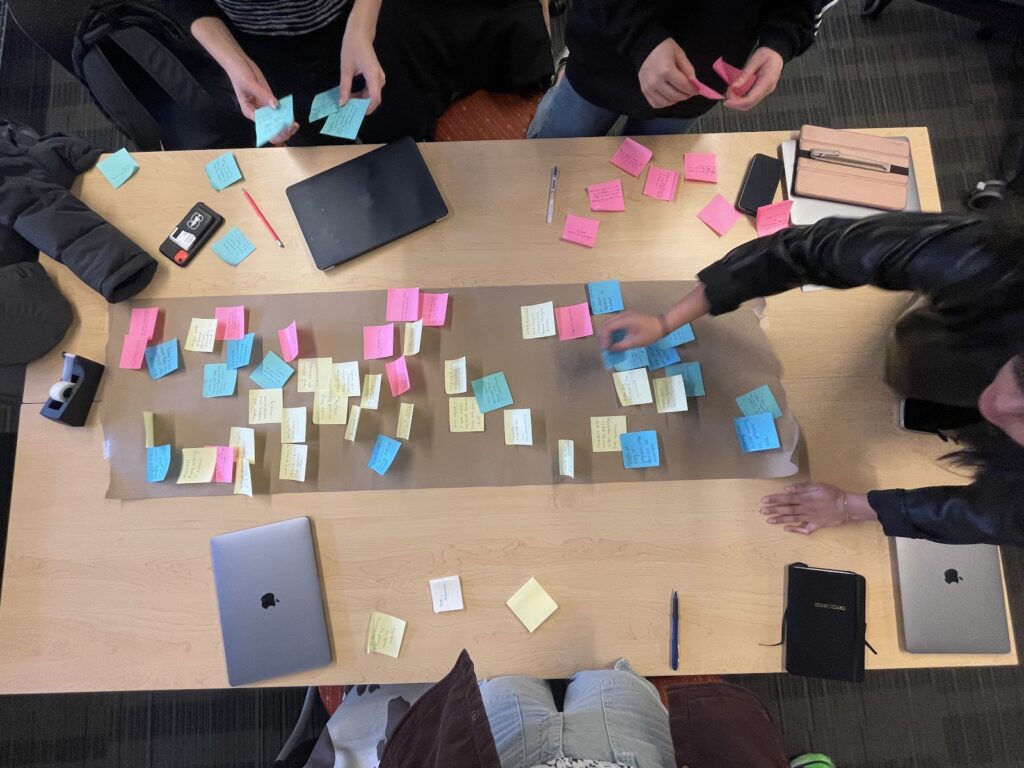
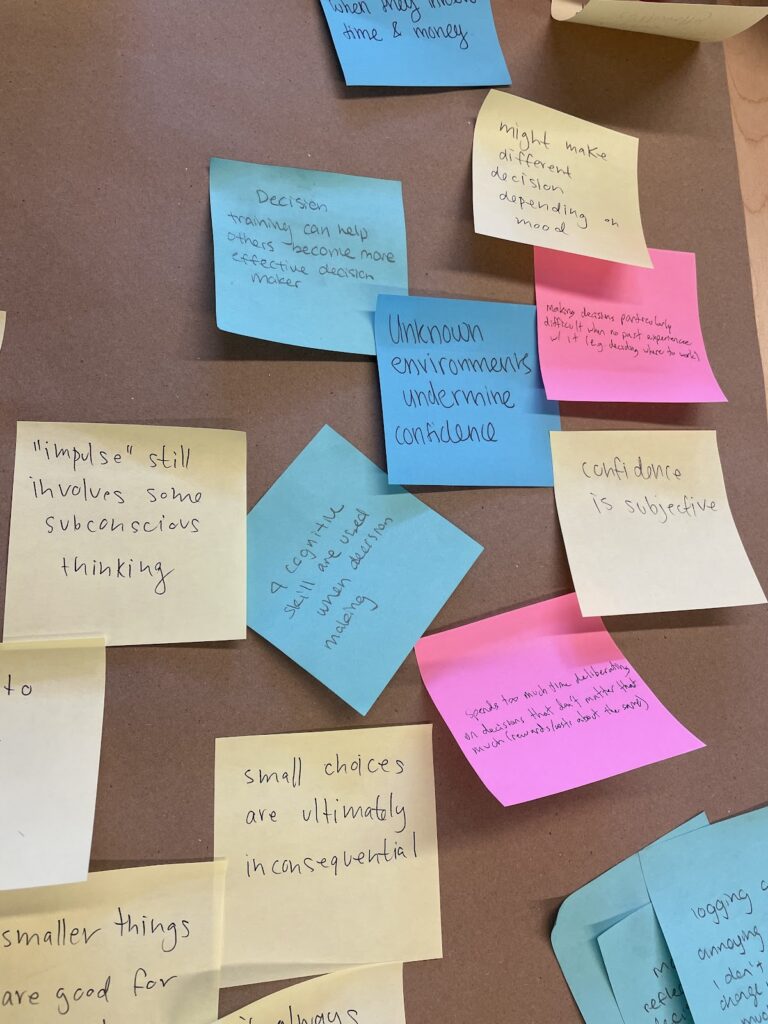
This mapping allowed us to confirm some of the ideas we had about our participants’ decision making struggles falling into several categories. Not all issues around indecision are related to speed: the closeup below demonstrates how our participant data clustered around issues of confidence as well as importance in decision making.
Next, we did frequency grouping by moving the stickies from the affinity map to rows off to the side. We didn’t fit all of our data into these groups; instead, we identified key themes that emerged from our affinity map (shown later in more detail) and used the data points that belonged to these themes in our groupings.
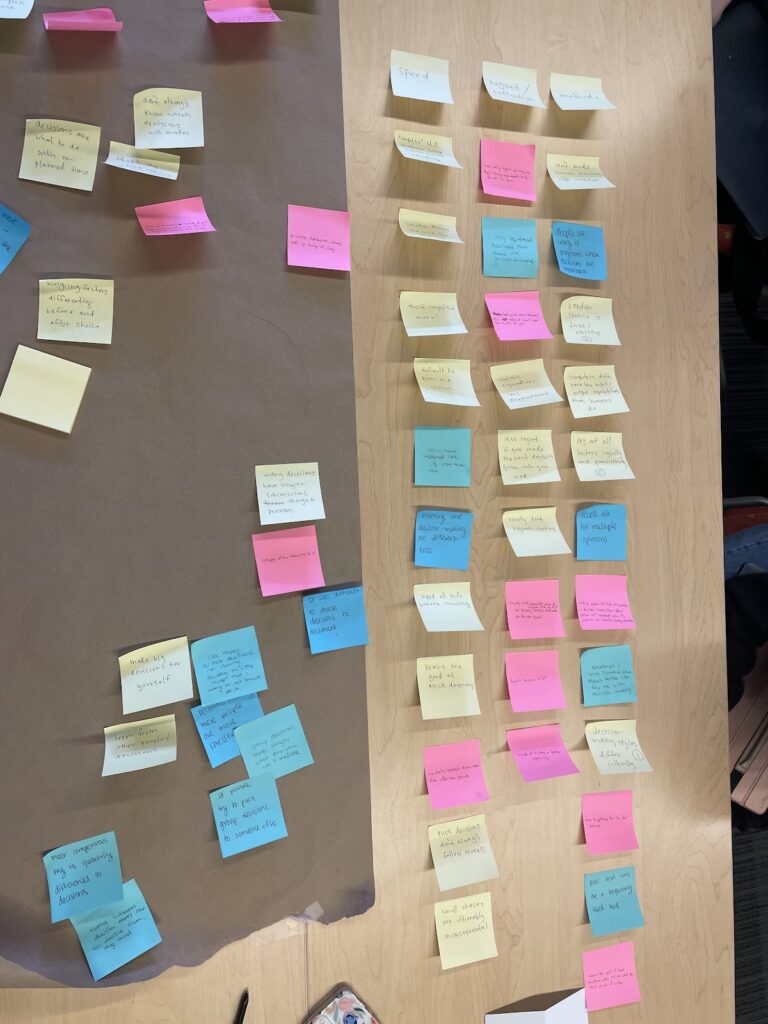
We found that decision making speed came up in a lot of our baseline study data and research, but not only in the context of faster decision making. Most of the approaches to decision making we encountered – for example, participants making pro/con lists or apps utilizing randomness – were aware of the timescale of the decision, and therefore lent themselves to different types of decisions. We learned that people were more comfortable being impulsive when making small, inconsequential decisions (“Do I wear shorts or pants today?”), while they preferred to consider their options more carefully and involve others when making long-term decisions (“Where should I live after graduating?”).
Another category with high frequency was “Regret/Reflection” which encompassed feelings after making a decision. One sticky (shown below) noted that a participant “never really regrets decisions [because] there’s always some benefit to the decision he chose”. We thought this angle was promising because it suggested that decision making confidence, something many participants struggled with, was a mindset rather than a fact of the decision. We wondered how we could get other people to change their behavior to focus on the positive outcomes of their decisions in order to avoid regret.

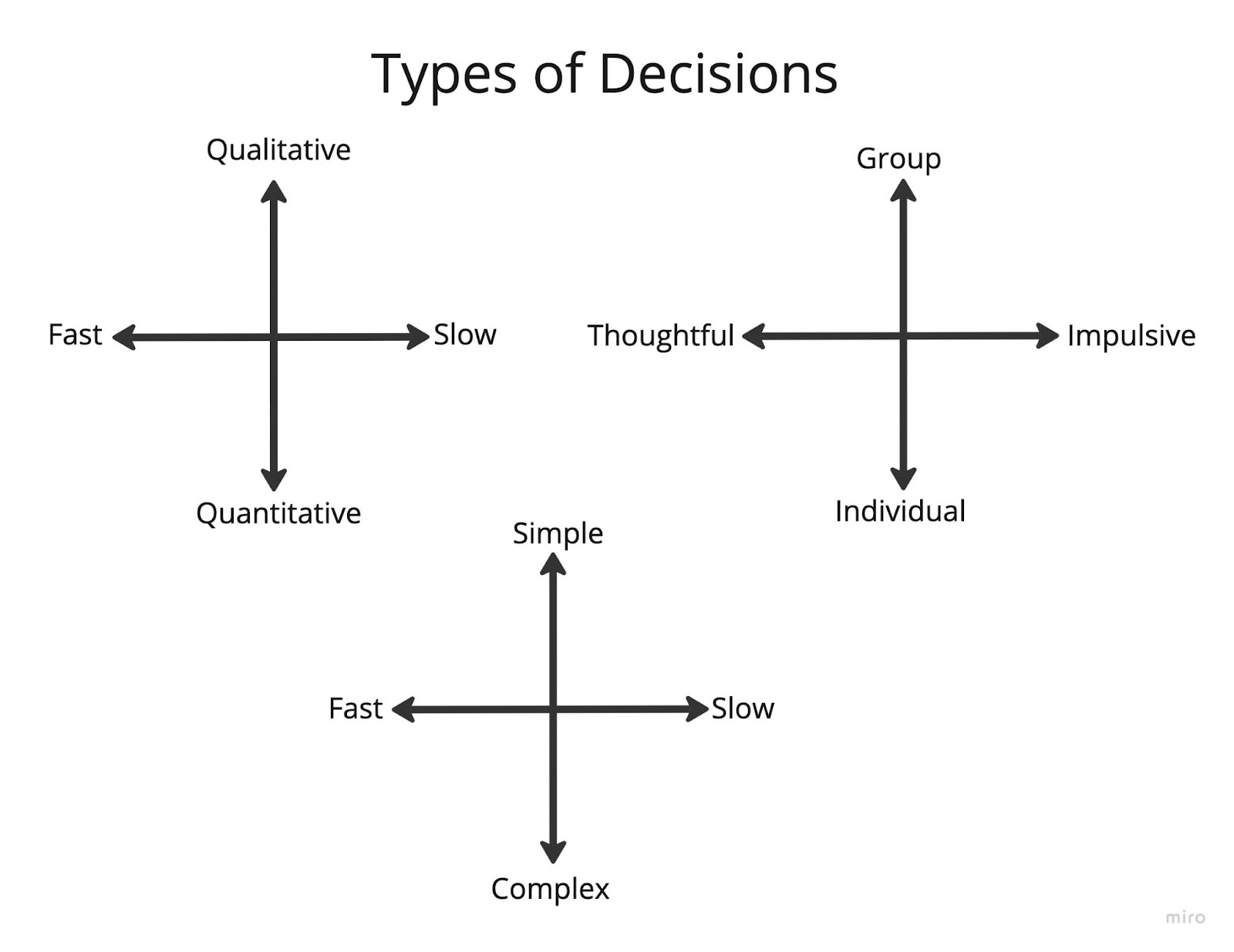
Using this information about frequent themes in decision making, we explored different 2×2 matrices to further organize our data. A pattern across these matrices was the fast/slow decision making. After populating the matrices with the decisions our participants made, as well as the solutions explored in our comparative analysis, we found that we had more areas to explore rather than answers. Can we ever convince someone to make an important decision quickly? Should we try to compete with the existing market of solutions for simple/fast or complex/slow decisions or branch into the untouched quadrants?
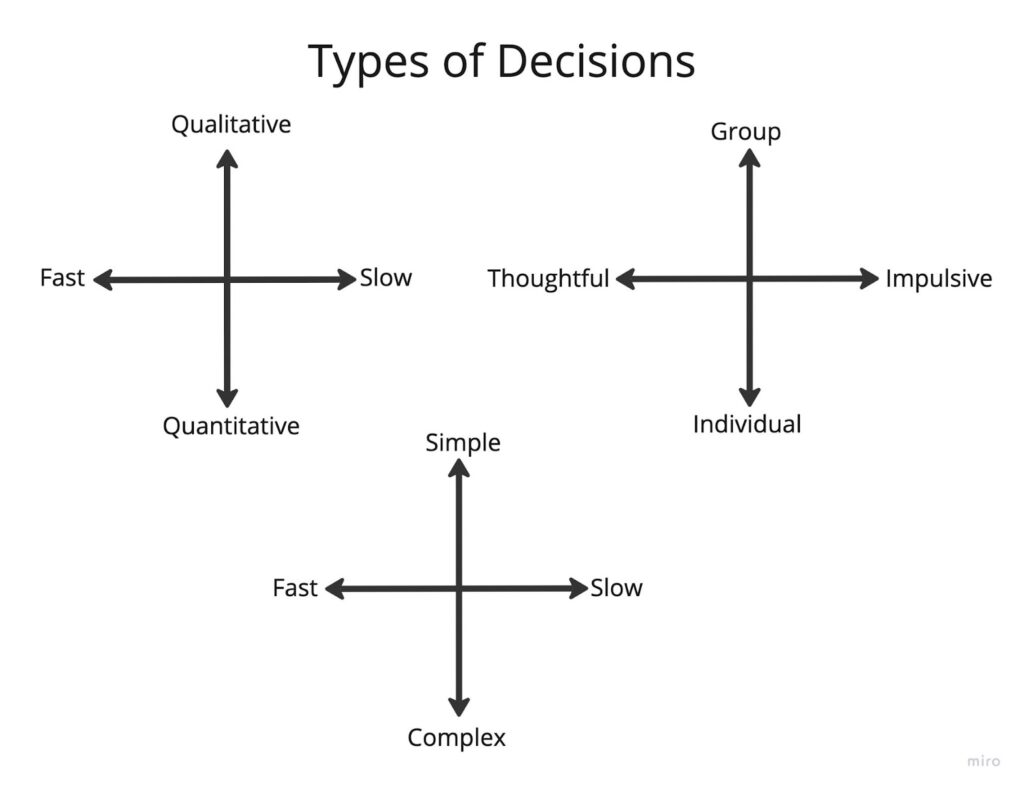
After these in-class exercises, we wanted to look for common threads that emerged across these different types of decisions. We used models to supplement our understanding of this data.
Models

We have constructed a connection circle to indicate the factors that could influence one’s decision making process. Here, positive and negative relationships were outlined with the gray lines, indicating neutral connection between two of the categories. The following model illustrates a few important factors that contribute to one’s decision, the most such as timing, responsibilities, and short vs long term. The complexity of the decision that needs to be made ultimately determines the process and time needed to make a decision.
Personas & Journey Maps
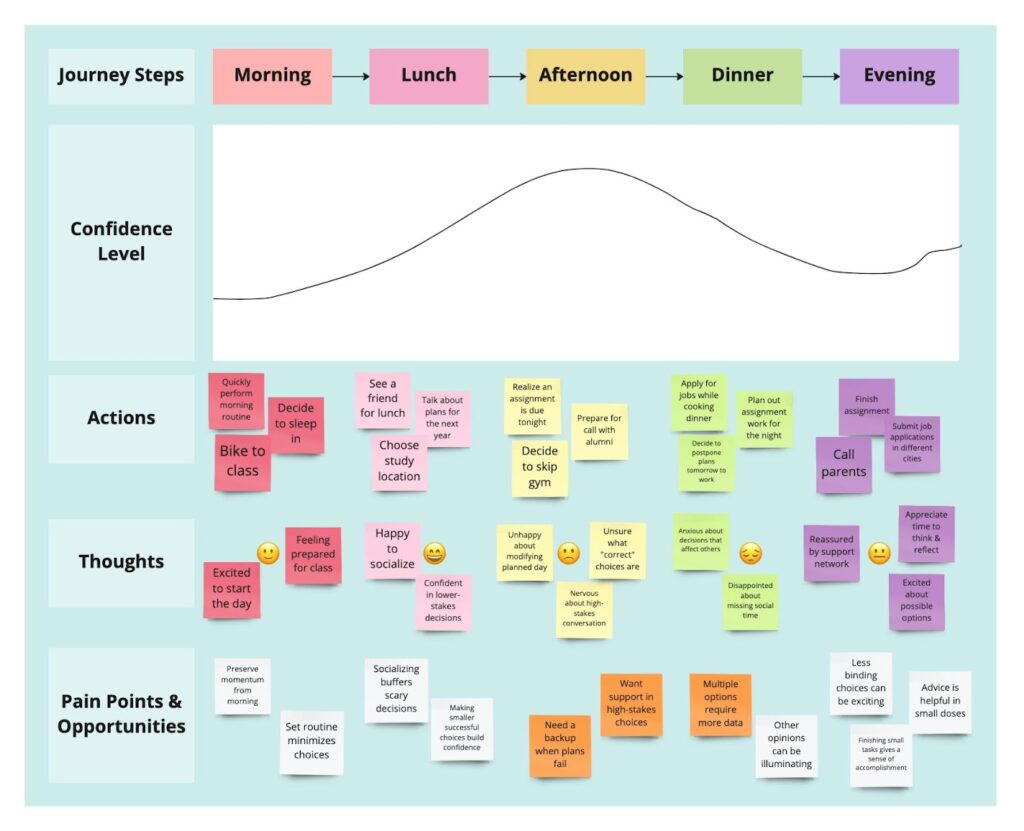
For our project, our team (Team 3) decided to focus on reducing the stress our friends and peers experience when making decisions. In our baseline study, we asked participants to document the different decisions they made throughout the day—as well as the choice they ultimately made—and their reflections on those choices at the end of the day. Overall, we noticed that college students face multiple smaller decisions throughout the day, and all of our participants struggle in identifying the priorities important to them, especially when their decision involves multiple people.
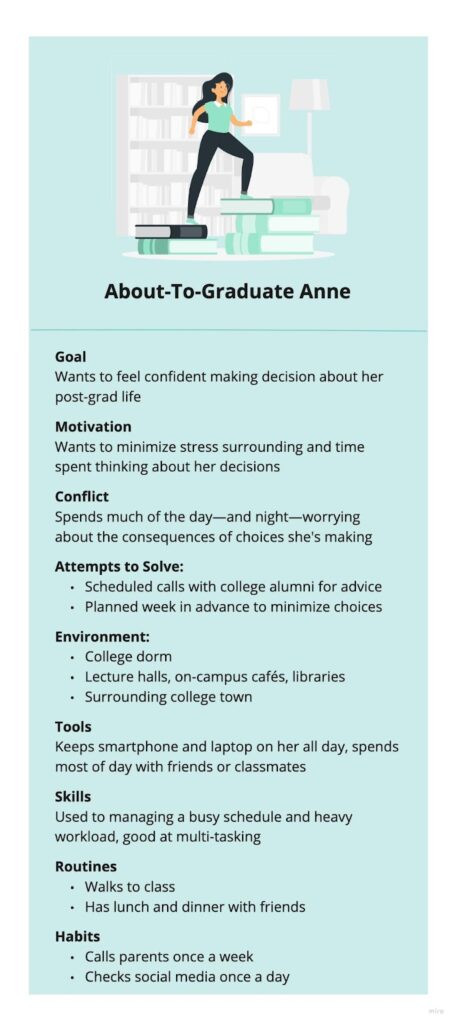
About-To-Graduate Anne
For our first proto-persona, we wanted to deep dive into a state of mind many of our participants are in: preparing to leave college. Participants who are graduating seniors or coterms not only face important decisions surrounding their careers and future living situations, but they also tend to place more weight on relatively minor social or personal decisions because it’s their final year at Stanford.
This journey map catalogs a single day in the life for “Anne.” We chose to track her stress level, noting when decisions had an impact on that level.
Working Walt
For our second proto-persona, we wanted to understand the feelings of someone navigating big decisions for which they don’t fully understand the consequences or possibilities that come with them. Many of our participants didn’t know where decisions would lead them, and it’s a universal truth that none of us can fully anticipate what the “right” choice is when deciding where to live, who to date, what job to take, etc. This second persona enters the mindset of Walt, who recently graduated from college and is experiencing a huge lifestyle change.

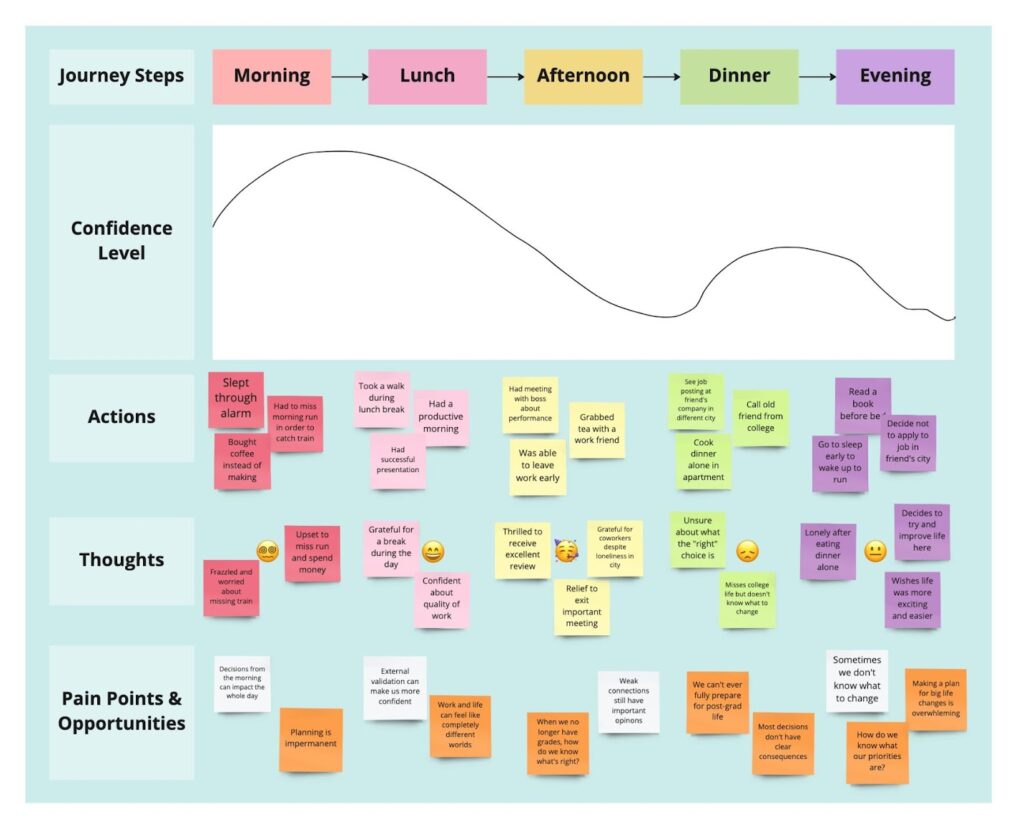
Again, Walt’s journey map tracks his stress level throughout the day:
Intervention Plan
Intervention Ideas
1. Focus on Positive Outcomes of Past Decisions by Listing Them
This is an intervention that focuses on the positive outcomes of past decisions in order to boost decision-making confidence and reduce feelings of regret. Participants will be asked to reflect on past decisions they have made and list the positive outcomes that resulted from those decisions. This exercise encourages individuals to focus on the benefits of their choices and to view decisions from a more positive perspective, which can help to reduce feelings of regret and increase confidence in decision making. This intervention can be facilitated in individual or group settings, and can be tailored to fit the specific needs and goals of the participants. By focusing on the positive outcomes of their decisions, individuals can develop a growth mindset, increase their self-awareness, and build resilience in the face of challenges and setbacks. This is motivated by our research synthesis which indicated that decision making confidence, something many participants struggled with, was a mindset rather than the decision itself.
Pros:
- Encourages a more positive perspective on past decisions
- Can reduce feelings of regret and increase confidence in decision making
- Supports the development of a growth mindset and increased self-awareness
Cons:
- May not be suitable for individuals who have made highly negative or harmful decisions
- May not address the root causes of regret or negative feelings about past decisions
- May not fully address the reasons why a decision was made in the first place
- Focuses on a past decision rather than help to make a “better” current decision
2. Use a Timer to Help with Making Decisions Faster
Our second intervention idea was nudging participants to use a timer when making decisions to help them to arrive at a decision faster. Participants will be given a set amount of time, for example 30 seconds, to make a decision on a specific task or prompt. This creates a sense of urgency and encourages quick thinking, helping participants to become more efficient in their decision making process. The use of a timer can also help to reduce indecision and overcome analysis paralysis by forcing participants to act within a limited time frame. This intervention idea is motivated by our research synthesis which indicated that participants would take a lot of time when making decisions, especially for long-term decisions.
Pros:
- May forces participants to act quickly and reduces indecision
- May help participants overcome analysis paralysis
- May encourage efficiency and quick thinking
Cons:
- May not allow enough time for adequate consideration of all options and careful reflection
- May not be suitable for all types of decisions, such as complex or high-stakes decisions
- May create added stress and pressure for participants
3. Reassessing Priorities During Two Checkpoints (Chosen Intervention)
The proposed intervention idea is a time management strategy where participants start their day by setting priorities (i.e. completing an assignment, socializing with friends, etc.) and following those priorities when making decisions throughout their day until the first checkpoint: lunch. During lunch, they assess the decisions they have made so far and their progress in tasks they wanted to complete, using that assessment to reassess their priorities. For example, if they decided to prioritize completing homework at the start of the day and found that they followed through with it until lunch, they can reassess their priorities during the checkpoint and prioritize something else like socializing until the next checkpoint. The second checkpoint is at dinner, where they will do the same procedure and resasses their priorities for the rest of the day. This approach encourages participants to make easier decisions throughout the day by having a clear priority for decisions, which can also lead to faster decisions and feeling less regret for them. This is motivated by our research synthesis which indicated that many participants struggled with picking between decisions to be productive and decisions to socialize, and also worrying about the consequences of either decision.
Pros:
- Encourages participants to prioritize their decisions and focus on their most important responsibilities.
- Offers a structured approach to reducing stress when making decisions and increases productivity.
- Provides participants with regular checkpoints to reassess their progress in tasks to make necessary adjustments to their priorities.
- Can lead to faster decision-making because of clear priorities.
- Clear priorities can help participants feel less regret for a decision they made.
Cons:
- May not be suitable for individuals with flexible schedules.
- May cause stress and demotivation if participants are unable to complete their most prioritized tasks by a checkpoint.
- May not allow for unexpected events or emergencies that require a change in priorities between checkpoints.
- Only really works for smaller every-day decisions.
- Can lead to more feelings of regret if the participant makes a decision that doesn’t follow their priorities.
Chosen Intervention
Idea 3 was our favorite intervention idea because it addresses multiple challenges faced by participants in making decisions. It provides a structured approach to time management and decision making, helping participants clearly prioritize different things throughout the day and making decisions easier. It also, like ideas 1 and 2, has the potential to help participants make faster decisions and feel less regret about the decisions they make because they are following the priorities they set. We chose not to use idea 1 because it focuses on helping participants with decisions made in the past when we think it’s more beneficial to help them with ones that haven’t been made yet. We chose not to use idea 2 because our synthesis found that making faster decisions was a less important problem to help with than other ones, and idea 3 has the potential to encourage faster decision-making anyways.
Intervention Study Details
Hypothesis: People find it easier to make decisions if they have a clear list of priorities they can base their decisions off of. Being able to reassess priorities throughout the day gives more flexibility to participants and helps with burnout and productivity.
Who is being recruited: 10 college students/recent graduates who have completed the previous screener and were determined to be an eligible participant, but NOT a power user (i.e. recruited participants have a hard time making decisions).
Length of study: 5 days
Details: Participants will be given instructions to make an ordered list of priorities when they start their day and make decisions throughout the day based on the list. During lunch, participants will go through a short list of reflection questions (detailed in the next section) to help them think about their day so far and reassess their priorities. They will then note down their new ordered list of priorities. During dinner, participants will go through the same procedure. At the end of the day, participants will complete a few short reflection questions about how the lists affected their decision-making.
Data being collected each day:
- 3 ordered lists of priorities (start of day, lunch, dinner)
- (Optional) Impactful decisions they made that didn’t follow their priorities
- Short answers to checkpoint reflection questions
- How satisfied are you with decisions you’ve made since the last checkpoint?
- What are the biggest factors that led you to change/not change your priorities at this checkpoint?
- (Optional) Any other methods used to reassess priorities
- End of day reflection questions
- How often did you find yourself making decisions that weren’t at the top of your priorities?
- Do you feel the list of priorities made decision-making easier today?
- What, if any, effect did reassessing your priorities throughout the day have on your feelings about your decisions?
Questions being addressed by the study:
- Do people find it easier to make decisions if they have a clear list of priorities they can base their decisions off of?
- Does reassessing priorities throughout the day help reduce stress and regret?




Comments
Comments are closed.