
Problem domain and motivation
For our problem domain, we wanted to improve the commitment to and composition of our morning routines. The driving force behind our interest in this topic was the observation of a strong correlation between these two factors and a sense of contentment expressed by both ourselves and our colleagues throughout the day. From our problem domain, we derived that our objective was to identify and address the key challenges that prevent people from establishing a healthy morning routine.
Baseline study
While selecting participants for our baseline study, we utilized a mix of personal connections and cold-emailing to gather participants who indicated on their screener that they felt unsatisfied with their current morning routine. Our target group consisted of college students.
From our pre-study interviews of our participants, we looked to extract information regarding the activities the participants perform in their morning routine and their thoughts about whether having a comprehensive morning routine led to a more successful remainder of their day.
For the baseline study, we asked participants to log the following daily: activities the participant performed the night prior to performing the morning routine, a log of the activities they performed in the morning, and Likert Scale questions to judge the participant’s emotional well-being in the form of satisfaction and energy level.
Post-study, we synthesized the data by first placing our baseline data into an empathy map to see the problem from the participant’s point of view and get insights into their habits.

After examining the empathy map, we analyzed the user data by placing them on a 2×2 grid that measured the level of impact on their morning routine and the type of factor. The grid showed us that distractions were the main hindrance to completing morning routines and were an external factor we could potentially influence in hopes of reducing the negative impact.

To better understand the relationship between participants’ actions and emotions and visualize the connections between them, we created a mind map. The mind map was key in showing us that distractions from devices were a critical problem for participants who couldn’t stick to their planned morning routines.

To further emphasize this and ensure we were understanding the insight correctly, we proceeded to create a connection circle that unpackaged the various emotions and activities mentioned by our participants which revealed the key takeaway, heavy unintended use of electronics in the morning greatly impacted the commitment individuals allocate towards maintaining their morning routine.
Comparative Research/Analysis
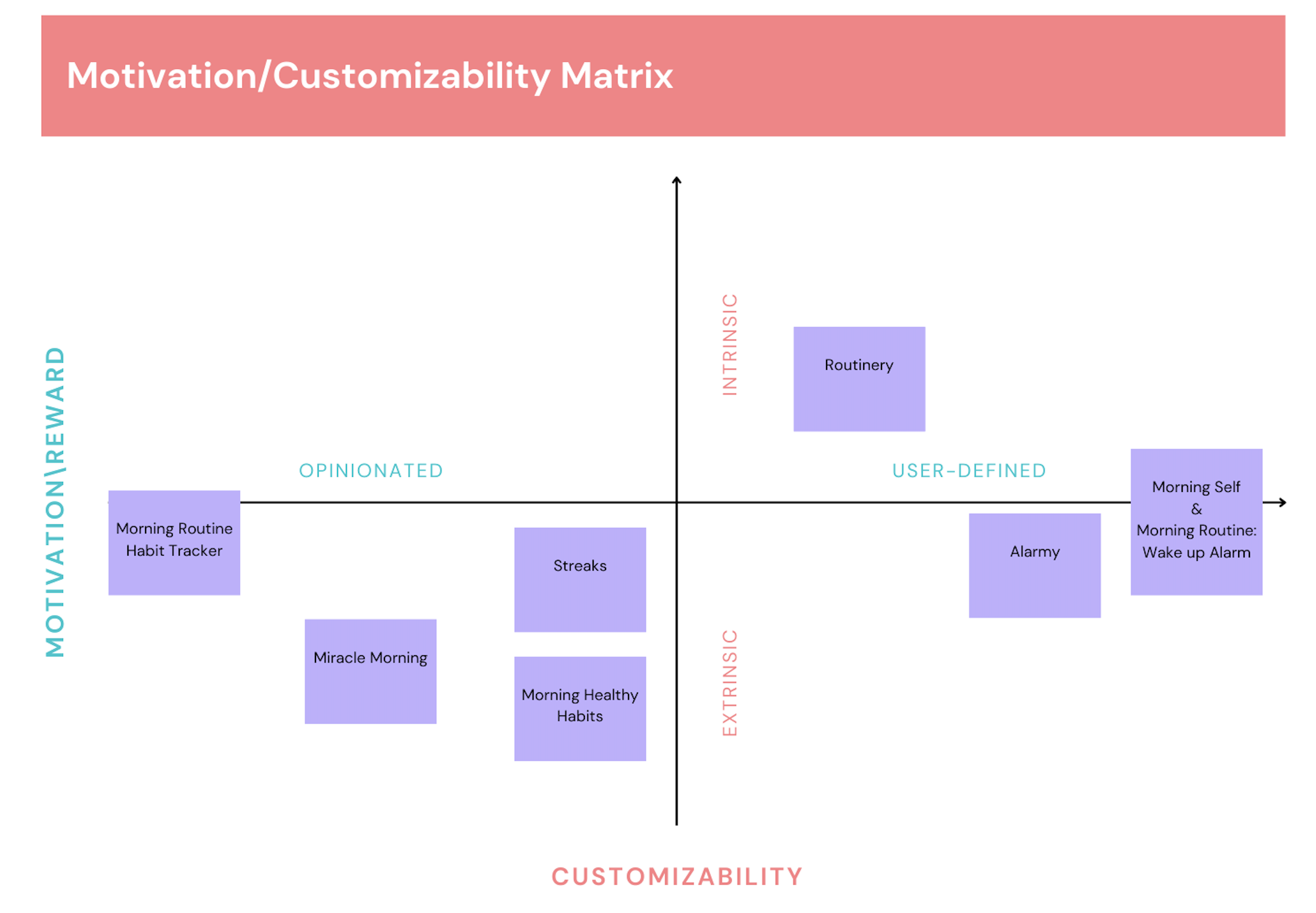
Most apps do a decent job of nudging and notifying users about their tasks. A few apps are great at building extrinsic motivation to be consistent by using streaks and point systems. Some apps are very flexible at allowing users to define their tasks and others create task lists for the users (opinionated).
While research-backed predefined morning tasks can be a great option for someone who has a decent morning routine, students may find it overwhelming. Furthermore, extrinsic motivations wear off quickly. Most importantly, all of these apps rely on users to be on phone to build the routine thus allowing for more distractions.
We categorized the apps in a 2×2 motivation/customizability matrix. An app on the first quadrant would be most beneficial for students. Thus we plan to keep our app’s task list completely user-defined and celebrate the success of users to amplify their mental satisfaction. The design will be minimal which requires low interaction with the app and creates a barrier to digital distractions.
A more detailed comparative analysis can be found here.
Literature Review
In the HCI research domain, several people attempted to help people stay on top of their morning tasks utilizing smart devices such as smart mirrors. A few articles tried to formulate a perfect morning routine, however, we found the task list on the perfect morning routine slightly overwhelming or often inapplicable to the students. However, a very common suggestion we found is that habits are most effectively built in small steps. For the morning routine specifically, having a set wake-up time and time to leave home help bring everything else in order. Having a set time is often the hardest part of the routine for college students since their class schedules vary throughout the week. On top of the variable schedule, digital distractions cause unexpected time shifts in the schedule. Although we don’t have much control over the class schedules, we can help students with digital distractions. A detailed literature review can be found here.
Proto-Personas
From our baseline study, we discovered that there is a fundamental difference between the expectations of graduate and undergraduate students from their mornings. They also define a “successful morning” slightly differently with some overlaps. Thus our personas are based on two students: Grace who is a graduate student, and Aaron who is an undergrad.
Grace and Aaron both want to have a healthy (physically) morning. However, Grace prioritizes mindfulness and being able to do critical thinking in the morning, whereas, Aaron endeavors to have a minimal morning routine with healthy habits.
Detailed descriptions of the different aspects of their personas can be found in our 5A writeup.


Journey Maps
The critical observation to be made about the journey maps here is that the timeline entries aren’t at constant intervals. Furthermore, the timeline for Grace’s map is different from Aaron’s. This is because of the differences in their morning expectations. Grace has a longer morning routine since she wants to achieve certain intellectual and academic milestones in the morning. On the other hand, Aaron’s morning schedule is short since his morning’s primary purpose is to ensure that he is energized enough for the rest of day in order to achieve the academic milestones at the later stages of the day. We see that Grace wakes up early in a quite energized state; however, Aaron wakes up late and with low energy. Neither Aaron nor Grace gets the most out of their mornings because of their unplanned wastage of time on digital devices.
More on the journey maps can be found in our 5A writeup.


Intervention Ideation
Based on the findings above, we decided to focus on helping people stay away from distractions stemming from the phone as they go about their morning routine. Below is a brief summary of the top three intervention ideas:
- Ask the participants to pause for 30 seconds whenever they feel the urge to do something unintended on the phone
- Have the participants send a text message to a team member every time they get distracted by their phone
- Ask the participants to stick a sticky note on the screen of the phone to remind them to do a task (written on the note) before they’re allowed to use their phone
We moved forward with the third idea (see our 5A writeup for all ideas we considered and the detailed selection process). This idea scores high on effectiveness because it is a physical and unavoidable obstacle in between participants and their phones. This idea also scores high on feasibility because post-it notes are easy to get and simple to use.
Intervention study
Below is a brief summary of the intervention study plan (see our 5A writeup for study protocol details):
- Intervention Method
- Have participants write down their planned morning routine tasks on post-it notes and place the stack on their phone before going to bed.
- As participants complete each task in the morning, they may peel off the corresponding sticky note.
- Each time the participants get distracted during a task, they would place a tally mark on the sticky note.
- Data Collected
- One entry for each morning for a total of 5 weekdays submitted through this google form, including
- A photo of the completed post-it notes
- Answers to a series of questions, such as level of distraction and sources of distraction
- One entry for each morning for a total of 5 weekdays submitted through this google form, including
- Who We Recruited
- 2 participants from the baseline study, who face challenges with distractions in their morning routines and provided us consistent data during the baseline study
- 4 new participants, who are university students wishing to improve their morning routines (our initial target audience) and reduce distractions in particular
Synthesis
A total of 6 participants completed our 5-day intervention study. Because we asked the participants to answer questions such as how distracted they were and how difficult they felt it was to stay away from distractions, compared to a typical morning, we decided to first view the aggregate results of their daily answers to these questions.

In this chart, we were glad to see that a third of the entries indicated somewhat or significantly less distracted, showing some promise that the intervention could have helped the participants be more focused on their morning routines some of the days.

In this chart, we can see that close to half of the entries indicated that it was somewhat or significantly less difficult to stay away from distractions. This result also shows promise that the intervention might have helped the participants to stay away from distractions some of the days.
Although the charts above showed some positive results, around 20% of the entries indicated negative sentiments and a large portion also indicated “about the same.” Therefore, we dived deeper into those days specifically and created sticky notes for each of the reported sources of the distractions. We colored each sticky note by the participant. When viewing the entries, we were surprised to see that some participants reported distractions that were not caused by the phone. On the other hand, a participant reported social media as the main source of distraction. Thus, we came up with the axes of internal to external and low to high social content. Looking at the grid, we were surprised that only one participant (colored blue) reported social media as a distraction source, while most participants reported messages, calls, and notifications as main distractors.

We next took a closer look at all the reported distraction sources to understand what factors often disrupted the participants’ morning routines. We found four main categories – internal state, people, information, and unwelcomed interruptions – and created a fishbone diagram that summarizes these main factors that lead to distraction from morning routine.

This diagram is particularly useful as it helps us see the challenges that our participants still faced despite having the sticky notes placed on their phones as physical barriers and task reminders during the intervention study. We learn that, while the sticky notes may have helped some of the participants be more focused, there are still internal and external factors beyond the participants’ control that can disrupt their morning routine plans. Therefore, we will next think about effective ways to both nudge users to stay away from distractions as well as motivate them to follow through with the routine despite having been distracted.
Storyboard & Stories
Our app’s main objective is to help people stay away from unnecessary electronic use in the morning – subgoals include preventing a user from using their phone as a distraction, helping a user remember their morning tasks, motivating them to complete their morning routine, and nudging them to maintain their progress.
In the two stories below, the app:
- Helps someone who spent a few hours on social media on their morning get back on track
- Helps a late riser get started with their morning routine instead of feeling dejected


Future Direction
Our synthesis of the intervention study results helped us identify challenges and obstacles that participants faced when attempting to stay focused on completing their morning routines. Although the challenges fall into different categories, phone notifications and social media use were still the most common and consistent distractors. Therefore, moving forward, we will focus on helping people reduce distractions specifically caused by phone notifications and unintended phone use in their morning routines.
While the sticky notes intervention somewhat helped participants be less distracted than usual, it is neither realistic nor effective enough to lead to a sustainable long-term change. In addition, since we are aiming to build a product that can help participants stay away from phone distractions, it makes natural sense to develop a mobile app that can control components of the phone screen such as capturing notifications, monitoring phone use, and sending users nudging messages. As illustrated in our storyboards above, we will develop features that can help the participants both stay away from distractions and stay motivated to complete their morning routines, even if their mornings got disrupted or had a late start. These are important features to build because we learned in our secondary research that it is important to maintain consistency when it comes to morning routines, and that staying motivated is key to consistency.



