Three Problems
See our Long List of problems here
We decided to narrow in on the following 3 problems
- Alignment and shared understanding (words mean different things, decisions shift)
- Need visual or sketch alignment, and remote work makes it harder
- Meetings dominate and are draining
These 3 were emphasized the most in the interviews, generated excitement in our team, and felt like we could reasonably prototype a solution in one quarter.
ICP
Our ICP brainstorm from studio
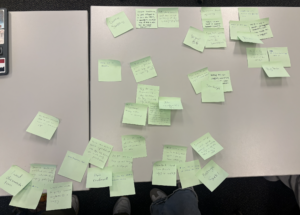
Our final ICPs that were polished after studio. Each is tied directly to learnings and personas from our interviews.
| Meetings suck! | Visual alignment | AI speeds timelines | |
| ICP | PMs at medium to large companies where almost all time is spent in meetings, teams that want more time to bond in person, teams that want to bond over meetings, product teams that want to align quickly and move quickly | PMs who need visual aids to communicate with their team and get everyone on the same page. Strongly correlated with alignment issues. | PMs who struggle with their engineers skipping ideation and jumping into building with AI which drives costs up and derail the PMs timeline. Mostly at startups where speed is paramount. |
SAM/SOM
Follow the link above for all resources and reasoning behind our numbers.
| Meetings suck! | Visual alignment | AI speeds timelines | |
| SAM math | 250k × 60% mid/large companies × 50% meeting friction | 250k × 11% startups × 35% remote × 50% visual friction | 250k ×11% startups × 66% AI-assisted dev × 50% premature-build friction |
| SAM (PMs) | 75,000 | 4,800 | 9,000 |
| SOM math | SAM × SF share (7%) × who we can get in 1 year (1%) | SAM × SF share (7%) × who we can get in 1 year (5%) | SAM × SF share (7%) × who we can get in 1 year (5%) |
| SOM (yr 1) | 52 PMs (find at mid to large tech companies in SF) | 17 PMs (find at remote tech startups in SF) | 32 PMs (find at tech startups in SF) |
Competitive Landscape
| Meetings suck! | Visual alignment | AI speeds timelines | |
| Current/existing solutions |
|
|
|
| Where each falls short | Zoom, Google Meet, Microsoft Teams, Calendly are all good for virtual meetings and syncing up but are not interactive in any way and can be draining.
Granola, Otter.ai etc usually just do AI note-taking/transcriptions/turning notes into action items but again, are not interactive to sustain people’s attention spans and are very text-based. So usually people who are visual learners etc and find it difficult to stay attentive during meetings just suffer through them. |
Canva, Google Slides, Figjam, and Miro are too manual
ProductBoard, Linear, Jira, text to speech, and integrations are too text-based |
Productboard and claude are very adaptable
FigJam , miro,granola and aha roadmaps are too rigid Linear and Jira are too build first. |
| Axes for Mapping | Visual vs Text Based
Interactive vs Non-Interactive |
Visual vs Text Based
Automated vs Manual |
Validate First vs Build First
Adaptable vs Rigid |
| MAPPING OUR SOLUTIONS | Map 1 | Map 2 | Map 3 |
FigJam’s BMC
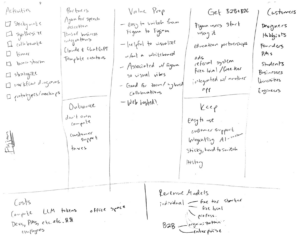
How it makes money
- Its revenue sits within Figma’s broader revenue model
- Individual and B2B subscriptions
- Educational plans
- Web based makes it easily accessible
Where it’s weak
- Very rigid, requires mostly manual edits
- Doesn’t feel like you’re collaborating in person
- Scattered information means it’s hard to organize post meeting; shared canvas so can get all over the place
Comparison Table
| Meetings suck! | Visual alignment | AI speeds timelines | |
| The problem | “You’re like, cool, I just was in meetings for, like, 8 hours, but I have a to-do list that’s still a mile long.” (Amelia) | “It’s not as easy, it’s not as tactile, it’s not as satisfying.” (Bryce, on digital whiteboards) | “We ship in hours what would have taken weeks.” (Craig) |
| Evidence strength | 4 PMs mentioned how meetings dominate and are draining | 4 PMs mentioned needing visual/sketch alignment with either AI or devs or even for translating customer feedback into features etc | 4 PMs mentioned how AI speeds timelines, adds pressure, changes the role |
| Current workarounds | Ad hoc solutions (team game meetings, agendas ahead of time, blocking time on calendar for no meetings) | PMs draw out lo-fi prototypes / sketches by hand on ipads or paper and then put them into claude design to make proper prototypes because otherwise it’s also hard to align claude design on what the look you’re going for is | Most small startup teams seem to be actively running into this problem right now. Solutions tend to look like a lot of backtracking and realizing too late, and trying to do better the second time around. |
| Competitive gap | Mainly email, text, or calls replace meetings but to a lesser degree of productivity. | Existing tools (FigJam, Miro, Figma) support visual collaboration and prototyping, but the gap is helping a PM turn an unclear technical discussion into a shared visual explanation and reveal conflicting interpretations. | Planning tools and AI assistants can support requirements and reviews but the gap is checking unresolved assumptions at the moment work moves into implementation, without adding a slow approval process. |
| ICP | PMs at medium to large companies where almost all time is spent in meetings, teams that want more time to bond in person, teams that want to bond over meetings, product teams that want to align quickly and move quickly | PMs who need visual aids to communicate with their team and get everyone on the same page. Strongly correlated with alignment issues. | PMs who struggle with their engineers skipping ideation and jumping into building with AI which drives costs up and derail the PMs timeline. Mostly at startups where speed is paramount. |
| Market Size (SAM/SOM) | SAM PMs at tech companies in the US who have meetings(75,000) SOM PMs at medium sized tech companies in SF who have nonstop meeting schedules(52 PMs) |
SAM
PMs at tech companies in the US who collaborate with engineering PMs at medium sized tech companies in SF who are non technical (17 PMs) |
SAM PMs at tech companies that are AI forward in the US(9,000)SOM PMs at small (<10 person) tech startups in SF that are AI driven and moving quickly (32 PMs) |
| Buildability | We could definitely build a fully working version over this quarter, especially if it’s an integration for just zoom. | Honestly we’re not totally sure here. Our guess is that this will be a heavier lift, but we could get a prototype working. | This feels like most solutions could be a simple ChatGPT wrapper with a nice interface. We could definitely build this out nicely in a quarter. |
| AI Fit | AI could identify unnecessary meetings, agendas, and recommend updates. | AI can turn discussion into visual maps but the concern was how AI is still in the early stages of creating visual images/maps and unsure how AI can help this in meeting in real time. | AI can easily act as a rubber duck doing an audit making sure none of the proper ideations and user research process steps are being skipped over, making sure PMs are thinking through everything |
Which part was hardest to fill?
Market Sizing was the hardest to fill. It’s intimidating to have to generate numbers from broad assumptions about the world. Our team struggled to decide how specific to be in the comparison table versus whether we should start broad and then go back in with specifics once we calculate our SAM/SOM.
Our interviews also told us that problems existed for certain people, but we were unsure exactly how broad and what ICP each of those problems affected. For this reason, we struggled to fill out Market Sizing.
What problem we’re leaning towards, and why
We’re leaning towards combining problems 1 and 2 into improving visual alignment post meetings. We chose this because we wanted to pick a problem that was open ended enough that it would spark lots of possible solutions while brainstorming. We felt problem 3 would corner us into one solution a bit too much. We also felt that problems 1 and 2 nicely supported each other and would give us flexibility as we progressed through the solution brainstorming process.
One thought from this week’s reading
- The Lean Product Playbook: The reading discusses Customer Benefit Ladders, where you keep asking the customer questions until you get to the root of a problem and why it matters to them. We didn’t have a name for this, but it’s what we were doing in our customer interviews and in our analysis of insights afterwards. For “Meetings Suck!” in particular, we were being told that people don’t like meetings, they take too long, they feel tired at the end of the day. After digging, we realized the root of the problem was that people felt like their time was being wasted by meetings that weren’t productive. For this reason, we decided to have a renewed focus on alignment since that can help reduce the feeling of unproductive meetings.
- One idea we used from this week’s reading is defining an ICP by its three most unique and important characteristics, which Lenny describes on page 6 under “How to identify your ICP” and illustrates in the “Initial ICPs” table on pages 5–6. We applied it in our “What Matters to our ICP” doc, where our ICP is “a PM who works at a remote startup who is overwhelmed by engineering jargon and wants visual aids to help with alignment,” combining job title, company type and way of working, and pain point. We also carried those same three attributes into our SAM_SOM doc as the filters for sizing the visual alignment market.
Extra Credit
For additional interview transcripts and insights visit the link above.