Team Members: Diego Sanchez Tirado, Felicia Yan, Isaac Were, Itai Reingold-Nutman, Janus Tsen, Victor Ahona, Carolyn Lee
Value Proposition
Cross-team knowledge that stays up-to-date, so you’re never out of the loop.
When PMs in large multi-team enterprise companies want to plan new features, but struggle with conflicting or duplicated work across teams, our product proactively searches for the missing context behind other teams’ plans and keeps company-wide knowledge of all ongoing initiatives up-to-date.
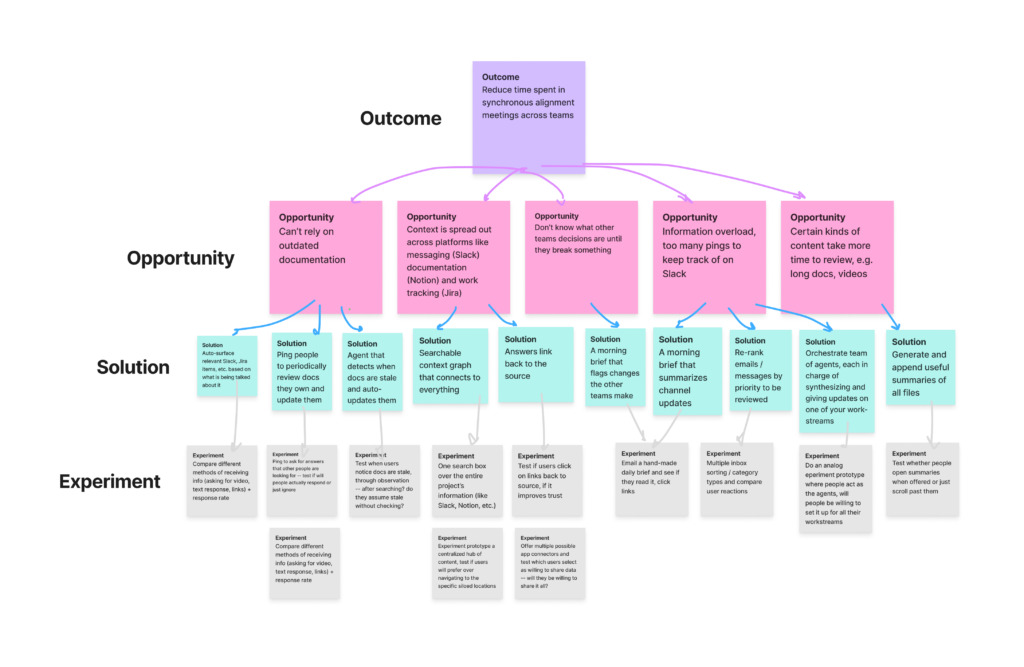
Opportunity-Solution Tree
Figjam: https://www.figma.com/board/UYCHvzN70JMSgCLkGkjhD8/Milestone-5?node-id=33-296
Story Map & User Stories
Figjam: https://www.figma.com/board/UYCHvzN70JMSgCLkGkjhD8/Milestone-5?node-id=0-1
Features for our MVP include connecting specific projects, providing search functionality to query the team knowledge base, and notifications to ping relevant teammates to answer questions and provide updated context. Future releases plan for better recommended results and more powerful AI tooling (e.g. integration across other apps, doing knowledge search across the web, more advanced agentic verification to minimize workday interruptions), as well as a more diverse and personalized set of tools to reach a wider user base (e.g. views for non-PM teammates, summaries tuned to the user’s level of technical expertise).
Below are our top user stories:
- As a product manager, I want to quickly find the latest knowledge on workstreams that I know other teams are working on, so I can guide my own team with confidence.
- As a product manager, I want to see where information comes from and who owns it, so I can trust what I’m using and know who to ask.
- As a product manager, I want to sync the tools I already use, so the knowledge base reflects real current work without extra manual updates.
- As an engineer or PM on another team, I want to answer questions quickly and only when they’re relevant to me, so I can help give context without constantly being pulled out of my work.
What we’re changing
One thing that we’re changing for our solution is narrowing our focus to help PMs find reliable and up-to-date information about specific projects across teams. Our initial vision of maintaining a company wide knowledge base was too broad for our MVP, so based on our OST and story map, we want to help our users better understand related projects. Additionally, we plan to prioritize core functionalities of the product instead of jumping to advanced AI features immediately.
An idea we applied from Continuous Discovery Habits was distinguishing opportunities from solutions, which helped us narrow our MVP to addressing the most important information gaps across PM teams.
We’re no longer building our own data-access layer from scratch. Our original plan was to build a custom authorization network: separate OAuth flows, permission handling and extraction pipelines for each source, including Slack, Notion, Jira and Google Drive. We’re replacing that with existing MCP (Model Context Protocol) connectors and the integrations those platforms already offer. Instead of starting from zero on how we get and parse company information, our agent connects through standard interfaces that already respect each tool’s permissions and data structures.
This makes things simpler for both groups of users. PMs authorize the tools they already use in a few clicks, and the knowledge base starts reflecting current work right away, with no manual setup or migration. Engineers and teammates on other teams keep their existing workflows, and their access controls carry over as they are. That speaks to the trust concerns behind our user stories about provenance, where users want to know where information comes from and who owns it.
The change also helps us build and grow. For the MVP, we can put our engineering time into the core value: cross-team search, staleness detection and targeted pings to teammates. We no longer spend it rebuilding auth and ingestion plumbing. For scalability, adding a new source means plugging in an existing connector rather than building and maintaining a custom pipeline, which fits our future-release goals of working across more apps and doing more advanced agentic verification. For adoption, enterprise teams are more willing to try a tool that builds on integrations they’ve already vetted than one that asks for broad new data access. Less security review and less onboarding means a shorter path from trial to team-wide use.
This week’s Strategyzer reading argues that an experiment has to stay tied to the Value Proposition Canvas. A Simple Landing Page test, for example, should be built from the customer’s top pains and gains and the value map, rather than only describing the solution, because “Do not create your Value Proposition in a vacuum.” Our move to MCP connectors follows the same logic. Our original plan of building a custom authorization network was solution-first. It would have spent most of our effort on infrastructure before we had validated whether PMs care about cross-team context and whether teammates will answer targeted pings. Using existing integrations takes that cost off the table, so the MVP itself can work as a test of our value proposition, “Cross-team knowledge that stays up-to-date, so you’re never out of the loop.” It also lets us speak directly to the pains and gains in our customer profile. The pains are conflicting or duplicated work across teams and outdated documentation; the gains are confidence in planning and knowing who owns information. Connecting through the tools PMs already trust also fits the reading’s guidance on low-friction calls to action. A landing page can promise “connect your Slack, Notion, and Jira in one click.” Sign-ups and connected workspaces then give us a clear signal of whether the value proposition resonates, without a heavy security review or onboarding getting in the way.