
Introduction
I am running an observational experiment centered around behavior change. Since I often find myself watching television when I should be asleep, I shall set out to change this ‘negative’ behavior. I will have alarms set on my phone every hour and log my current behavior. The goal of this observational experiment is to 1) see how often this behavior occurs and 2) identify the factors and habits that contribute to the behavior.
Observations
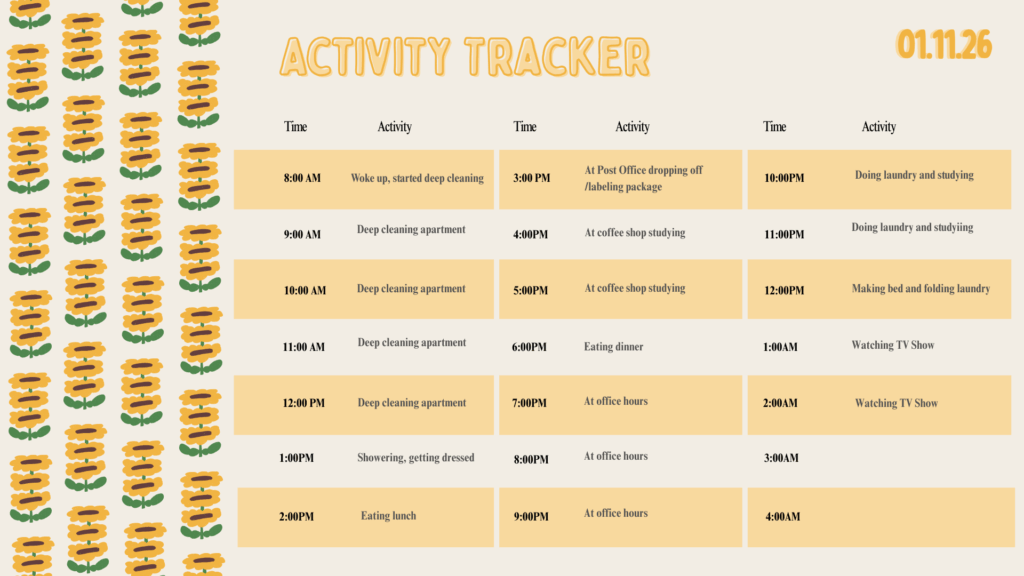
Activity Log for Saturday, January 10, 2026.

Activity Log for Sunday, January 11, 2026.
Analysis, Inference, & Habit Models
In conducting this observational experiment, I noticed two main trends: 1) I tended to watch television at night when I’ve had a pretty full day without the opportunity for downtime, like on Sunday, 01.11.26 and 2) I tended to watch television at night when I had felt like my day has largely been unproductive, and while I didn’t want to do work, I also didn’t want to go to sleep and admit to myself that I had an unplanned, incredibly unproductive day.
Extending my day due to lack of downtime during the day itself is called Revenge Bedtime Procrastination. Unfortunately, doing this results in getting less sleep at night and being tired the next day, which leads to napping. When I am so tired that I nap during the next day, it makes it less likely that I will be productive, which could lead to even more bedtime procrastination, continuing this vicious cycle.
I also observed myself starting a television show that was recently referenced on social media. However, most of the time I found myself watching television as a way to cope with feeling anxious, stressed, unproductive, or inadequate in some way. I have created two habit models to visualize the factors and habits that contributed to watching television late into the night.
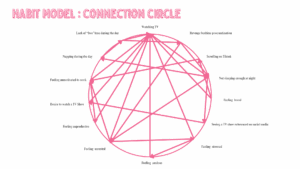
In the connection circle model, many of the observed habits are cyclical and interconnected, especially “Revenge bedtime procrastination,” “Not sleeping enough at night,” and “Napping during the day.”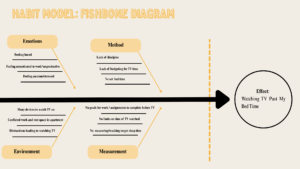
In the fishbone diagram, the habits and behaviors which contribute to late night television watching are depicted, especially “No set bed time” and “No limits on time of TV watched.”
Next Steps & Improvements for Future
This was a very eye-opening observational study. If I were to do a similar experiment in the future, I would go a bit further than pure observation, and instead, I would replace poor habits with positive ones. For example, instead of watching television I could do another activity before bed, like reading a physical book or journaling.
I think I would also want to institute stricter, blocked times for being productive or resting/watching television to reduce the urge to binge a television show when I should be sleeping. I also would love to implement a bedtime goal because I know that earlier sleep times would improve my well-being overall and reduce the likelihood of getting locked into a negative habit cycle that leads to late night television watching.



