SnapEdit Assumption Test Card Design – Team 13
Assumption selection criteria
When it comes to how we identify our riskiest assumptions, we had two main frameworks to assess them under. The first is according to our assumption map, with the uncertainty and importance axes, and the second was our initial business problems and needs. Since SnapEdit faces user churn to Canva and low user retention, we put business critical assumptions (ie. clear differentiation from Canva enough to avoid churn, addresses clear use cases as the most appropriate choice from users, provides enough value that the user is confident in both the final output and will keep returning to) as riskiest and priority to address over just product usability.
Mapping assumptions to their risks
For example, when it comes to the multi-step design workflow that we provide, we are not interested in testing how users navigate the flow and what options they’d like to see along the design process – instead, we are focused on understanding whether they want to use it, which is especially important since entry into the product requires starting with a prompt rather than browsing templates as our competitor does (we chose a prompt start to expand to more use cases other than mobile and appear less limiting, which is another assumption tied into this). For a user, an unnatural start to the design flow can be an intimidating behavioral shift and lead to churn if we don’t prove value fast or provide proper guidance, so this was a hypothesis we chose to test. Another important, uncertain, and business critical risk that we ended up testing is what our users will prioritize in their design work that would make them choose us over Canva for it – for us, we’ve made the bet that users value speed over full design control, and the product took a complete turn to prioritize that expectation. However, it’s also because we’re confident that it’s our biggest differentiator to Canva and what we can overtake Canva in. There are many risks attached to this – users that prioritize speed may not prioritize only speed, and would users prioritize speed enough to choose it over a design powerhouse like Canva?
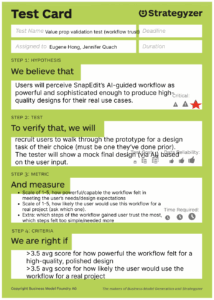
So, product usability perception was actually uniquely important to our product success due to a recent pivot in product improvement direction. We went from a regular design tool with AI-finetuning that focuses on manual design work improvements on a canvas over to an AI-guided step by step workflow, so confidence in the product to produce a high quality output before the final generation is especially important to us for adoption and acceptance from current SnapEdit users (although we did weave all our previous features into the step-by-step workflow, we need to make it obvious that despite seeming more “simple”, we’re still “sophisticated” – a core value prop of SnapEdit). However, that also means that the novelty of the workflow gives us new uncertainty on whether it will be accepted by current users and new users who come across the web app. The sophisticated element is important – for design use cases, the final output matters most, and users will only be willing to stay and eventually pay if the product provides speed and quality (although willingness to pay was not one of our key assumptions to test, as we focused more on retention). Even without giving users full design control, we want our product to feel and truly be high quality.
We had a discussion on whether to test if users still feel that they are in control throughout the workflow to keep our users who wanted it, but we made a decision to choose sophistication (and perceived sophistication) over control since we already knew that users were drawn to our product for its simplicity (from the high top-of-funnel metrics and downloads), but left due to feature limitations in terms of what they can create, not how they would create the design. Sophistication encapsulates what the users want as a final output (and perceived feelings would aid in acquisition!), and control was something that we could weave into the flow at any point later on.
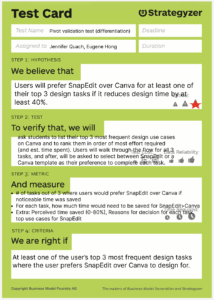
Test #1 Overarching assumption: Users value speed over design control enough to choose SnapEdit over Canva for their use case.
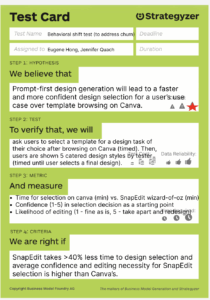
Test #2 Overarching assumption: Prompt-first design generation will lead to faster and more relevant design options than template browsing.
Test #3 Overarching assumption: Users see the AI-guided workflow as sophisticated and trustworthy enough to produce high quality designs for their use cases (so we’re still “simple-to-sophisticated”, not just simple).